
Most compensation event mistakes are not arguments about the law. They are missed dates, the wrong programme or a quotation that prices the wrong thing, and nearly all of them can be avoided. This page groups them by who usually makes them, under NEC4 ECC unless it says otherwise.
For the correct sequence, start with the compensation events guide. This page is the list of how that sequence goes wrong.
The mistakes at a glance
| Mistake | What it costs | The habit that prevents it |
|---|---|---|
| Contractor notifies after the time bar | The whole event, unless a communication caused it | Notify on the day someone says "that isn't ours" |
| Project Manager gives an instruction with no notification | Argument later, with cost running unassessed | Decide the compensation event question before the instruction goes out |
| Quoting against an out-of-date programme | A delay figure that can't be supported | Check which Accepted Programme was current at the dividing date |
| Measuring delay from the Completion Date, not planned Completion | Overclaimed or underclaimed time | Measure how far the event moves planned Completion on the Accepted Programme |
| Pricing actual cost for work still to come | A quotation that gets rejected or reassessed | Split the work at the dividing date |
| Letting a reply period lapse | A deemed result nobody chose | Diarise every period the day the clock starts |
Mistakes contractors make
Waiting for the full picture before notifying
The notification only needs to identify the event. Its cost can come later, in the quotation. Teams that wait until they "know the number" are the ones who run into the eight-week bar in clause 61.3. The clock runs from when you became aware that the event had happened, not from when you worked out what it cost.
Citing the catch-all first
Calling something a breach by the Client or a prevention event when a specific entry fits weakens the notice. Both only apply where nothing else does. Test the specific entries first and name the one you rely on.
Pricing the event as if nothing could be done about it
Under 63.9, the assessment assumes the Contractor reacts competently and promptly, and that its cost and time are reasonably incurred. A quotation that keeps a whole gang standing for three weeks, when they could have been moved, invites a revised quotation or the Project Manager's own figure.
Leaving out risk allowances
Clause 63.8 lets the assessment include allowances for matters with a significant chance of occurring that are not themselves compensation events. Once a compensation event is implemented it is not revised because a forecast was wrong (66.3). Leaving the allowance out means carrying that risk for nothing. See risk allowances.
Giving no early warning, then being surprised
If an experienced contractor could have warned and didn't, the event can be assessed as if the warning had been given (61.5 and 63.7). A warning costs almost nothing, and gives both sides a chance to look at options.
Mistakes project managers make
Separating the instruction from the notification
Where an instruction causes the event, clause 61.1 puts the notification on the Project Manager at the same moment. Issuing the instruction first and "sorting out the commercial side later" also leaves the dividing date, and so the split of actual and forecast cost, harder to follow.
Replying "not a compensation event" with no ground
Clause 61.4 gives a closed list of reasons for saying the Prices and dates stay as they are, and the reply should state which one applies. "We don't agree" is not one of them, and neither is "the budget won't stand it".
Asking for revised quotations as a negotiating tactic
A revised quotation is asked for with reasons, once those have been explained. If you think the assessment is wrong and more rounds won't help, the contract gives you your own assessment as the next step. Repeated requests with no new reason only delay the Prices being settled.
Refusing to accept a programme, then assessing on nothing
An out-of-date Accepted Programme makes every delay assessment harder. Reply to submitted programmes on time, for reasons the contract gives, so there is a sound baseline when the next event arrives. The guide to the programme and compensation events shows why.
Mistakes both sides make
- Agreeing the money and forgetting the time. Implementing an event settles the money, the Completion Date and any Key Dates together. A figure agreed with "time to be discussed" leaves the second half open, usually until delay damages are in view.
- Assessing with hindsight. Costs up to the dividing date are actual and the rest is forecast. Waiting months and pricing everything as actual cost is not what 63.1 describes, and the longer it goes on, the harder any later dispute gets.
- Trying to reopen an implemented event. Being wrong about a forecast doesn't reopen it. A corrected assumption is a different thing, and only applies where an assumption was stated.
- Keeping the status in someone's head. When nobody can see which events are awaiting a reply, the periods get missed. A simple compensation event register reviewed weekly catches most of this.
- Ignoring the Z clauses. Time bars, reply periods and even the event list are often amended. Read your Z clauses before relying on a general guide, this one included.
Related guides
- NEC Compensation Events: The Complete Guide
- Compensation Event: Change to the Scope
- Compensation Event: Access Not Provided
- Compensation Event: Something the Client Should Provide
- Compensation Event Flow Chart Explained
- Compensation Event Examples
How this looks in Contract Status
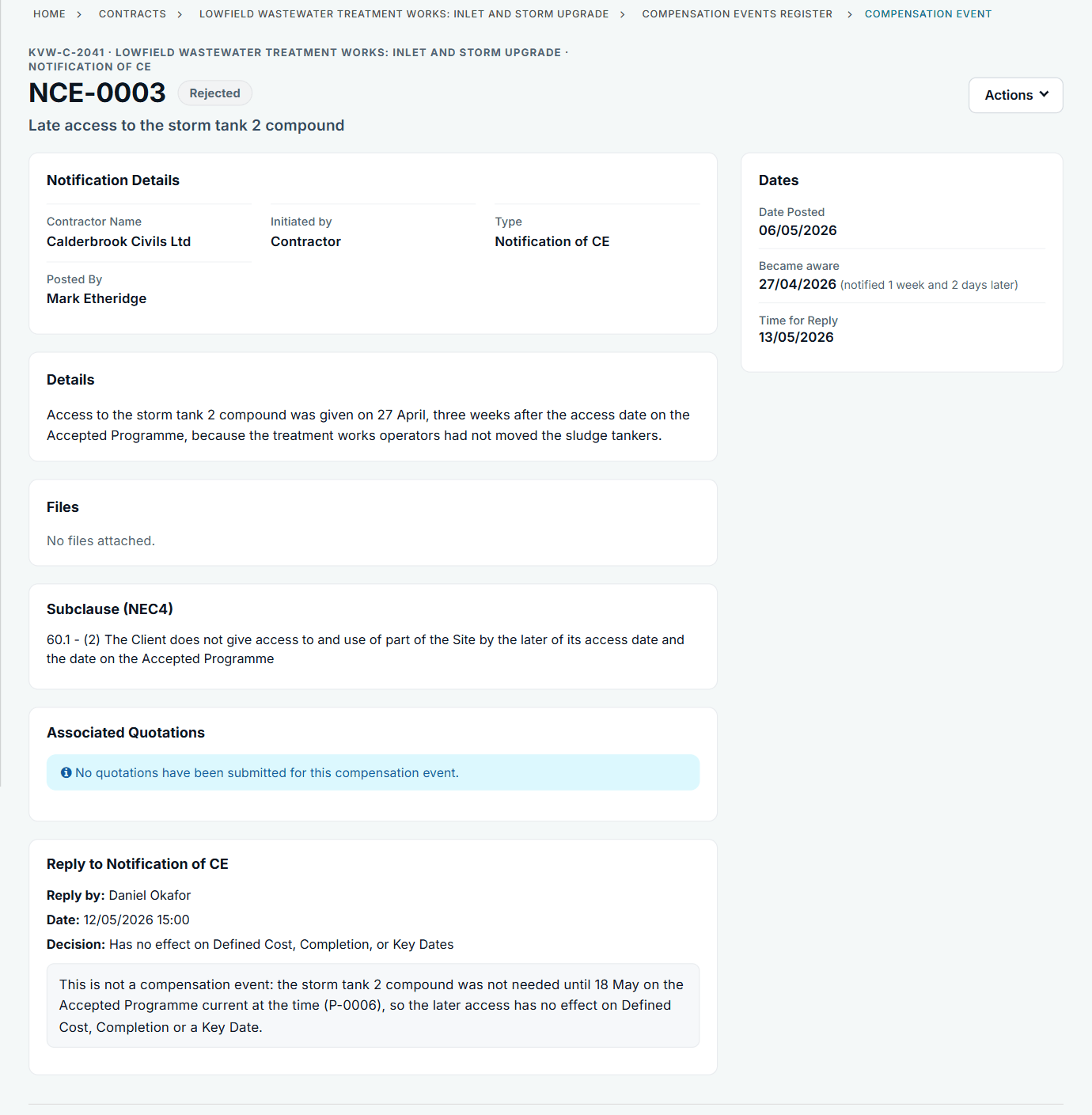
A rejected notification: the decision, the reason and the dates stay on the record. See the worked example.
See how this works in practice
Click through Contract Status with sample contracts: raise the notice, reply to it, and watch both sides of one record.
Take the guided tour Book a demo
Take the NEC4 ECC quiz, use the free NEC tools or download free NEC templates.
This guide is general information in our own words, not legal advice. Your contract and its Contract Data always govern. NEC, NEC3 and NEC4 are trade marks of Thomas Telford Ltd; Contract Status is not affiliated with or endorsed by NEC.