
To notify a Defect under NEC, the Supervisor or the Contractor tells the other as soon as it knows of it. This duty applies to both of them, runs until the defects date, and sits at clause 43.2 of the NEC4 ECC and 42.2 of NEC3.
The rest of the process, from tests to the certificate, is in our overview of quality and Defects under NEC.
Who has to notify
| Person | Position |
|---|---|
| Supervisor | Has to notify each Defect it becomes aware of |
| Contractor | Has the same duty. Finding your own Defect doesn't let you stay silent, even if you plan to fix it |
| Project Manager | Not named in this clause. A Project Manager who spots a Defect should pass it to the Supervisor |
| Client | Not named in this clause either. Occupiers' complaints after take over go to the Project Manager or Supervisor, who decides whether there's a Defect to notify |
This matters most for Contractors. It's common for a site team to fix something quietly and say nothing. The Contractor has to correct a Defect whether or not anyone has notified it, but the duty to notify exists too, and an honest record protects you later if the same problem comes back.
When it has to be done
The trigger is awareness, and the contract asks for notification as soon as that happens. It doesn't provide a grace period, and there's no reason to batch up a list until the next monthly meeting.
The notification date also matters for the clock:
- Notified before Completion: the defect correction period begins at Completion.
- Notified on or after Completion: the period begins when the Defect is notified.
The guide to correcting Defects shows how to work out due dates from this.
What a useful notice says
Clause 13 applies here as elsewhere, so the notice has to be a lasting written record. Beyond that, a good Defect notice is specific.
- A unique reference and the date.
- That it is a notification of a Defect under the relevant clause.
- Exactly where it is: grid line, level, chainage or room number.
- What's wrong, in factual terms.
- The part of the Scope or the accepted design it departs from.
- Any evidence, such as a test result or a photograph.
Point 5 is often skipped, yet it is the point that makes the item a Defect. "Paint finish unsatisfactory" invites an argument. "Finish on Level 2 corridor doesn't meet the colour and sheen stated in section 7 of the Scope" doesn't.
Example notice wording
After the defects date
The duty to notify ends at the defects date. This doesn't make later problems the Client's problem. Under the correction process, what stops is the machinery of notifying and correcting within a period. The contract keeps the Client's rights over any Defect the Supervisor hasn't found or notified, once the Defects Certificate has been issued, and those rights then run under the general law.
It does matter in practice, though. A Client who notifies before the date gets the contract's own remedy: correction by the Contractor, or a cost assessed by the Project Manager. One who notifies later usually needs legal advice and possibly a claim. So a final walk-round shortly before the defects date is well worth the time.
What people get wrong
- Using an early warning instead. An early warning is about things that could happen and need managing. It can sit alongside a Defect notification, but it doesn't replace one.
- Calling it a Defect too soon. Unfinished work in progress isn't necessarily a Defect, and over-notifying undermines the register.
- Notifying in meeting minutes only. A line in the minutes is easy to miss and hard to track. Send a separate notice for each item.
Related guides
- Quality and Defects Under NEC
- Correcting Defects
- Uncorrected Defects
- Accepting a Defect
- Tests and Inspections
- Searching for Defects
How this looks in Contract Status
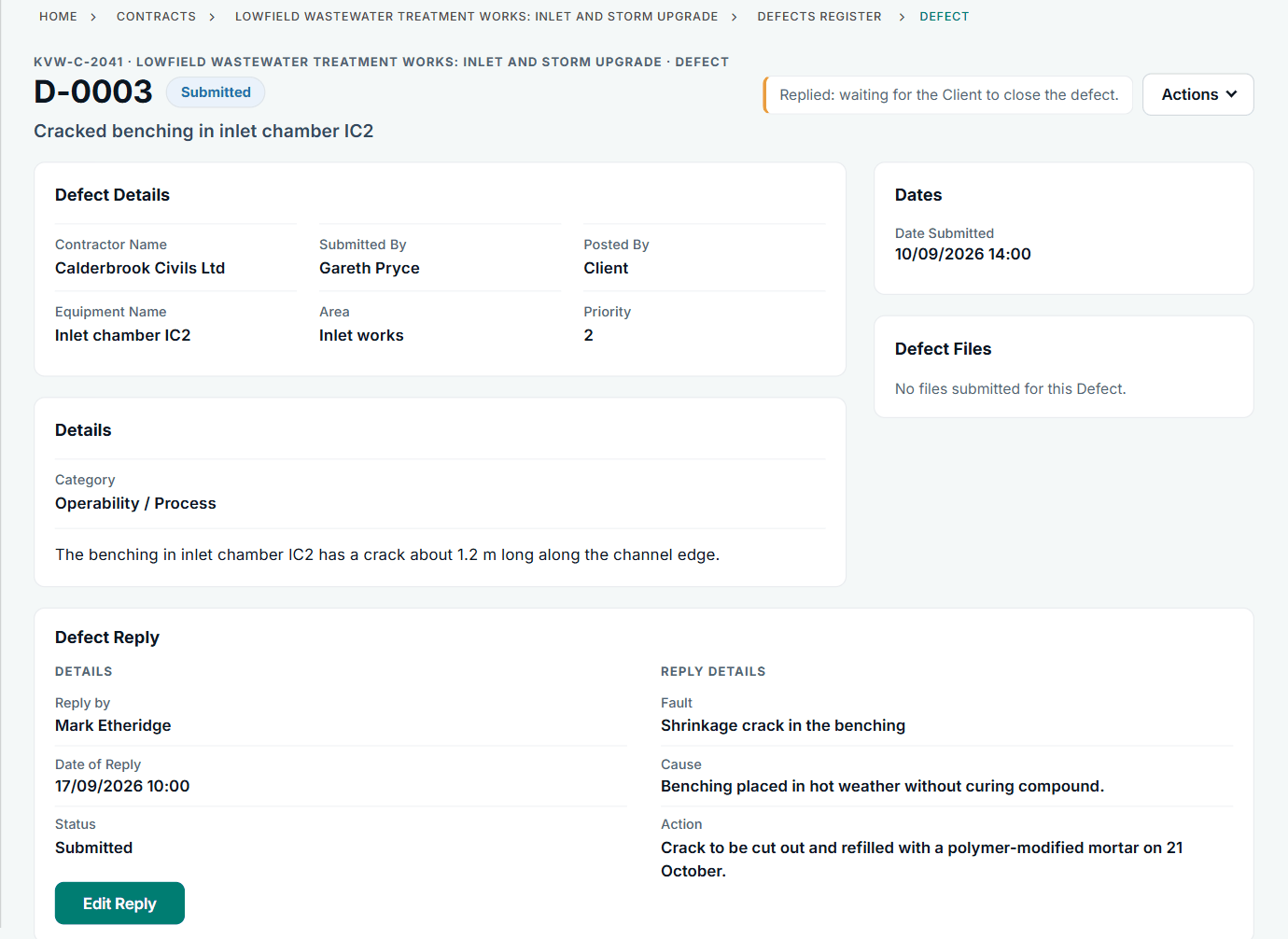
A Defect with the Contractor's reply: fault, cause and action. See the worked example.
See how this works in practice
Click through Contract Status with sample contracts: raise the notice, reply to it, and watch both sides of one record.
Take the guided tour Book a demo
Try the Supervisor role-play, use the free NEC tools or download free NEC templates.
This guide is general information in our own words, not legal advice. Your contract and its Contract Data always govern. NEC, NEC3 and NEC4 are trade marks of Thomas Telford Ltd; Contract Status is not affiliated with or endorsed by NEC.