
NEC tests and inspections are governed by clause 41 of the NEC4 ECC (clause 40 in NEC3), and it only covers those the Scope or the law requires. Each side tells the other before it starts a test and shares the results afterwards, and if a test finds a Defect the Contractor corrects it and the test is done again.
This sits within the wider process for quality and Defects under NEC. The practical value of the clause lies in who bears the cost when something goes wrong.
The clause in plain terms
| What it deals with | NEC4 ECC | NEC3 ECC |
|---|---|---|
| Only tests required by the Scope (Works Information) or the law are covered | 41.1 | 40.1 |
| Materials, facilities and samples are provided as the Scope says | 41.2 | 40.2 |
| Notice before, results after, and the right to watch | 41.3 | 40.3 |
| A Defect found: corrected, then the test is repeated | 41.4 | 40.4 |
| The Supervisor doesn't cause unnecessary delay | 41.5 | 40.5 |
| Cost of a repeat test, assessed and charged to the Contractor | 41.6 | 40.6 |
| Items to be tested before they are delivered | 42.1 | 41.1 |
The notice that catches people out
The Contractor has to tell the Supervisor early enough for the test to be arranged and carried out before later work hides it. No fixed number of days appears in the clause, so the Scope is the place to set one. A planner's look-ahead that shows hold points helps both sides here.
If this goes wrong, the effect shows up at 60.1(10). A search for a Defect that finds nothing is normally a compensation event, but not where it was only needed because the Contractor gave too little notice. So a screed poured over pipework before the pressure test was witnessed can leave the Contractor paying to break it out and finding nothing wrong.
Three compensation events to know
- 60.1(10): a search is instructed and no Defect is found.
- 60.1(11): a test or inspection by the Supervisor causes unnecessary delay.
- 60.1(16): the Client doesn't provide the materials, facilities and samples the Scope says it will.
The word "unnecessary" in 60.1(11) matters. A test that takes the time it reasonably needs isn't an event, even if it interrupts the sequence. Note the date you asked for attendance and the date it happened, because that is what the argument will turn on.
Paying for a repeat test
Where a repeat follows a Defect, the Project Manager works out what the repeat test cost the Client, and the Contractor pays it (41.6). This covers the Client's cost: say, the Supervisor's team and a laboratory it engages. The Contractor carries its own cost in a different way, depending on the main Option.
An illustrative example. A concrete cube test on a fictional bridge deck fails. The Contractor corrects the affected pour and the test is repeated. The Client's laboratory charges £1,200 and its inspector's time comes to £800, so the Project Manager assesses £2,000 and it comes off a later amount due. Removing and replacing the concrete is separate, and is at the Contractor's cost under Option A.
Payment that depends on a test
Sometimes a payment is tied to a test passing. If the Supervisor hasn't done that test and the delay isn't the Contractor's fault, the payment still falls due, but not until both the defects date and the final defect correction period have passed. That can be a long wait, so a Contractor should chase an outstanding test in writing and not rely on this as a remedy.
Testing before delivery
If the Scope says Plant and Materials have to be tested or inspected before delivery, they stay away from the Working Areas until the Contractor has been told they passed. Factory acceptance tests on switchgear or pumps are the usual example. Build that notification into the programme as a dated step, since a truck turning up early has nowhere to go. For the title and marking rules on such items, see Equipment, Plant and Materials.
A short checklist for the Scope
- A schedule of each test and inspection, stating who does it.
- The notice period for attendance at each hold point.
- Who provides materials, facilities and samples.
- Pass criteria that can be measured.
- Which items are tested before delivery, and where.
Related guides
How this looks in Contract Status
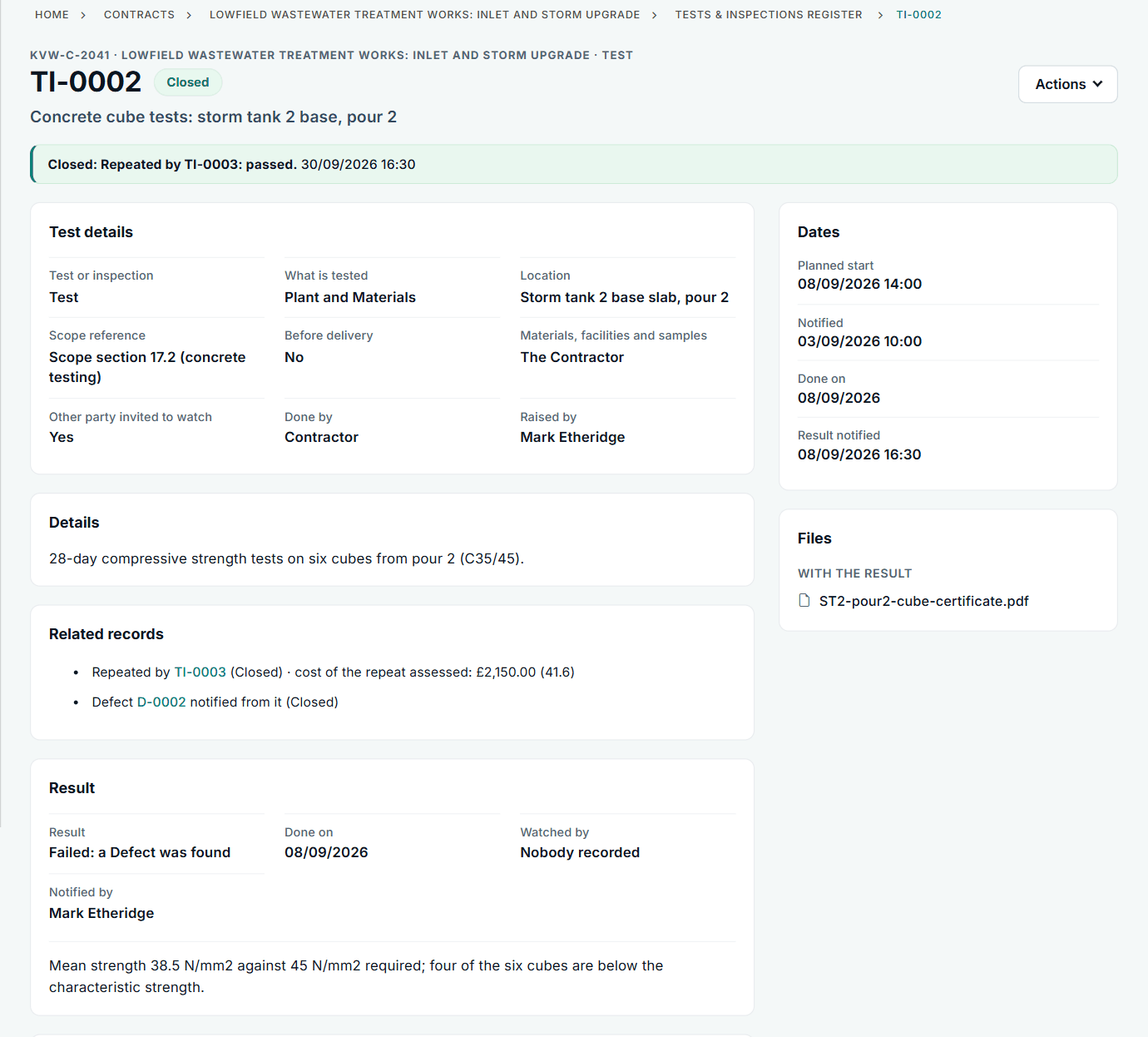
A failed test linked to its Defect and its repeat, with the cost of the repeat. See the worked example.
See how this works in practice
Click through Contract Status with sample contracts: raise the notice, reply to it, and watch both sides of one record.
Take the guided tour Book a demo
Try the Supervisor role-play, use the free NEC tools or download free NEC templates.
This guide is general information in our own words, not legal advice. Your contract and its Contract Data always govern. NEC, NEC3 and NEC4 are trade marks of Thomas Telford Ltd; Contract Status is not affiliated with or endorsed by NEC.