
NEC uncorrected Defects are dealt with by a cost assessment: the Project Manager assesses an amount, the Contractor pays it, and the Scope is treated as changed to accept the Defect. Which cost is assessed depends on one question: was the Contractor given access to correct it?
The rules are at clause 46 of the NEC4 ECC (45 in NEC3). They are the final step in the wider NEC Defects process.
Two different assessments
| Contractor had access but missed the period | Contractor did not get access before the defects date | |
|---|---|---|
| NEC4 ECC / NEC3 ECC | 46.1 / 45.1 | 46.2 / 45.2 |
| What is assessed | The cost to the Client of having other people correct it | The cost to the Contractor of correcting it |
| Typical size | Higher: a new contractor's price, mobilisation and the Client's own costs | Lower: the Contractor's own rates, in effect its saving |
| Who assesses | Project Manager | Project Manager |
| The Scope afterwards | Treated as changed to accept the Defect | Treated as changed to accept the Defect |
The difference reflects fairness. If the Contractor has its chance and doesn't take it, it pays what the Client's fix costs. If the Client keeps the Contractor out, the Contractor still shouldn't profit from the work it never did, so it pays back only the cost it has avoided.
A worked example
A fictional office fit-out with illustrative figures. The same Defect, a failed section of raised floor, is priced in two scenarios. The Contractor would have spent £9,000 fixing it. Another firm quotes £16,000, plus £1,500 of the Client's management and supervision cost.
| Scenario | Clause | Assessed amount |
|---|---|---|
| The Contractor was given access in week 3 of a 4-week period, but didn't return | 46.1 | £17,500 |
| The tenant refused access right up to the defects date | 46.2 | £9,000 |
The assessed amount is paid by the Contractor, normally by appearing as a deduction in the amount due. The Project Manager sets out the reasoning, since the amount can be challenged under the contract's dispute procedure.
Effect on the Contractor's liability
Treating the Scope as changed means the work now counts as meeting it. That closes the Defect: no further instruction to correct it should follow. Note two consequences:
- The Client can't have it both ways. Having taken the money, the Client gets the work as it stands under the changed Scope, and pays any further correction itself.
- The Defects Certificate should reflect the position. A Defect treated as accepted isn't an outstanding Defect in the ordinary sense, so the register should show how it was closed. See the Defects Certificate guide.
Access: the facts to keep
The whole thing can turn on access, so record it properly.
- The date the Contractor asked for access, in writing.
- What access it asked for: hours, areas, isolation or permits.
- The date access was given, or the reply refusing it.
- Any time the Contractor was given access and didn't turn up.
Partial or very limited access can leave room for argument about which limb applies. Where access is offered only in a window too short to do the work, say so at the time and propose something workable.
Beyond the assessment
A Contractor that repeatedly fails to correct notified Defects may be substantially failing to comply with its obligations. That can lead to a notified default, and in serious cases to termination for reason R11. This is a separate route, and it's more drastic than most situations justify.
What people get wrong
- The Client bringing in others without giving access first. The higher assessment is only open where the Contractor had access and let the period run out.
- Adding a markup without evidence. The assessment is of the actual or forecast cost. Keep the quotation or invoice behind the figure.
- Treating this as the way to accept a Defect. If the Parties are happy for it to stay, the better route is accepting a Defect by quotation, which is agreed and not imposed.
Related guides
- Quality and Defects Under NEC
- Accepting a Defect
- Defects Date Explained
- The Defects Certificate Explained
- Notifying Defects
- Correcting Defects
How this looks in Contract Status
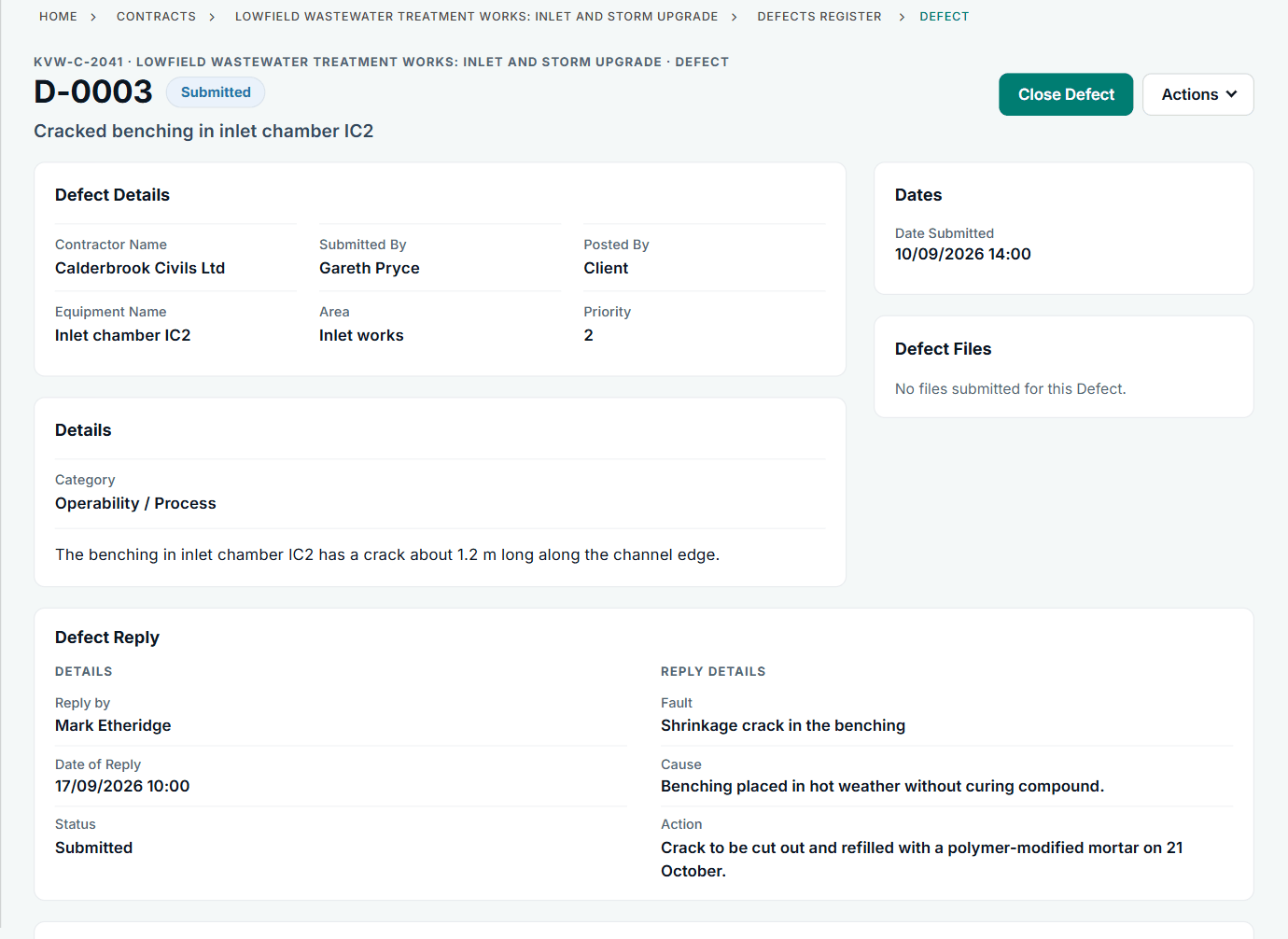
A Defect from the Client side, with the Contractor's reply on the record. See the worked example.
See how this works in practice
Click through Contract Status with sample contracts: raise the notice, reply to it, and watch both sides of one record.
Take the guided tour Book a demo
Try the Supervisor role-play, use the free NEC tools or download free NEC templates.
This guide is general information in our own words, not legal advice. Your contract and its Contract Data always govern. NEC, NEC3 and NEC4 are trade marks of Thomas Telford Ltd; Contract Status is not affiliated with or endorsed by NEC.