
The NEC assessment date is the day on which the amount due is assessed, and everything else in the payment cycle is counted from it. The Project Manager chooses the first one, and the assessment interval in the Contract Data sets the rest.
Clause 50.1 covers this in both NEC3 and NEC4. It's only one sentence or two, but the choice affects cash flow for the whole job. See the NEC payment and Defined Cost guide for the rest of the process.
How the dates are set
| Point | Rule |
|---|---|
| First assessment date | Chosen by the Project Manager, with both Parties' procedures in mind |
| Latest first date | No later than one assessment interval after the starting date |
| Interval | Stated in the Contract Data. NEC3 ECC says in weeks, with a five-week limit, and NEC4 subcontract data simply asks for the interval, so check yours |
| Later dates | At the end of each interval |
| Last date, NEC4 | Until either a termination certificate or the Defects Certificate goes out |
| Last date, NEC3 | Until four weeks after the Defects Certificate, plus one when the whole of the works reaches Completion |
Other things can make an extra date. Under Option X7, the date of repaying delay damages becomes an assessment date, as noted in our delay damages guide.
Weeks or calendar months?
NEC3's Contract Data asks for a number of weeks, so a calendar month doesn't fit it without a Z clause. A monthly cycle is still common. Check that your Contract Data entry and your finance team's practice actually match, because this is a frequent source of quiet error.
| Four-week interval | Calendar month (by agreement) | |
|---|---|---|
| Cycles per year | 13 | 12 |
| Date moves through the month | Yes | No |
| Fits a month-end finance close | Sometimes | Yes |
| Fits the printed Contract Data | Yes | Needs a clear entry or Z clause |
Choosing a sensible first date
Clause 50.1 asks the Project Manager to think about both Parties' procedures. It's worth a five-minute conversation at the kick-off meeting. Consider these questions:
- When does the Client's payment run happen? If it's weekly, aim for the final date to fall just after one.
- When does the Contractor's cost ledger close? On Options C, D and E the application depends on it.
- When are subcontract assessment dates? An application upward usually needs subcontract figures first.
- Do any dates hit Christmas or a bank holiday? Think about the cycle, not only the date.
Worked example: why a day matters
A fictional contract with illustrative figures. A £200,000 activity on an Option A job completes on the 6th of the month. There are two possible schedules:
| Assessment date on the 5th | Assessment date on the 7th | |
|---|---|---|
| Activity completed at the assessment date? | No | Yes |
| Included in this cycle? | No | Yes |
| Assessed in | The next cycle, about four weeks later | This cycle |
The cost of those four weeks falls on the Contractor. On NEC4, the application also comes before the date, so the Contractor is applying for work that it believes will be complete by the date. The Project Manager should then assess the position on the date itself. See payment applications.
What people get wrong
- Never confirming the first date. If the Project Manager doesn't state it, the latest possible date is one interval from the starting date, but the Contractor still doesn't know exactly when to apply. Ask.
- Changing the date to help a cash shortage. After the first date, the interval decides. Changing it needs a proper agreement between the Parties.
- Assuming the date moves for a weekend. The contract doesn't say so. Plot the actual day, and agree how to handle it if that day falls on a non-working day.
- Forgetting assessment dates continue after Completion. They keep running, so that retention and final sums can be handled, as the clause 50 guide shows.
Related guides
- NEC Payment and Defined Cost: The Complete Guide
- Making an NEC Payment Application
- Pay Less Notices Under NEC
- The Final Assessment
- NEC Clause 52: Defined Cost Accounting
- The NEC Payment Timeline
How this looks in Contract Status
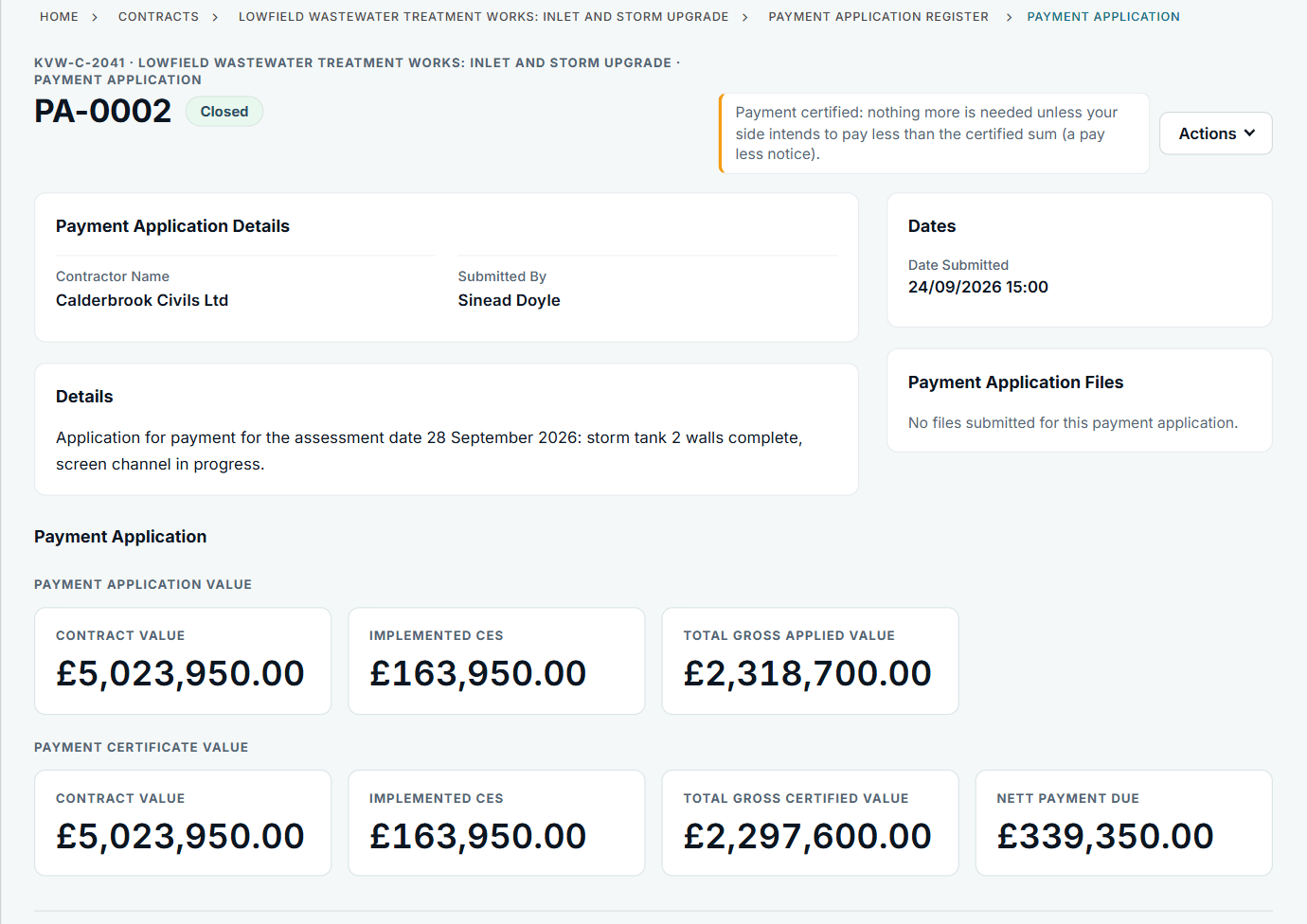
Applied and certified figures together on one record. See the worked example.
See how this works in practice
Click through Contract Status with sample contracts: raise the notice, reply to it, and watch both sides of one record.
Take the guided tour Book a demo
Try the commercial role-play, use the free NEC tools or download free NEC templates.
This guide is general information in our own words, not legal advice. Your contract and its Contract Data always govern. NEC, NEC3 and NEC4 are trade marks of Thomas Telford Ltd; Contract Status is not affiliated with or endorsed by NEC.