
Most NEC payment mistakes come down to a missed date, a misread defined term or a record nobody kept. They're easy to avoid, but they can be expensive because each NEC date has a specific consequence attached.
The list below follows the order of a payment cycle, using NEC4 ECC unless stated. For the background on any item, start with the NEC payment and Defined Cost guide.
Before the first payment
| Mistake | Why it hurts | Fix |
|---|---|---|
| No first programme submitted when none is identified in the Contract Data | A quarter of the value of work done is held back under 50.5 | Plan the first programme before the first assessment date |
| First assessment date never confirmed | The Contractor doesn't know when to apply | Ask for it in writing, and see assessment date |
| Contract Data periods not read | The team works to printed periods when the data says something else | Put actual dates in a calendar from day one |
| Ambiguous Activity Schedule | Nobody can agree when an activity is complete | Define each activity with a clear end point at tender |
During the cycle
| Mistake | Why it hurts | Fix |
|---|---|---|
| Applying on or after the assessment date under NEC4 | Clause 50.4 applies and the amount due can't rise | Set an internal deadline several days earlier |
| Assuming the certificate is an invoice, or the reverse | Payment stalls because no one has sent what the Client's finance team needs | Agree the paperwork route at the start |
| Measuring payment from the wrong date | A late-paid sum isn't spotted and interest goes uncollected | Clause 51.2 counts from the assessment date, not the certificate |
| Forgetting a certificate that shows a negative | Contractor ends up owing a payment without noticing | Check the direction as well as the figure |
| Writing "we deduct £X" in a pay less notice | It doesn't state the sum considered due and could be challenged | State the replacement figure and how it was calculated |
| Missing the pay less deadline | The notified sum generally has to be paid | Check certificates in the first week, not the third |
| Correcting next month, instead of giving notice this month | The current payment isn't reduced | Use both tools for what they're for |
On cost Options
| Mistake | Why it hurts | Fix |
|---|---|---|
| Treating an internal cost report as Defined Cost | Fee costs get claimed, and the application fails | Keep a separate view by schedule section. See what Defined Cost is |
| No proof of payment on file | Cost can be removed as not justified by records, along with the Fee on it | Link bank records to the ledger automatically |
| Charging group plant at internal rates | The schedule looks at open market rates instead | Collect market evidence when plant arrives |
| Charging all of a shared manager's time | The people section allows only a proportion | Keep time records for those not based in the Working Areas |
| Ignoring rebates | Clause 52.1 takes them off, sometimes after the amount has been paid | Ask finance for a rebate list each quarter |
| Letting forecasts drift upward | It damages trust, and may be reversed with a negative later | Reconcile each forecast against what actually happened |
At the end
| Mistake | Why it hurts | Fix |
|---|---|---|
| Leaving compensation events open until the end | Agreement gets harder, and the deadline doesn't move | Run batches during the defects period. See final account |
| Missing the 53.3 challenge period | The assessment can become conclusive | Diarise four weeks from the day the final assessment is issued |
| Forgetting half of the retention | The X16 release after the Defects Certificate period isn't automatic in practice | Check each later assessment shows it. See retention |
| Delay damages not reconciled after a Completion Date change | Overpayments are due back with interest under X7.2 | Recalculate after every implemented event that moves the date |
A quick monthly check
Three questions take five minutes and catch most of the above:
- When's the next application, certificate, pay less deadline and final date, by actual date?
- Does the amount in the certificate reconcile to the application, line by line?
- Has anything in the last month changed the Prices, the Completion Date or the retention position?
A register or shared tracker, like the one discussed in NEC registers, makes these questions easy to answer. Contract Status records assessment dates and payment certificates for this reason, but a clear spreadsheet does the job if someone keeps it up to date.
Related guides
- NEC Payment and Defined Cost: The Complete Guide
- Payment for NEC Subcontractors
- Retention Under NEC
- Delay Damages
- Open Book and Cost Records
- Auditing Defined Cost
How this looks in Contract Status
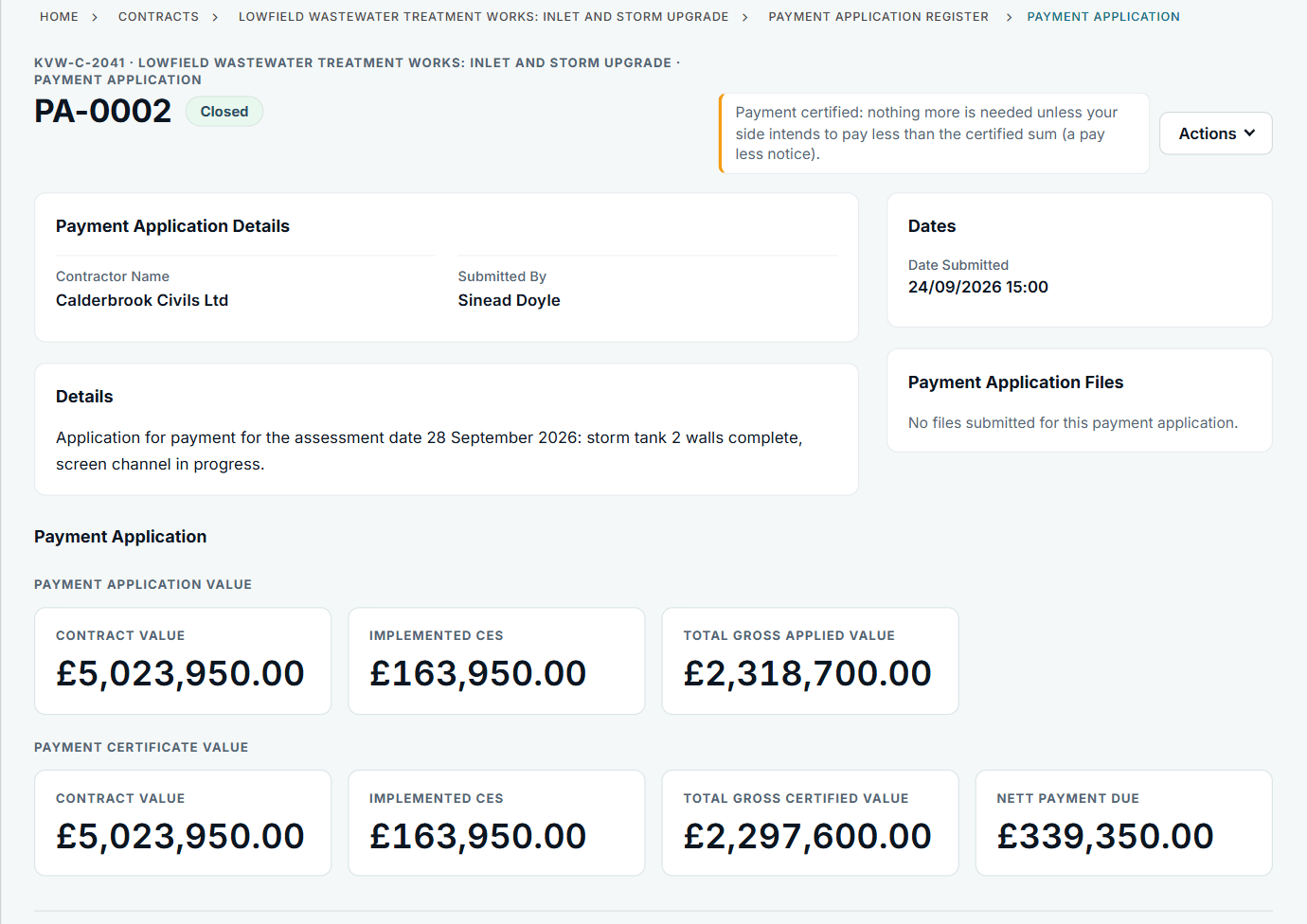
Applied and certified figures together on one record. See the worked example.
See how this works in practice
Click through Contract Status with sample contracts: raise the notice, reply to it, and watch both sides of one record.
Take the guided tour Book a demo
Try the commercial role-play, use the free NEC tools or download free NEC templates.
This guide is general information in our own words, not legal advice. Your contract and its Contract Data always govern. NEC, NEC3 and NEC4 are trade marks of Thomas Telford Ltd; Contract Status is not affiliated with or endorsed by NEC.