
An NEC pay less notice is what a Party must give before paying less than the notified sum, and under Option Y(UK)2 it must be given no later than seven days before the final date for payment. Miss it, and the notified sum generally has to be paid, even if the certificate is wrong.
The rule comes from clause Y2.3 in NEC3 and NEC4, which writes the Construction Act's requirements into the contract. See the Y(UK)2 guide for the Option as a whole and the NEC payment and Defined Cost guide for the wider process.
The basics
| Question | Answer under Option Y(UK)2 |
|---|---|
| Who gives it? | Either Party, whichever is paying. A Contractor owing money back also needs one if it won't pay the full sum |
| What's the notified sum? | The amount in the Project Manager's certificate, which is the payment notice under Y2.2 |
| By when? | Seven days before the final date for payment |
| What must it say? | The amount considered due, and the basis for calculating it |
| What if there's none? | A Party doesn't withhold an amount due without one |
With the standard periods, the assessment date is day 0, the final date is day 21 and so the last day for a notice is day 14. If your Contract Data states a different payment period, the deadline moves too. See the NEC payment timeline to plot it.
Worked example: it replaces, it doesn't deduct
A fictional contract with illustrative figures. The certificate states £100,000. The Client then finds a £20,000 overvaluation and gives a valid notice on day 12.
| Wrong way | Right way |
|---|---|
| "We deduct £20,000 from the certified amount" | "We consider the sum due to be £80,000, calculated as follows..." |
A notice should state the sum now considered due, with its basis. It's the number the payer will actually pay. On day 15 the same discovery would be too late for this cycle. The Client would need to pay £100,000 and let the Project Manager correct the amount in the next certificate under 50.6.
A template of what to include
- Contract name and reference, and the certificate it relates to.
- A clear statement that this is a notice of intention to pay less, under Y2.3.
- The notified sum, and the final date for payment.
- The sum now considered due.
- The basis: a short calculation that shows how you've reached it, with each reason and amount.
- Who it's from: the name and role, showing it's from the Party or someone authorised by it.
- The date. Keep proof of when it was received.
Who can sign it
The clause speaks of a Party. A Project Manager doesn't have that authority just from being the Project Manager, so if the Client wants the Project Manager or a consultant to issue the notice for it, set out the authority in writing at the start. Also check how NEC communications must be given. A notice sent to the wrong place, or in the wrong form, could be challenged.
Common mistakes
- Treating a corrected certificate as a notice. The Project Manager's later correction happens in the next cycle. It doesn't remove the need for a notice in this cycle.
- Forgetting the basis. A bare figure doesn't meet the requirement.
- Counting days loosely. In the NEC4 subcontract text, Y2.1 leaves out Christmas Day, Good Friday and bank holidays. NEC3 follows the Act's own calculation. Check your own wording before relying on a tight date.
- Thinking a dispute removes the need. A disagreement doesn't stop the clock.
- Issuing one too early for a reason yet to arise. A notice can only rely on what's known, so a later problem might need a further notice before the deadline, or should go through the next assessment.
Connected points
- Suspension. If the payer doesn't pay, the Act gives the payee a right to suspend performance. Under Y(UK)2 doing so is a compensation event: Y2.5 in NEC4 and Y2.4 in NEC3. Take advice first, as there are notice requirements.
- Termination. NEC4 adds a rule at Y2.4 about certified sums unpaid at termination, tied to whether a pay less notice was given or could have been.
- Without Y(UK)2. The Act's requirements can still apply. If a contract doesn't meet them, the statutory Scheme for Construction Contracts can fill the gap, and the periods might differ from those above.
- Adjudication. A valid notice decides what's payable for now, not what's finally owed. Either side can still refer the real value to adjudication.
Related guides
- NEC Payment and Defined Cost: The Complete Guide
- The Final Assessment
- Closing Out the Final Account
- Open Book and Cost Records
- Assessment Date and Assessment Interval
- Making an NEC Payment Application
How this looks in Contract Status
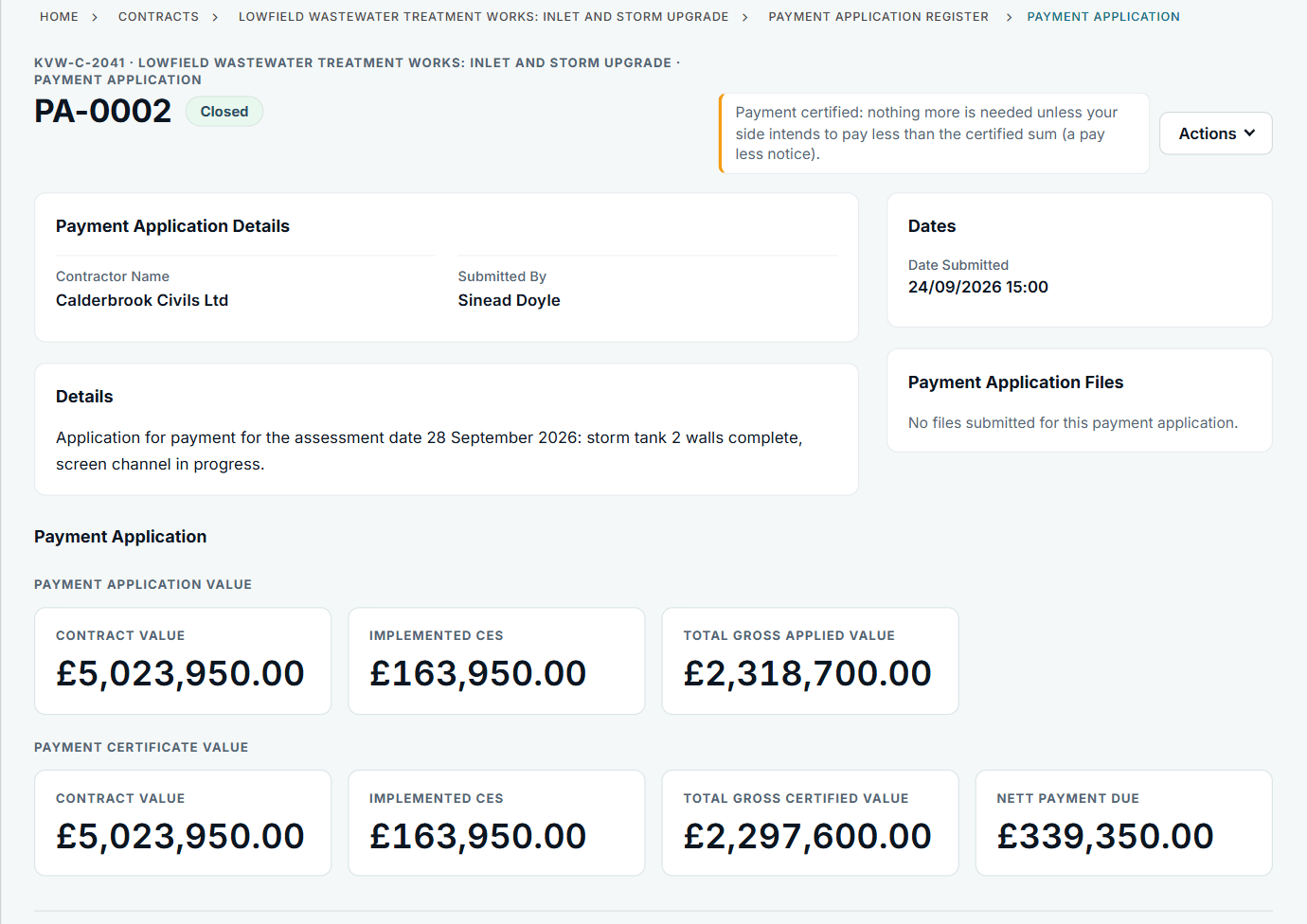
Applied and certified figures together on one record. See the worked example.
See how this works in practice
Click through Contract Status with sample contracts: raise the notice, reply to it, and watch both sides of one record.
Take the guided tour Book a demo
Try the commercial role-play, use the free NEC tools or download free NEC templates.
This guide is general information in our own words, not legal advice. Your contract and its Contract Data always govern. NEC, NEC3 and NEC4 are trade marks of Thomas Telford Ltd; Contract Status is not affiliated with or endorsed by NEC.