
NEC clause 50 sets how the amount due is worked out at each assessment date. Under NEC4 the Contractor applies first, the Project Manager assesses, and the result starts from the Price for Work Done to Date, with other sums due to the Contractor added, and sums payable by or retained from it taken off.
The biggest change from NEC3 is that a missed application now directly limits the amount due. This guide follows the NEC4 Engineering and Construction Contract (ECC) and shows the NEC3 numbers alongside. For the rest of the process, see the NEC payment and Defined Cost guide.
Clause by clause
| Subject | NEC4 ECC | NEC3 ECC | Key point |
|---|---|---|---|
| Assessment dates | 50.1 | 50.1 | The Project Manager picks the first date, then the Contract Data interval runs |
| Contractor's application | 50.2 | 50.4 (considered if submitted) | NEC4: must come before the date, with details. NEC3: optional, on or before the date |
| Amount due with an application | 50.3 | 50.2 | Three-part sum |
| Amount due with no application | 50.4 | No equivalent | The lesser of two figures |
| No first programme | 50.5 | 50.3 | A quarter of the value is held back |
| Correcting mistakes | 50.6 | 50.5 | Wrong assessments are put right in a later certificate |
| Finalising parts of Defined Cost (Options C to E) | 50.9 | No equivalent | See below |
Where assessment dates stop also differs. NEC4 runs until either the Defects Certificate or a termination certificate is issued. NEC3 runs until four weeks after the Defects Certificate, plus a date when the whole of the works reaches Completion. See assessment date and interval.
The three-part sum
- The Price for Work Done to Date, whose meaning depends on the main Option.
- Plus other sums the Contractor is owed. For example, an Option X14 advance, or interest from an earlier late payment.
- Less amounts paid by or retained from the Contractor. For example, retention and delay damages.
The result is cumulative. Clause 51 then turns it into a payment, which is the change since the last assessment.
Worked example: what a missed application costs
A fictional NEC4 Option A contract. At the last assessment date the amount due was £500,000. Illustrative figures for two different outcomes:
| Work has continued | Work has been found defective | |
|---|---|---|
| Project Manager's own assessment of the amount due | £540,000 | £480,000 |
| Amount due at the previous date | £500,000 | £500,000 |
| Amount due with no application: the lesser figure | £500,000 | £480,000 |
| Certified payment | Nil | £20,000 paid by the Contractor |
So no application can never raise the amount, but it can reduce it. The £40,000 in the first column isn't lost. It should arrive at the next assessment if an application goes in, though the cash comes one interval later. The payment application guide covers what to send.
The quarter held back
Where the Contract Data names no programme, a quarter of that first line stays with the Client until a first programme goes in, showing the information the contract needs. It's about submission of a compliant programme, not its acceptance, so a Project Manager waiting to accept doesn't extend the hold if the submission was complete. The first programme guide has more.
Corrections
A wrongly assessed amount is corrected in a later certificate under 50.6, and interest may then apply under 51.3. This is not a substitute for the proper steps in the current cycle. If a Client intends to pay less than a current certificate says, a correction next month doesn't do that job in time. It needs a pay less notice.
Finalising Defined Cost under 50.9
On Options C, D and E, NEC4 lets the Contractor tell the Project Manager when Defined Cost for a part of the works is finalised, and make the records available. A timetable follows for acceptance, further records and a decision. If the Project Manager doesn't decide in time, the Contractor's figure is treated as correct. The NEC4 subcontract text gives 14, 3 and 5 weeks for these steps. The main contract periods can differ, so read your own 50.9. There's more in the guide to finalising amounts.
What people get wrong
- Applying on the assessment date. NEC3 allowed "on or before". NEC4 needs it before.
- Treating the application as the assessment. The Project Manager considers it, then makes its own assessment.
- Showing only a net figure. The application needs to show how the amount was worked out.
Related guides
- NEC Payment and Defined Cost: The Complete Guide
- NEC Clause 51: Certifying Payment
- NEC Clause 52: Defined Cost Accounting
- The NEC Payment Timeline
- The Prices
- Price for Work Done to Date (PWDD)
How this looks in Contract Status
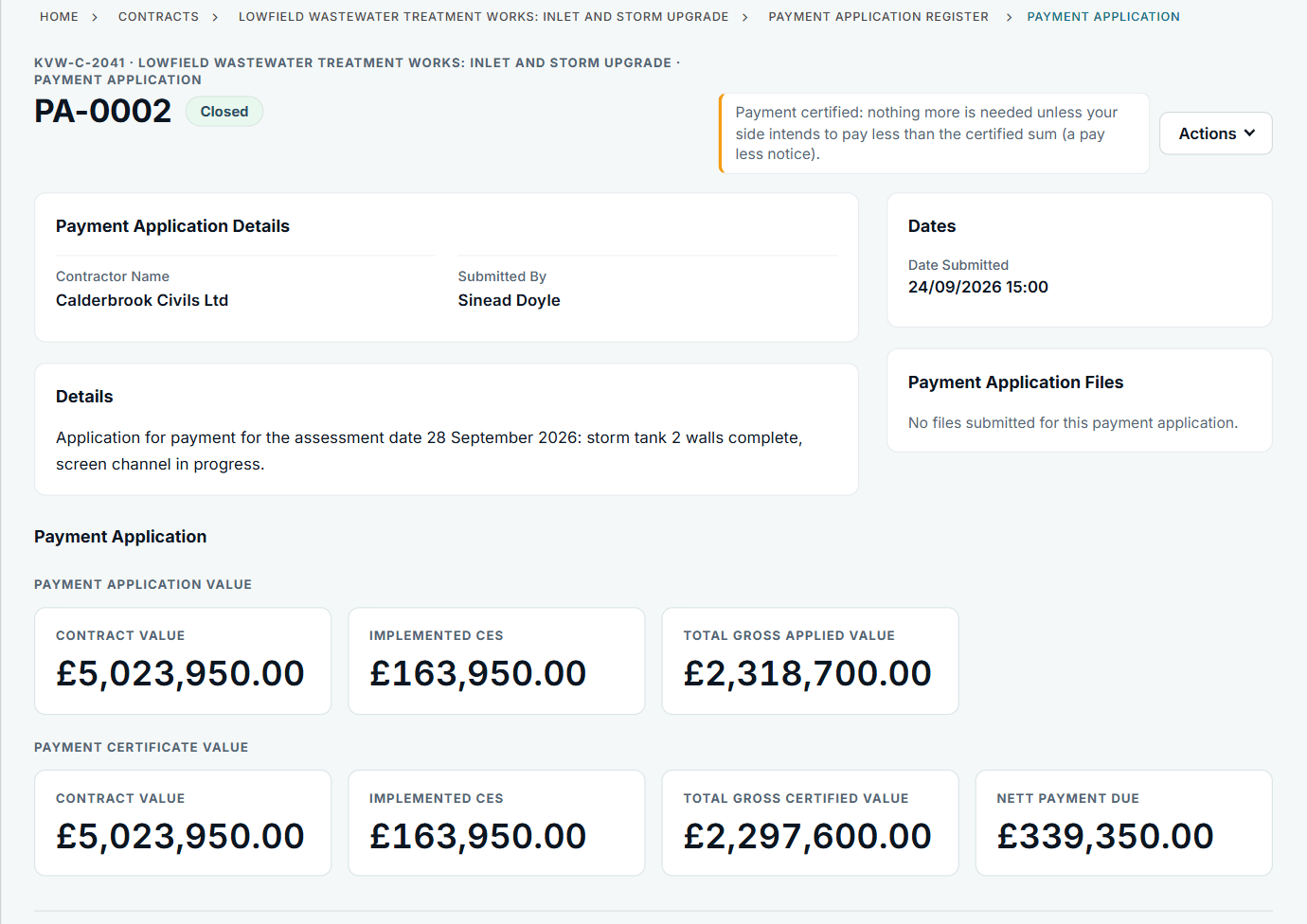
Applied and certified figures together on one record. See the worked example.
See how this works in practice
Click through Contract Status with sample contracts: raise the notice, reply to it, and watch both sides of one record.
Take the guided tour Book a demo
Try the commercial role-play, use the free NEC tools or download free NEC templates.
This guide is general information in our own words, not legal advice. Your contract and its Contract Data always govern. NEC, NEC3 and NEC4 are trade marks of Thomas Telford Ltd; Contract Status is not affiliated with or endorsed by NEC.