
Getting NEC software approval usually depends on answering a dozen plain questions well. Most of them are about whether the benefit is real, whether people will use it, and what happens if it goes wrong. The answers below are honest ones, which sometimes means they aren't flattering to software, and a finance director will trust that more than a brochure.
Use them as preparation, and replace our general answers with your own contract facts. They sit with the NEC contract management software guide, and the figures come from building the business case.
Is the problem real?
"Why do we need this? We've run NEC contracts for years."
You may not. If nothing has gone wrong and nobody is spending much time on tracking, say so and stop here. The case rests on specific things: an NEC contract has dated reply periods and a time bar, and each late item has a defined effect. If you can point to near misses or heavy tracking time on your own contracts, that's your answer. If you can't, wait until you can. Do we actually need NEC software? gives a test.
"Isn't this just an expensive spreadsheet?"
Partly, and for one small contract a spreadsheet can be the right answer. The differences are that dates come from records rather than typing, both sides work from one set of facts, and a good system keeps the history instead of letting it be overwritten. Whether that's worth paying for depends on how many contracts and how many people you have. See NEC software vs spreadsheets.
"Couldn't we fix this with training or a better process?"
Sometimes, yes, and it would be cheaper. If your near misses come from people not knowing the rules, train them first. Software won't fix that. If they come from knowing the rules and losing track of dates, a process helps only up to a point. Then it becomes a matter of volume.
Is the benefit real?
"What's the payback?"
We don't quote a general figure, and you shouldn't trust anyone who does. It depends on your contracts. Bring the time saving, which you can test on a real week, separately from avoided losses, which involve judgement. If the time saving alone doesn't justify it, say that the case depends on risk, and let the director weigh it.
"Will this cut headcount?"
Probably not, and don't promise it. The realistic outcome is that surveyors and contract administrators spend less time rebuilding information, and more on commercial work. Some new work also appears, such as entering off-system events.
"Will it reduce our claims or disputes?"
It may narrow arguments about facts. It won't remove disagreements about what a clause means or what an event is worth. On the Contractor side, it may also mean more events get notified on time, so your register looks busier. See how good records reduce disputes.
"Client side: won't better tracking simply mean paying more compensation events?"
It may mean seeing them sooner. A compensation event is owed under the contract whether or not your tracker shows it, unless it is barred. What you gain is an earlier sight of your exposure, and fewer events decided by silence. A system doesn't change what's due.
Will it work here?
"Will people actually use it?"
This is the best question on the list, and the biggest risk. Site staff in particular won't use something slow. Ask for proof by having a supervisor and a surveyor try it on a real scenario before you commit, and name someone responsible for adoption. A system half the team ignores is worse than a spreadsheet they trust.
"Does the other side have to agree?"
For it to work as the shared record, yes. Whether a message in a system counts as a communication depends on what your contract says under clause 13 and in the Scope or Works Information. If they won't join, it can still work as your internal tracker, with reduced benefit. Moving a live contract onto software sets out the options.
"Does it replace our cost system or planning software?"
Generally not, so no savings there. A contract system tracks the contract's process. Defined Cost records stay in your cost system, and the programme is built in your planning tool. Ask each supplier what they connect to, and don't assume.
"Does it make us compliant with NEC?"
No software can promise that. Contract Status, for example, records what the two sides did and when, and uses the periods and clauses you've set, but your own contract decides, and the judgement stays with your team. Treat any stronger claim with caution.
What if it goes wrong?
"What if the system gets a date wrong?"
The contract decides, not the tool. So a person still has to check periods at set-up, and to check any close call against the contract. Ask how the system counts time. If the contract and the screen disagree, the contract wins.
"What happens to our data if we leave or the supplier fails?"
Put this to every supplier, because contract records can matter years after Completion. Ask how you get your records out, in what format, for how long, and what's kept after the term. Get your answer in writing, and check it against your own retention rules.
"What about security and access?"
Your IT team should ask its normal questions on data location, access control and backups. Contract records hold commercial information, so it matters who can see what, on both sides.
What's the smallest sensible decision?
Ask for less. Propose one or two live contracts, a named owner and a review date with agreed tests. For example: did replies go out on time, did the monthly report take less effort, and did site staff use it? If it doesn't pass, you've limited the cost. That is usually easier to approve than a company-wide rollout, and it gives you real evidence for the next conversation. If the director's question is what inaction costs, what poor NEC administration costs shows how to put figures on it.
Related guides
- NEC Contract Management Software
- Building the Business Case for NEC Software
- Moving a Live NEC Contract Onto Software
How this looks in Contract Status
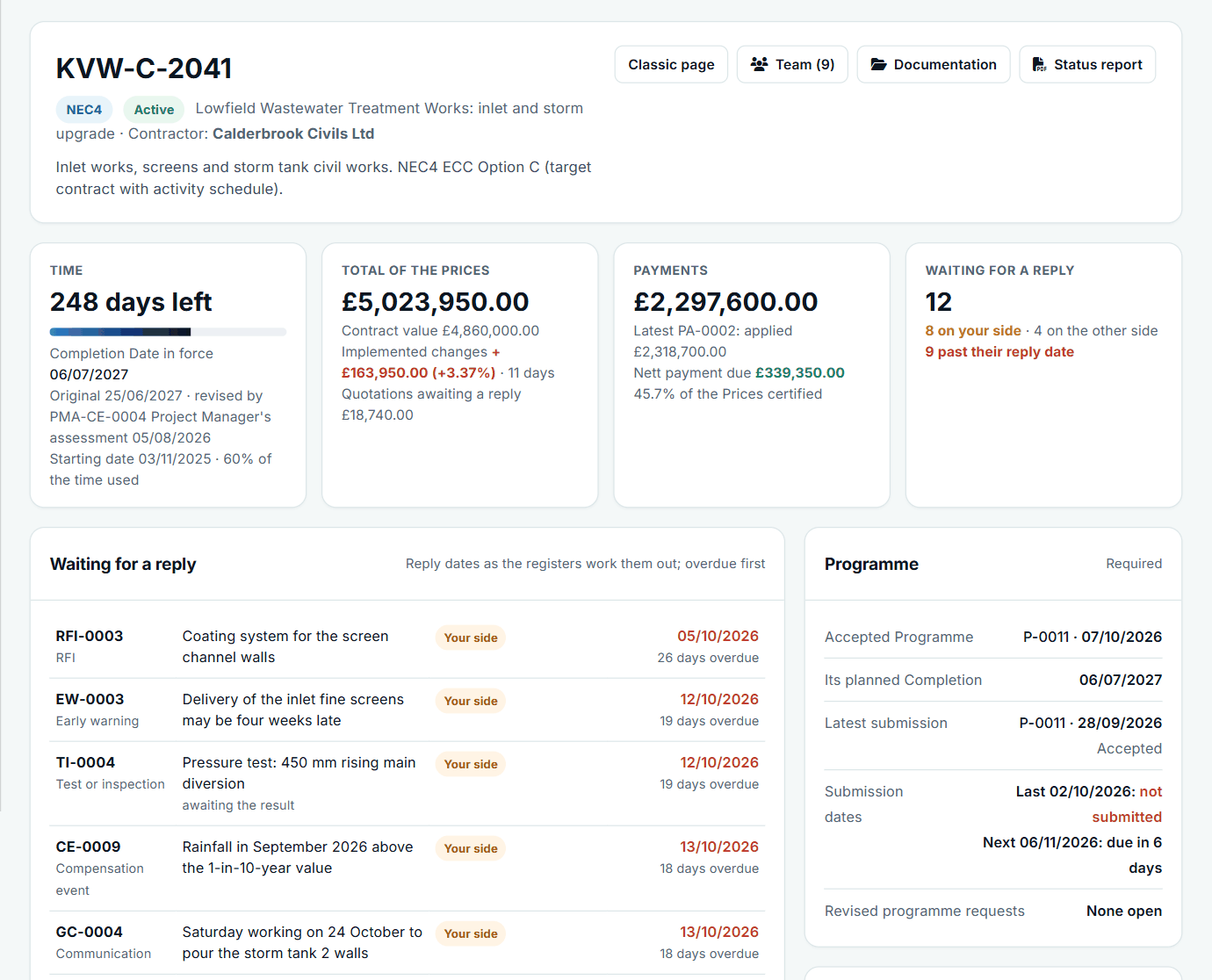
A contract at a glance: time, the total of the Prices, payments and replies waiting. See the worked example.
See how this works in practice
Click through Contract Status with sample contracts: raise the notice, reply to it, and watch both sides of one record.
Take the guided tour Book a demo
Test your NEC knowledge, use the free NEC tools or download free NEC templates.
This guide is general information in our own words, not legal advice. Your contract and its Contract Data always govern. NEC, NEC3 and NEC4 are trade marks of Thomas Telford Ltd; Contract Status is not affiliated with or endorsed by NEC.