
An NEC contract needs a single audit trail because its money and dates depend on who said what, and when. NEC audit trail software puts each notice, reply and decision on one dated record for each contract, so the answer to "when did we tell them?" doesn't depend on who is still around or what they kept.
This page is about why that matters and what to check in a system. It belongs with the NEC contract management software guide. If you want to know what to keep in any case, including site records, see keeping a clear NEC audit trail.
Four questions the contract keeps asking
Nearly every contested point on an NEC job comes back to one of these.
- When did the Contractor become aware? The eight weeks in 61.3 run from that moment, not from the notice.
- When did the reply go, and was it inside the period? A late one can be a compensation event (60.1(6)) and can open the route to treated acceptance (61.4, 62.6, 64.4).
- Which programme was the Accepted Programme at the time? Delay from a compensation event is measured against it (63.5 in NEC4), and it won't always be the latest one.
- Was a warning given, and what was decided? If an experienced contractor could have warned and didn't, the event is assessed as if it had (61.5). The Early Warning Register and meeting notes are where that is shown.
On Options C, D and E there is a fifth. Can the cost be shown? Clause 52 requires Defined Cost records, and the Project Manager can inspect them. See auditing Defined Cost.
How scattered records let you down
| Where it lives now | The weakness | When you find out |
|---|---|---|
| Individual inboxes | Access depends on who is still employed, and on your retention rules | When the surveyor has left and the mailbox has gone |
| A long e-mail chain | The notice is mixed in with discussion, and 13.7 expects a notification to be separate | When the other side says no valid notice was given |
| A tracker spreadsheet | It records what someone typed about the event, later, and can be overwritten | When two versions disagree about a date |
| Meeting minutes | They summarise, usually from one side's viewpoint, and often come out late | When someone says "that isn't what was agreed" |
| Shared folders | File dates reflect when something was saved or copied, not when it was given | When a file was moved during the job |
| Letters by post or courier | Good evidence for each notice, but nothing joins them up | When reconstructing a chain takes days |
Each of these works on its own for a while. The difficulty is assembling them. Someone reconstructing an event two years later has to work across all six, usually to a short deadline. Adjudication timetables are short, as adjudication under NEC sets out.
What "single" should mean in practice
It doesn't mean every document on the job sits in one system. Drawings, photographs and cost ledgers will have their own homes. It means:
- One place to start. For any event, there is one record that shows what happened and points to everything else.
- Linked steps. Notification, reply, quotation, reply and implementation are joined, so nobody has to rebuild the chain.
- Dates set by the action, not by typing. The date a notice was submitted should come from submitting it.
- Both sides see the same thing. A private log can be useful, but it doesn't settle much with the other Party.
- Drafts kept apart. A draft shouldn't look as if it was issued.
- Old states retained. A record that can be overwritten shows only where things stand today, not what was known at the time.
Contract Status works in this way for its registers: a record starts as a draft that only your company sees, the other side is told when it is submitted, replies go on the record, and its history keeps who did what and when.
Five things to try on any system
- Change a record that has already been submitted. What can be changed, and is the earlier version still visible?
- Find out what happened on one event without opening anything else. How long did it take?
- Ask whether a record's history can be seen by both sides or by one.
- Ask how you can get the complete record out at the end of the job, in what format and for how long. Your records may need to outlast your subscription, and your legal team will have a view on retention.
- Ask how a site instruction given by phone gets on to the record. If the answer is "someone enters it", that is honest. Decide who.
The limits of a good trail
A dated record shows that something was entered and when. It doesn't show that it was true, complete or fair. If someone types in an awareness date months later, the record shows the date entered, and the other side may reasonably challenge it. Also, a trail inside a system only counts as contract communication if your contract allows it. Check clause 13 and your Scope or Works Information, and read why email is a poor way to run an NEC contract for the rest of that point.
Related guides
- NEC Contract Management Software
- Why Email Is a Poor Way to Run an NEC Contract
- Seeing Your NEC Commercial Position at a Glance
- Why NEC Project Managers Use Contract Software
- How Software Helps You Avoid Missed NEC Time Bars
- Avoiding Treated Acceptance by Keeping Replies on Time
How this looks in Contract Status
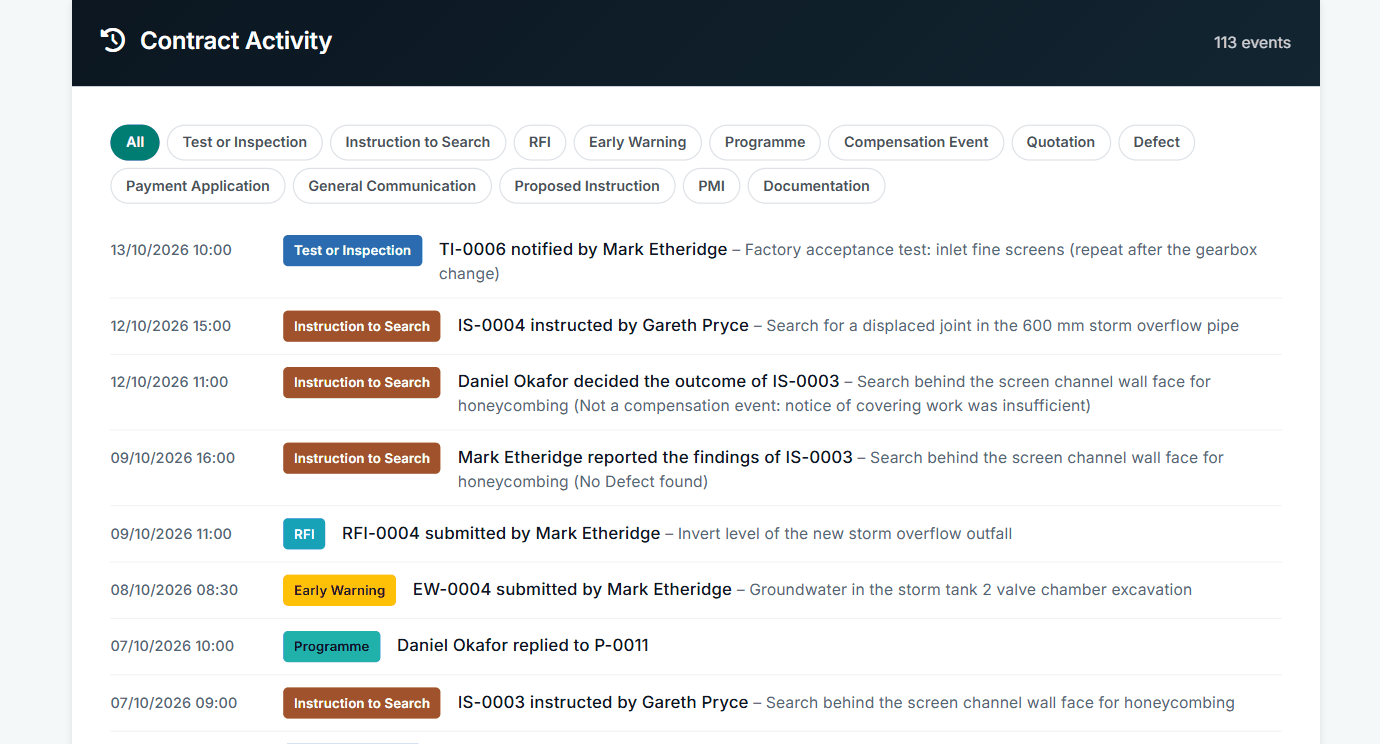
Contract Activity: every step, dated and named. See the worked example.
See how this works in practice
Click through Contract Status with sample contracts: raise the notice, reply to it, and watch both sides of one record.
Take the guided tour Book a demo
Test your NEC knowledge, use the free NEC tools or download free NEC templates.
This guide is general information in our own words, not legal advice. Your contract and its Contract Data always govern. NEC, NEC3 and NEC4 are trade marks of Thomas Telford Ltd; Contract Status is not affiliated with or endorsed by NEC.