
Running an NEC contract by email is usually allowed, but it is a poor fit. An email can meet clause 13.1, because it can be read, copied and recorded, so NEC contract email isn't invalid in itself. The trouble is that email is built for conversation and the contract needs separate, dated, trackable notices.
This page sets out where it fails, and how to reduce the damage if you stay on it. It is part of the NEC contract management software guide. For the clause itself, see clause 13: communications.
Where email fails, in the order you'll meet it
The notice gets buried
Clause 13.7 expects a notification to be given separately from other communications. Email drifts the other way. "Also, while I'm writing, the ground conditions at grid C4 have turned out differently" is a natural sentence in an email about something else, and it invites the argument that no compensation event was notified. The same applies to a notice inside a progress report sent as an attachment.
The reply clock has no home
An email arrives and nothing starts counting. Each person works out the period for themselves, or doesn't. A week after a notification, the 61.4 reply is due, and the only thing that knows is whoever happened to read it and diarise it. Out-of-office replies don't stop the clock.
It isn't clear when it took effect
Under NEC4 13.2, where the Scope names a system for communications, going through that system is what gives a message its effect. Otherwise, what counts is receipt at the address the recipient last notified, or the one in the Contract Data. So emailing a person who isn't the notified address, or using the wrong system, can raise a real question. An email to the site team isn't necessarily a notice to the Project Manager.
Versions drift apart
A quotation goes out as an attachment. A corrected build-up follows two days later, in reply to a different message. The Project Manager's surveyor comments on the first, and a colleague answers the second. Three weeks later, nobody is sure which figure was accepted, and which programme revision it relied on. Revised quotations under 62.4 need to be kept as separate versions, and an inbox doesn't do that.
Turn-taking disappears
At any moment, every open item is waiting on someone. An inbox can't show that. Chasing becomes the method, and chasing takes up time on both sides. Worse, the absence of an email looks exactly like nothing being due.
The record leaves with the person
When someone moves on, their mailbox may be archived, redirected or removed, depending on your IT policy. Their knowledge of which thread mattered goes with them. See keeping NEC knowledge when people move on.
What email does perfectly well
It would be wrong to say email has no place. It is good for the discussion before a decision, for a quick question that needs no reply period, and for sharing a thought. In a spirit of mutual trust, plenty of useful conversation happens there. A contract system shouldn't try to replace all of it, and it won't. The aim is to stop formal things happening in an informal place.
If you are staying on email
That can be a sensible decision on a small contract. Make it work with a few rules, agreed at kick-off.
- One notice per email. Nothing else in it.
- A fixed subject line. Use the type, a reference number and a short description. Our guide to managing NEC communications gives a format.
- A shared project address. Copy every formal communication there, so that it survives staff changes.
- Named notified addresses. Have each Party notify its address for communications in writing, and use only those.
- A log kept by one person, with cover. Record the date sent, the clause, and the reply date. Tracking in a spreadsheet shows how.
- A weekly review of what is waiting, by whose turn it is.
What a system should do differently
| In an inbox | On a contract system |
|---|---|
| A message about an event | A record of a particular type, on the right register |
| A date you notice for yourself | A reply date from the contract's period |
| A thread of replies | A reply attached to the record |
| Separate copies at each end | The same record for both sides, subject to access |
| Search and hope | Lists by status and whose turn it is |
E-mail doesn't vanish in that model. In Contract Status, for example, submitting a record e-mails the other side and shows it in their notifications, and they then answer on the record. General communications and requests for information have registers of their own, apart from formal notices.
Related guides
- NEC Contract Management Software
- Seeing Your NEC Commercial Position at a Glance
- Why NEC Project Managers Use Contract Software
- Why Contractors Use NEC Contract Software
- Avoiding Treated Acceptance by Keeping Replies on Time
- Why an NEC Contract Needs a Single Audit Trail
How this looks in Contract Status
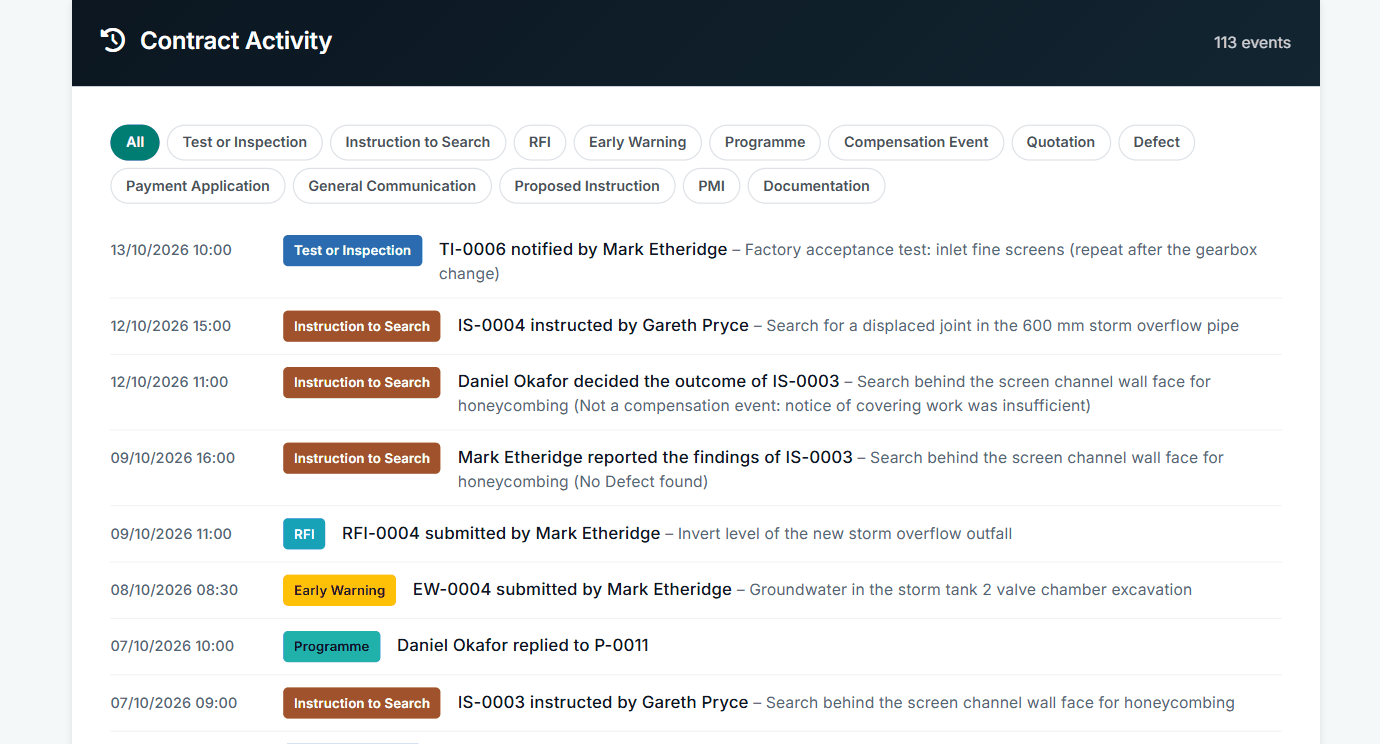
Contract Activity: every step, dated and named. See the worked example.
See how this works in practice
Click through Contract Status with sample contracts: raise the notice, reply to it, and watch both sides of one record.
Take the guided tour Book a demo
Test your NEC knowledge, use the free NEC tools or download free NEC templates.
This guide is general information in our own words, not legal advice. Your contract and its Contract Data always govern. NEC, NEC3 and NEC4 are trade marks of Thomas Telford Ltd; Contract Status is not affiliated with or endorsed by NEC.