
Good records reduce NEC disputes mainly by ending arguments about facts. If both sides can see when a notice went, what was accepted and which programme applied, what's left to argue about is what those facts are worth, and a meeting can often settle that. Records won't stop people disagreeing, and we have no figure to offer for how much difference they make.
What follows is about the mechanism rather than a promise. It uses the NEC4 ECC, with NEC3 notes, and sits within the NEC contract management software guide. For the formal routes, see how disputes work under NEC.
Arguments that records can end, and ones they can't
| The argument | Can a record settle it? |
|---|---|
| "You never notified that." | Yes, if each notification is its own dated item |
| "The reply was in time." | Yes, from the dates and the period on the contract |
| "That was treated as accepted." | Yes, on the dates of the reply, the failure notice and the further period |
| "Which programme applied?" | Yes, if acceptance of each revision is recorded |
| "We warned you in March." | Yes, from the Early Warning Register and meeting notes |
| "You knew about it earlier than that." | Partly. A recorded awareness date helps, but site diaries and photographs may say otherwise |
| "That cost was necessary." | Partly. On cost-based Options, the clause 52 records carry much of the weight |
| "That's not a compensation event." | Rarely. It is a question of what the contract means |
| "The ground was what an experienced contractor would have allowed for." | No. Records inform that judgement, but they don't make it |
So there are limits. If your disputes are mostly about interpretation, records will help you present them better, but they won't make them go away.
The same event, twice
A fictional NEC4 job. A late drawing delays a pour, and the Contractor says it's a compensation event. All details are illustrative.
Version one: inboxes. The Contractor's surveyor says the event was notified on 12 May in an e-mail about something else. The Project Manager can't find a reply, and says the e-mail wasn't a notification. Each side has a different programme revision in its quotation file, and neither is sure which had been accepted on the date. Weeks go by on those points alone. The positions harden, and senior people get involved. When they finally ask what the delay is worth, the parties are arguing about their history too.
Version two: one record. The notification is dated. So is the reply, rejecting it because the Contractor's own rebar was late too. The Accepted Programme at that date is plain, and the register shows no one gave an early warning. The disagreement is real, but it's now one question: what would have happened to the pour if the rebar had been on time? People can talk about that with a programme open between them. They may still not agree. But they are arguing about the point that matters, and sooner.
Why the timing matters under NEC
NEC settles things as they go, and its dispute routes are tighter than many people assume.
- Implemented means implemented. An implemented assessment generally stays as it is (66.3; 65.2 in NEC3). Sorting out the facts at the time is worth more than preparing to reopen them later.
- Dispute windows can be short. Under Option W1, limits can close the route if they are missed. Under W2 you can start adjudication at any time, but the notice to take a decision to the tribunal has its own limit. See time limits for NEC disputes.
- The final assessment has a limit too. It becomes conclusive unless a dispute is referred in time (53.3 in NEC4). See the final assessment.
- Adjudication moves fast. Once someone refers a dispute, you won't have months to assemble evidence. See adjudication under NEC. If the person who knew is gone, you will wish the record were better.
What to have ready before you need it
- For each open event: notification, reply, quotation versions and the current status, all in one place.
- Each Accepted Programme, its acceptance date, and each reason for not accepting a revision.
- Early Warning Registers as issued, with meeting decisions and who took which action.
- Site records for the period, with dated photographs, allocation sheets and diaries. A contract system rarely holds all of these, so know where they are.
- On Options C, D and E, Defined Cost records that can be traced to the event. See what to do if you don't have Defined Cost records.
Contract Status helps with the first three: each register's records keep their history of who did what and when, and the Completion Date timeline shows each change with the event behind it. It records what the two sides did and doesn't decide who is right. Site and cost records stay with you.
Honest caveats
- Better records may reveal more disagreements in the short term. Events that used to go unnoticed now get notified and answered. That's the contract working, but your register will look busier.
- A record can be wrong. If an entry was made late or by someone who wasn't there, the other side can challenge it, and may be right to.
- Records can be used as weapons. A team that spends its energy building files against the other side is missing the point of avoiding disputes on NEC contracts. Mutual trust and co-operation (10.2 in NEC4, part of 10.1 in NEC3) applies throughout.
- Take legal advice on a real dispute. Nothing here replaces it, and a software record doesn't settle what weight an Adjudicator will give it.
Related guides
- NEC Contract Management Software
- Keeping NEC Knowledge When People Move On
- What Poor NEC Administration Really Costs
- Building the Business Case for NEC Software
- Why Subcontractors Use NEC Contract Software
- Managing Many NEC Contracts Without Losing Track
How this looks in Contract Status
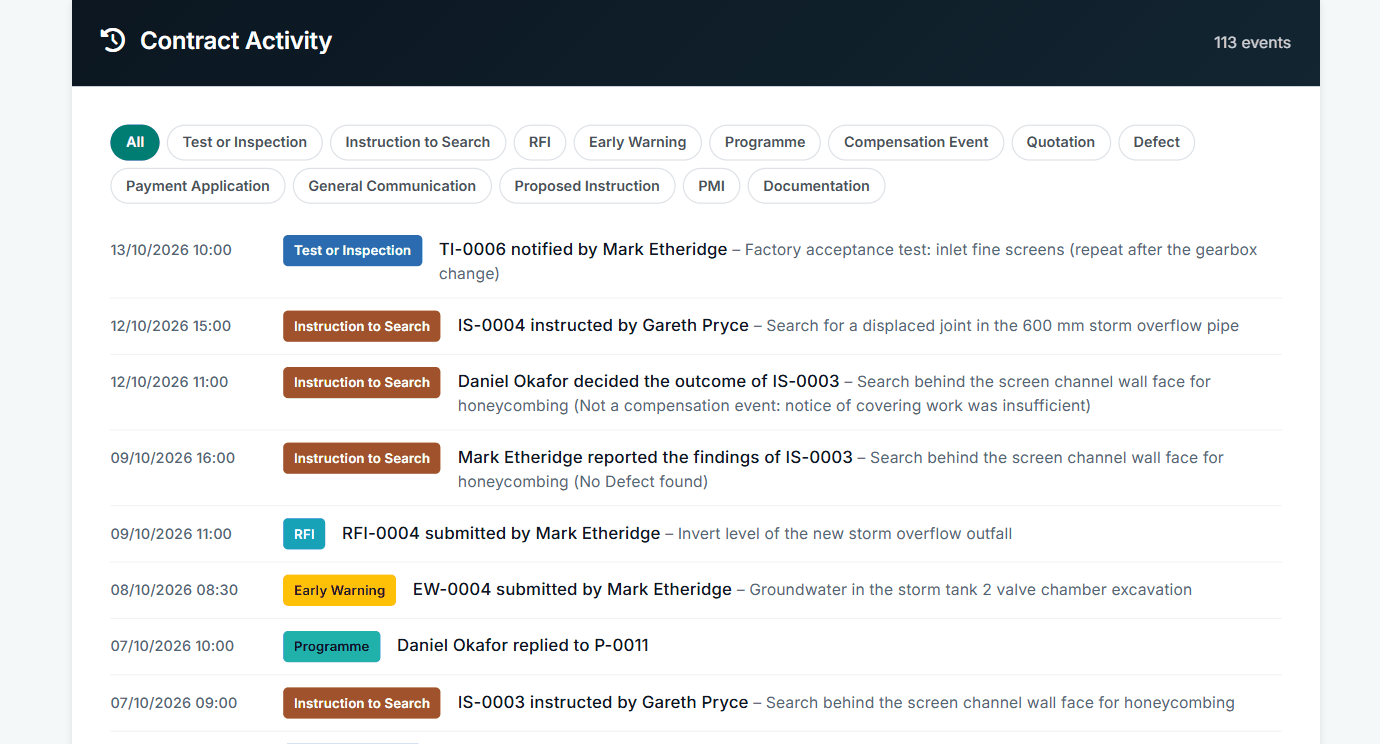
Contract Activity: every step, dated and named. See the worked example.
See how this works in practice
Click through Contract Status with sample contracts: raise the notice, reply to it, and watch both sides of one record.
Take the guided tour Book a demo
Test your NEC knowledge, use the free NEC tools or download free NEC templates.
This guide is general information in our own words, not legal advice. Your contract and its Contract Data always govern. NEC, NEC3 and NEC4 are trade marks of Thomas Telford Ltd; Contract Status is not affiliated with or endorsed by NEC.