
A good NEC contract handover gives the next person the running dates, the open decisions and the reasons behind past ones. Dates and records can be kept in a system. Reasons usually can't, unless someone wrote them down at the time.
People move during a long NEC job, and the contract doesn't pause for it. A reply period keeps running through a resignation, a holiday and a change of consultant. This page gives a practical handover for a live contract, and is honest about what software can and can't retain. It is part of the NEC contract management software guide.
What walks out of the door
| The knowledge | Where it usually lives | Can a system hold it? |
|---|---|---|
| What's due next, and whose turn it is | A person's diary or tracker | Yes |
| What was notified, replied and accepted | Their inbox | Yes, if it was on the record |
| Which programme is accepted | A folder they know about | Yes |
| What the Z clauses change, and how you've been applying them | Their head | Partly: the periods and clause wording, not the reasoning |
| Why a quotation was rejected, beyond what the letter says | Their head | Only if somebody wrote it in |
| Understandings reached in conversation | Their head, and the other side's | No. Get them recorded before the person goes |
| What the other side's team is like to deal with | Their head | No, and it shouldn't go on a shared record |
The handover list for a live contract
Use this when someone leaves the job. It suits a Project Manager, surveyor or planner, with some adjustment.
- Handle the contract formalities first. The Client can replace the Project Manager or Supervisor after notifying the Contractor of the new name. A Contractor's key person named in the Contract Data needs a replacement accepted under 24.1. Any delegation under 14.2 should be notified or cancelled, with the delegate named.
- Change the addresses. If notices come to a person's address, the recipient's notified address has to change as well. Otherwise a notice may have effect at an address no one is reading.
- List everything with a running date. Replies due, quotations due, the next revised programme, the next assessment date. Include the periods from your Contract Data, not the standard ones.
- Go through open events one at a time. For each, say where it stands and what the leaver would have done next.
- Write down the reasoning. A short note on each live disagreement: what each side says, and what the evidence is. One page is enough.
- Identify the Accepted Programme, and any revision in hand.
- Walk through the Early Warning Register. Who owns each open action, and which are stuck?
- Record the unwritten understandings. If the leaver agreed something in a conversation, put it into a communication now, while they can still confirm it.
- Move the files. Mailbox access, personal drives, phone photographs. Do this before IT closes the account.
- Introduce the successor to the other side, ideally in a joint meeting with the leaver present.
The new starter's own first weeks are covered by the first 30 days of an NEC contract, which applies to someone arriving midway as well, if you read it for what still needs doing.
Records alone don't transfer understanding
Suppose someone inherits a tidy system on a fictional job. They can see a quotation with a reply due on Friday. They can't see that the last three were accepted on a basis agreed in a workshop, or that the Z clauses change how the Fee applies. A system can tell them Friday. It can't teach them what to reply.
That's why training belongs in any handover plan. A successor needs enough NEC to read a record critically, and a system with due dates doesn't provide that. Where people are new to the contract:
- Train people on the contract, not only on the tool. Start with what's specific to their role. See what to learn about NEC4 and the NEC contract manager role.
- Read this contract, not a generic one. Sit down with the Contract Data, the Z clauses and the Options chosen.
- Give them a mentor on the first few replies. Someone who knows NEC should read their first quotation responses before they go.
- Don't use the system as the training. A person who has only learned the buttons will follow the buttons into a wrong answer.
Where software does change the picture
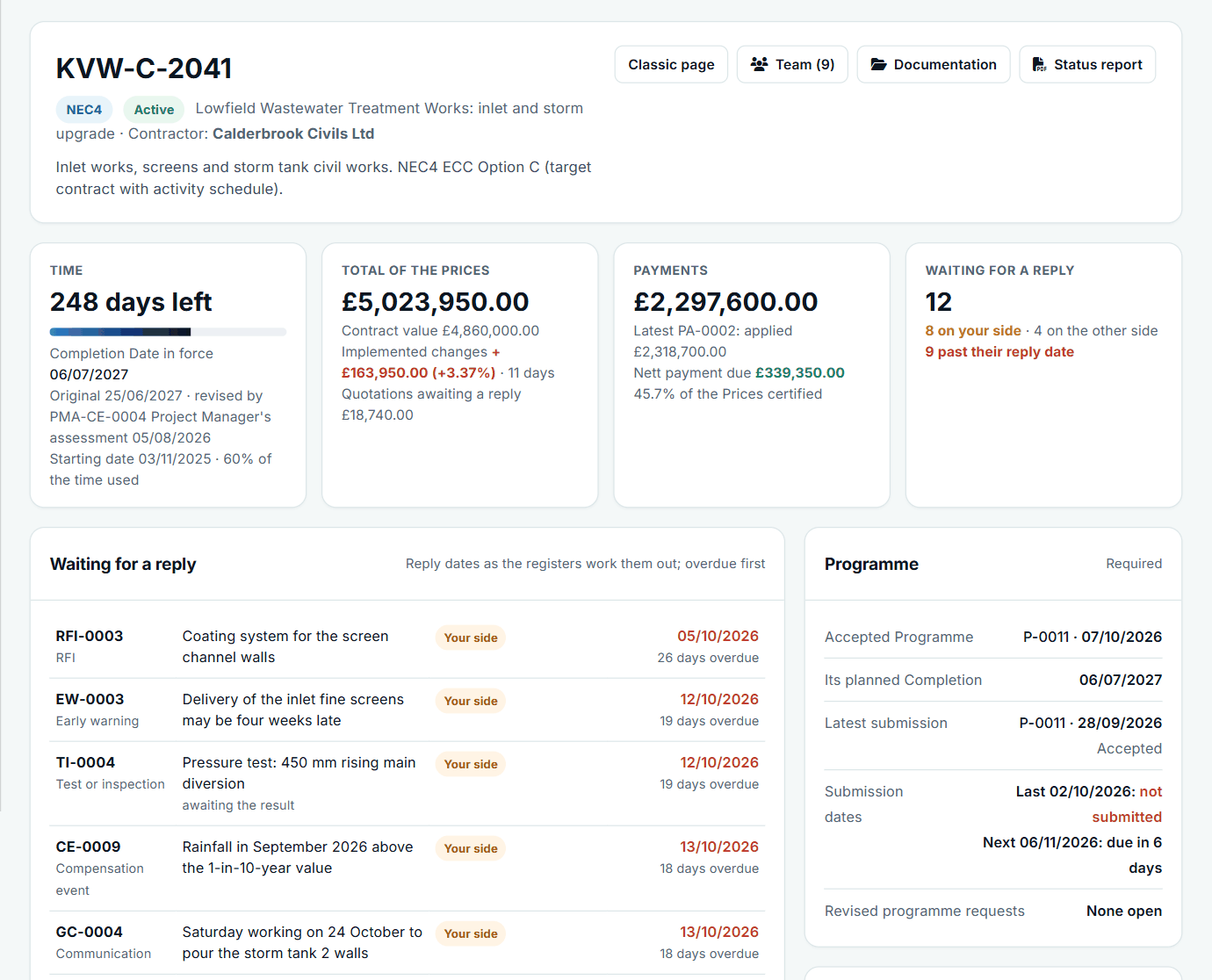
The biggest difference is the starting position. With one person's tracker and inbox, a successor has to rebuild the contract's history from fragments. With a shared record, the steps of each event are already there, and turn-taking carries on even during the gap.
In Contract Status, for instance, a record's history keeps every step, and the Action List and My Dashboard show what's waiting for your side, whoever is doing the looking. Clause wording in your clause library and the periods recorded on the contract stay with the account, not with the person who set them up. The reasoning still has to go somewhere, so write it down, with the record it belongs to, while people still remember it.
This only works if people use the system during the job. If they keep their real thinking in email and enter a summary at month end, the handover will be from the email. For the wider argument, see why a contract needs a single audit trail.
A test to run before anyone leaves
Pick your busiest contract. Ask someone unconnected with it to spend half an hour finding out what's due, what's in dispute and why. What they can't find is your handover risk, and you can deal with it while the person who knows is still here.
Related guides
- NEC Contract Management Software
- What Poor NEC Administration Really Costs
- Building the Business Case for NEC Software
- Moving a Live NEC Contract Onto Software
- Managing Many NEC Contracts Without Losing Track
- How Good Records Reduce NEC Disputes
See how this works in practice
Click through Contract Status with sample contracts: raise the notice, reply to it, and watch both sides of one record.
Take the guided tour Book a demo
Test your NEC knowledge, use the free NEC tools or download free NEC templates.
This guide is general information in our own words, not legal advice. Your contract and its Contract Data always govern. NEC, NEC3 and NEC4 are trade marks of Thomas Telford Ltd; Contract Status is not affiliated with or endorsed by NEC.