
Treated acceptance, often called deemed acceptance, happens when a Project Manager misses a reply, the Contractor notifies that failure, and there is still no reply after a further period. Deemed acceptance software can't remove that risk, but it can show every step coming, because this outcome takes two missed chances and at least two separate dates.
Nothing is ever treated as accepted automatically on the first missed reply. Knowing that changes how a Project Manager's team should work, and how a Contractor should use the right. This page covers the NEC4 ECC, with NEC3 differences. See the NEC contract management software guide for the wider picture.
How silence turns into a contract effect
| Unanswered item | Reply due | Further period after the failure notice | What it is then treated as | Clause |
|---|---|---|---|---|
| Contractor's notification of a compensation event | 1 week, or longer if the Contractor agrees | 2 weeks | It is a compensation event, with an instruction to quote | 61.4 |
| Quotation | 2 weeks | 2 weeks | The quotation is accepted, so the event is implemented on it | 62.3, 62.6 |
| Project Manager's own assessment not made | The time allowed for a quotation | 2 weeks | The Contractor's quotation is accepted | 64.3, 64.4 |
| Programme, NEC4 only | 2 weeks | 1 week | The programme is accepted | 31.3 |
These are the standard ECC periods, and your Contract Data or Z clauses may change them. Subcontract periods differ too, so use yours.
A few limits are often missed:
- The notice is the Contractor's choice. Without it, the further period doesn't start and nothing is treated as accepted, though a late reply can still be a compensation event under 60.1(6).
- A reply in the further period ends the route. The reply was late, but the matter isn't treated as accepted.
- NEC3 has no such rule for programmes. A late reply is simply a compensation event. See deemed acceptance of a programme under NEC4.
- Proposed instructions are different. A quotation for an instruction that hasn't been given isn't treated as accepted: NEC3 62.6 leaves it out, and NEC4 deals with proposed instructions separately in clause 65.
Why it deserves attention on the Client side
Take a fictional NEC4 Option A contract with illustrative dates. A quotation goes in on 6 May. The Project Manager's surveyor thinks it is too high, intends to instruct a revised quotation, and is pulled onto another job.
- 20 May. The reply date passes.
- 22 May. The failure notice arrives. It goes to the Project Manager, who assumes the surveyor has dealt with the quotation.
- 5 June. The further two weeks end with no reply. The quotation is treated as accepted.
The event is implemented on the Contractor's figures, so the change to the Prices and any movement of the Completion Date take effect. An implemented assessment generally stays as it is (66.3; 65.2 in NEC3), so the chance to answer it in the ordinary way has gone. There may still be a route through dispute resolution, but it has its own short limits: see time limits for NEC disputes.
Nothing dramatic happened in that story. Two people each thought the other had it. The fix is mostly about ownership.
What to track, whichever tool you use
| Date | Who should see it | Why |
|---|---|---|
| Reply due | The person replying, and whoever covers them | This is the moment to answer, or to agree more time |
| Failure notice received | The Project Manager personally, and the commercial lead | It should never be routine. It means a further period is running |
| Last day of the further period | Both sides | After this, the effect has arrived, and the next steps need recording |
| Agreement for more time | Both sides | It has to be agreed before the time runs out (61.4, 62.5, 13.5), so the date of the agreement matters |
A system should treat the failure notice as a separate event with its own countdown. If the record only shows "overdue", the team can't tell a reply that's a day late from one that's about to become an accepted quotation.
In Contract Status, an overdue record offers the Contractor side the notice that the reply is late and then counts the period down. When it has run out, either side can record the deemed acceptance. It never gives the notice on the Contractor's behalf, because that decision is the Contractor's to make. Other systems will handle this differently, so run the same scenario on anything you are looking at, using the checks in how to choose NEC contract software.
Habits that reduce the risk on the Project Manager's side
- Delegate properly. Under 14.2 the Project Manager can delegate actions after notifying the Contractor. A named delegate with cover is safer than an informal arrangement.
- Answer what you can. A reply saying a revised quotation is needed, with reasons, is a proper reply. It doesn't need the final view on the money.
- Ask early for more time. A Contractor who agrees a week today loses nothing, and it can't be fixed afterwards.
- Review by reply date each week. A review by event number can hide the urgent item in the middle. Tracking periods for reply has a method.
And for the Contractor
Using the notice isn't sharp practice: the contract provides it. But the parties are also working in mutual trust and co-operation (10.2; part of 10.1 in NEC3), and a call first often gets a quicker and better answer than a formal route. If you do rely on a treated acceptance, keep the dates and the notice together on the record. See what to do when the Project Manager is silent on a quotation.
Related guides
- NEC Contract Management Software
- Why an NEC Contract Needs a Single Audit Trail
- Why Email Is a Poor Way to Run an NEC Contract
- Seeing Your NEC Commercial Position at a Glance
- Do We Actually Need NEC Software?
- How Software Helps You Avoid Missed NEC Time Bars
How this looks in Contract Status
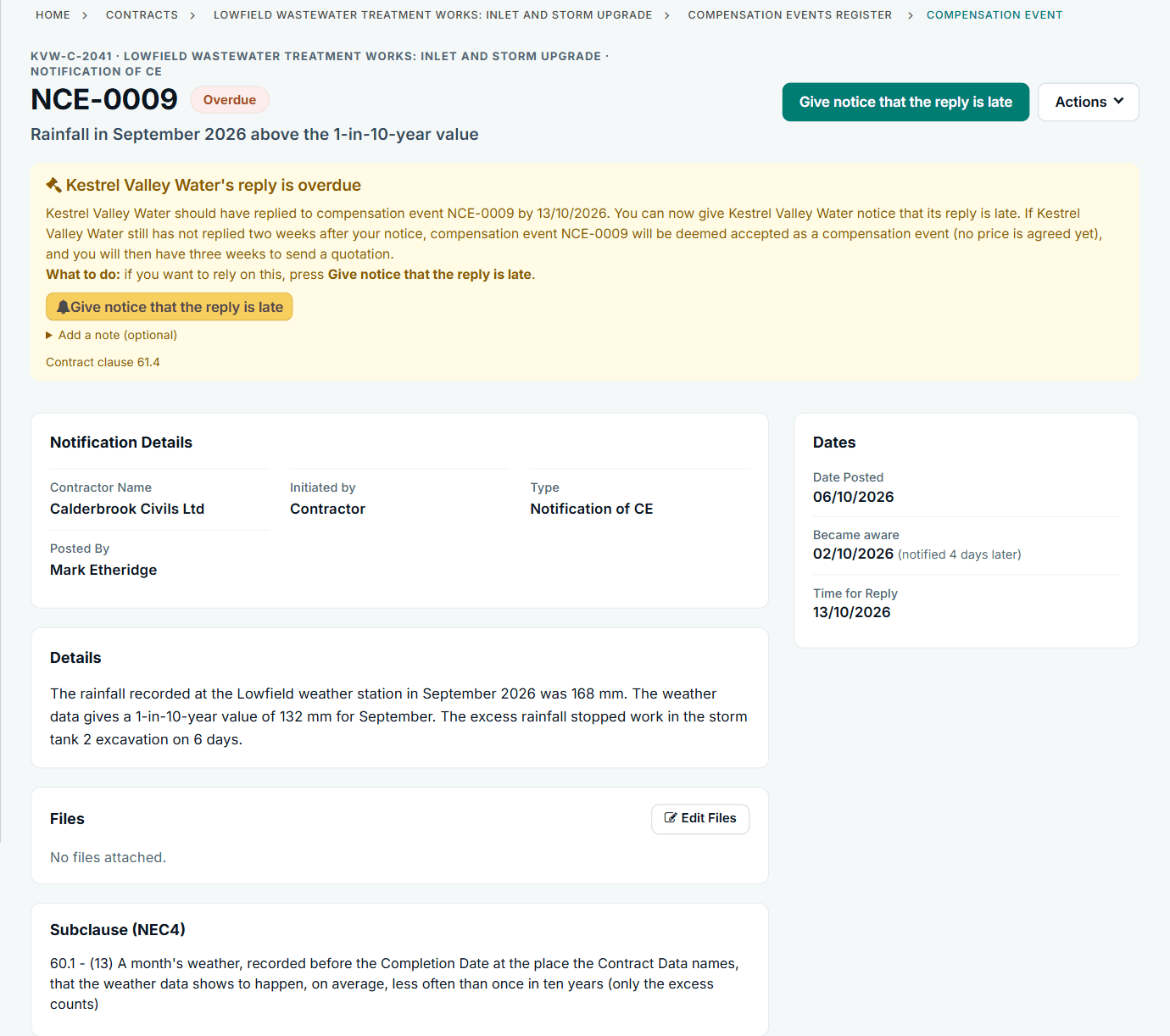
A late reply in Contract Status: the banner, the clause and the button for the notice. See the worked example.
See how this works in practice
Click through Contract Status with sample contracts: raise the notice, reply to it, and watch both sides of one record.
Take the guided tour Book a demo
Test your NEC knowledge, use the free NEC tools or download free NEC templates.
This guide is general information in our own words, not legal advice. Your contract and its Contract Data always govern. NEC, NEC3 and NEC4 are trade marks of Thomas Telford Ltd; Contract Status is not affiliated with or endorsed by NEC.