
The Contractor, if it really is a Defect and it comes to light before the defects date. For a defect after Completion under NEC, the defect correction period starts on the day it is notified, and the cost generally stays with the Contractor. What decides it is whether the item fails the Scope, or just wore out, got damaged or follows a Client's own design.
This page follows the NEC4 Engineering and Construction Contract (ECC), where notifying is clause 43.2 and correcting is 44.2. In NEC3, those are 42.2 and 43.2. The other side of this question is a defect after the defects date. Both sit under NEC questions answered.
Is it a Defect at all?
| What has happened | Likely answer | Who pays |
|---|---|---|
| Doesn't meet the Scope: pipes laid to the wrong fall | Defect | Contractor, subject to the table further down |
| Contractor's design breaks the applicable law, or departs from its accepted design | Defect | Contractor |
| Works as the Client's Scope required, but the Client's design was wrong | Not a Defect, because it meets the Scope. A fault in the design in the Scope is a Client's liability under 80.1 | Client |
| Client's staff damaged it after take over | Not a Defect. Damage to taken-over works is generally a Client's liability under 80.1 | Client |
| Wear from normal use, poor maintenance | Not a Defect, if it met the Scope when built. Check any performance or life requirement in the Scope | Client |
| Damage from a hidden fault that existed at take over | That exception in 80.1 puts it back with the Contractor | Contractor |
The Defect definition sets the test. A Scope that requires a level of performance may make a failure in use a Defect, even when the installed product looks fine.
What to do, and the time limits
- Whoever finds it notifies. The Supervisor and the Contractor each notify a Defect as soon as they become aware of it, until the defects date. A Client or tenant who spots a problem should pass it to the Supervisor or Project Manager the same day.
- Work out the correction date. The period in the Contract Data runs from notification, and the Contract Data may give different periods for different kinds of Defect (see the defect correction period).
- Sort out access. If the part has been taken over, the Project Manager arranges for the Client to allow access and use, and the clock waits until these have been given (44.4). Record the date.
- Agree the cause if it isn't obvious. The Supervisor can instruct a search under 43.1 up to the defects date. If nothing is found, that is a compensation event for the Contractor under 60.1(10).
- Correct and close. Have the Supervisor confirm, and repeat any test that originally showed the problem.
- If it isn't fixed in time, go to the contractor won't fix a defect or, if access was the problem, no access to fix a defect.
Who bears the cost, by main Option
| Main Option | Cost of correcting after Completion |
|---|---|
| A and B | The Prices don't change. The Contractor absorbs it |
| C and D | Disallowed Cost, whoever caused it within the Contractor's team |
| E | Disallowed Cost as well |
| Any, with Option X15 | The position may change for a design Defect, if reasonable skill and care were used. See the X15 guide |
The Contractor can look to its Subcontractor or designer under its own contract, but that doesn't delay the duty to the Client.
A fictional example
An office fit-out reached Completion on 1 April, with a 52-week period to the defects date and a four-week defect correction period. In September, the tenant reports water marks on a ceiling. The Supervisor inspects and notifies on 14 September that a pipe joint is leaking, which fails the Scope. The Contractor has until 12 October. The tenant allows access only from 21 September, so the period instead starts then, and the correction date moves to 19 October. Nobody disputes who fixes it. The tenant's replacement ceiling tiles and business interruption are a separate matter, and the contract's Defects clauses don't deal with them.
What you may hear
- Contractor: "It's a maintenance issue." Then ask for evidence: when was it last serviced, and what does the O&M manual say? A search instruction may settle it.
- Client: "You must fix it because you built it." Only if it is a Defect. Being the original builder doesn't make every later failure the Contractor's job.
- Either side: "We'll get round to it." The contract has a period, so state the date in writing.
In practice, a short joint inspection within a few days does more than an exchange of letters. If the same Defect keeps returning, record each instance, since that may point to a design or system problem. For the whole process, see NEC quality and Defects.
Related guides
- NEC Questions Answered: Real Situations on Site
- A Defect Appeared After the Defects Date: What Now?
- The Contractor Will Not Fix a Defect
- The Client Will Not Give Us Access to Fix a Defect
- Can We Add Margin on Subcontractor Costs?
- When Should Retention Be Released?
How this looks in Contract Status
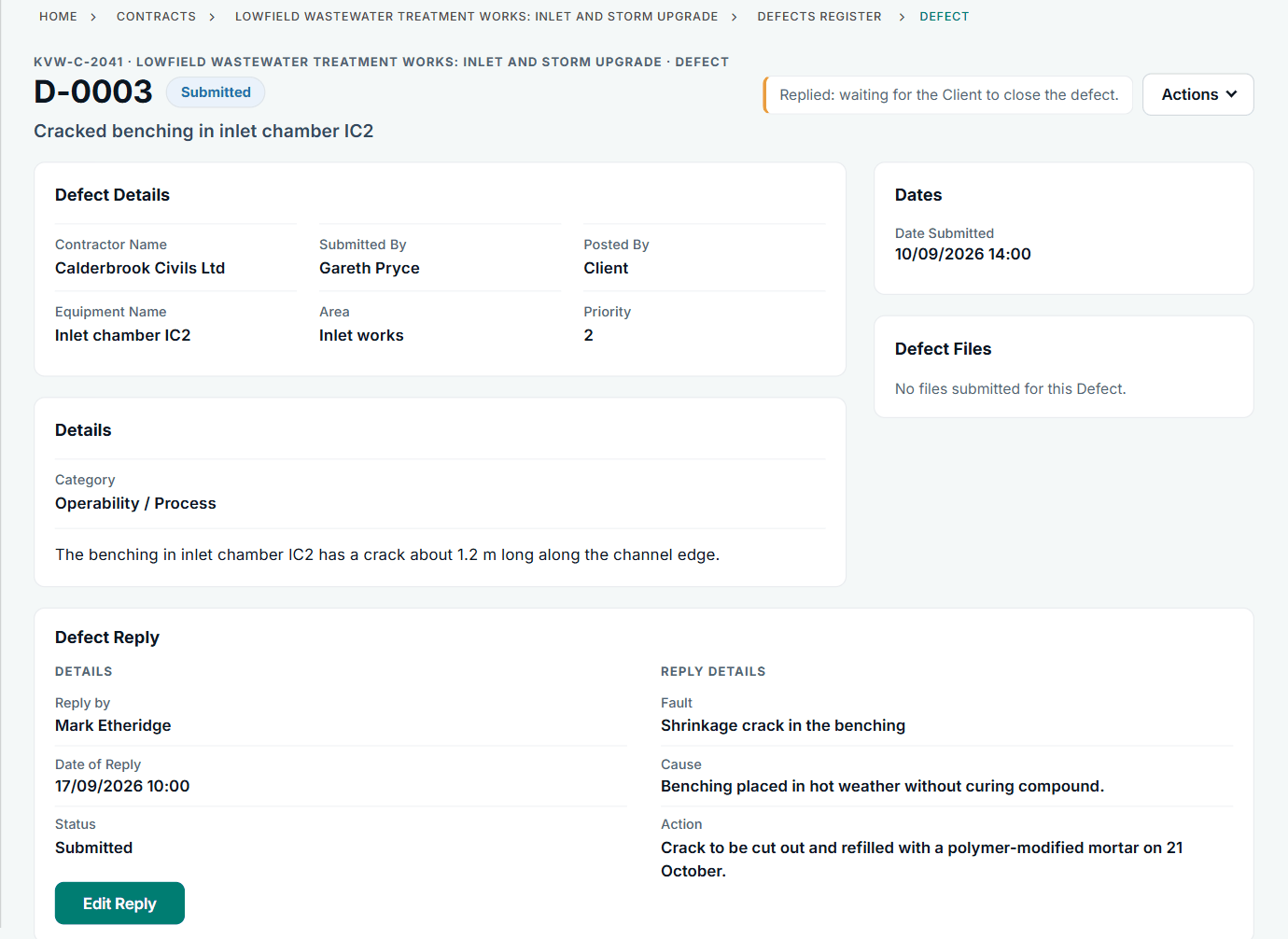
A Defect with the Contractor's reply: fault, cause and action. See the worked example.
See how this works in practice
Click through Contract Status with sample contracts: raise the notice, reply to it, and watch both sides of one record.
Take the guided tour Book a demo
Use the NEC deadline calculator, use the free NEC tools or download free NEC templates.
This guide is general information in our own words, not legal advice. Your contract and its Contract Data always govern. NEC, NEC3 and NEC4 are trade marks of Thomas Telford Ltd; Contract Status is not affiliated with or endorsed by NEC.