
Yes. Clause 61.3 lets the Contractor notify an event that has happened or that it expects to happen, so you can notify a compensation event before it happens as long as you genuinely believe it's coming and the Project Manager hasn't already notified it.
What decides whether you should is how firm the facts are. A notice saying access will definitely be a month late is useful. A notice saying something might go wrong is really an early warning, and it could get a short answer. The rule is the same in NEC3 and NEC4 ECC, but the time bar is worded differently (see below). This is one of our NEC questions answered.
Warn or notify?
| What you know | Send |
|---|---|
| Something might go wrong, and the cause isn't yet clear | Early warning only |
| It's now expected, and it would be a listed event if it happens | Early warning and notification, separately |
| It has happened | Notification now. The bar's running. Warn too if there's more to come |
| The Project Manager has already notified it | Nothing under 61.3. Respond to that notification |
An early warning doesn't do the job of a notification, and the two have different tests: see how they fit together.
Steps if you expect an event
- State the facts behind your expectation. A letter from the utility saying it can't attend until August is a fact. "We're concerned" isn't.
- Name the event. Quote the sub-clause and the date on the Accepted Programme you expect to be missed.
- Keep it as a separate notice. Clause 13.7 asks for a notification to be sent separately from other communications.
- Diary the reply. The Project Manager has one week under 61.4 (two under the NEC4 subcontract). If there's no reply, the failure route is open to you.
- Send a second notice if the event happens differently. If your notice said four weeks' delay to one area, and it's now a different problem in a different area, notify it again.
The effects you might not expect
Early notice has consequences beyond the time bar.
| Point | Effect of notifying before the event |
|---|---|
| Dividing date | For events not from a Project Manager's communication, it's the date of notification (63.1). Everything after that is a forecast, including work done later |
| Programme | Delay is assessed against the Accepted Programme current at that date (63.5 in NEC4). An earlier notice may mean an earlier programme |
| Uncertainty | If effects are too uncertain, the Project Manager can state assumptions (61.6). A wrong assumption can be corrected later, as an event in its own right |
| Reply | An event that hasn't happened and isn't expected is one of the reasons for saying no in 61.4, so your evidence has to show that you expect it |
Does the time bar run from your expectation?
NEC4's bar counts from awareness that the event has happened, so an event you only expect hasn't started the eight weeks. NEC3's text counts from awareness of the event, which leaves room to argue that it can start earlier. Under NEC3 especially, the cautious approach is to count from when you first knew it was coming. See clause 61.3.
Fictional example
The Accepted Programme shows access to Zone C on 1 July, which is also its access date. On 3 June, the Client tells the Contractor that its tenant will not move out until 29 July. The Contractor warns and notifies on 4 June, under 60.1(2), attaching the Client's email. The Project Manager agrees that it's expected, and instructs quotations within a week.
The dividing date is 4 June, so the quotation is entirely a forecast. It includes moving the Zone C gang to Zone D, and the cost of the four weeks that planned Completion moves. If the tenant leaves on 15 July, the assessment isn't revised for that alone. If the Project Manager has set an assumption of 29 July, a correction under 61.6 can reopen it, so the difference between the two routes matters. See quoting with unknown facts.
What you may hear back
- "Too early. Come back when it happens." The contract allows it, and this answer may need to be given in the terms 61.4 allows. If the Project Manager really doesn't expect it, that's a valid reason, but it should say so.
- "Let's deal with it by early warning first." Fine, and useful. Attend the meeting, but don't withdraw your notice.
- "Then you can't claim later." Wrong in principle: a refusal because it hasn't happened doesn't stop you notifying again when it does. Watch the clock from that moment.
In practice, notifying early works best where the facts are in writing from someone else, like the Client's email above. Where they aren't, warn first and use the meeting to find out.
Related guides
- NEC Questions Answered: Real Situations on Site
- The PM Has Not Replied to Our Compensation Event Notice
- The PM Has Not Replied to Our Quotation
- The PM Rejected Our Compensation Event Without Reasons
- We Missed the Eight-Week Time Bar: Is It Over?
- The PM Should Have Notified It: Does the Time Bar Still Apply?
How this looks in Contract Status
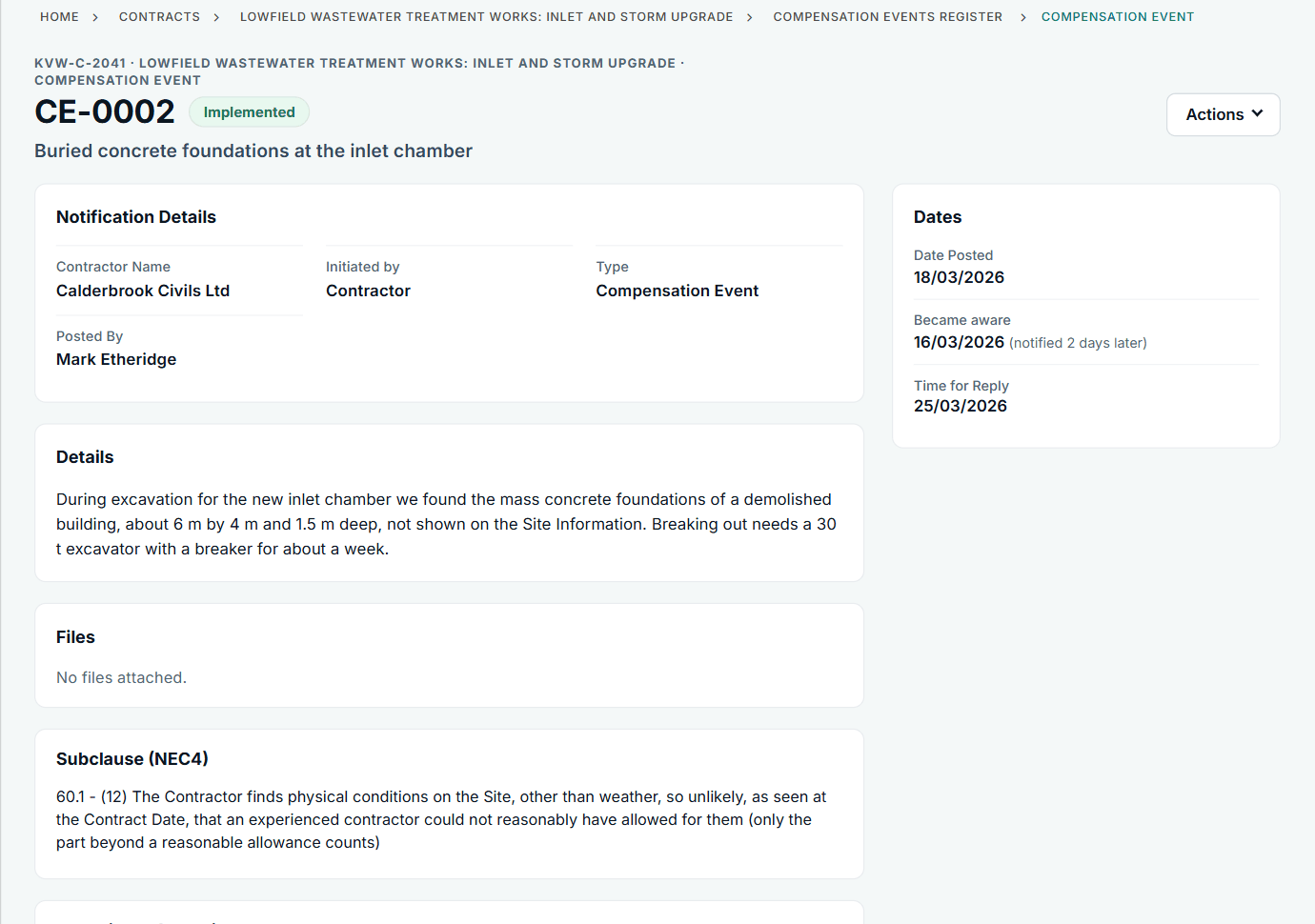
The record shows the date you became aware and how long you took to notify. See the worked example.
See how this works in practice
Click through Contract Status with sample contracts: raise the notice, reply to it, and watch both sides of one record.
Take the guided tour Book a demo
Use the NEC deadline calculator, use the free NEC tools or download free NEC templates.
This guide is general information in our own words, not legal advice. Your contract and its Contract Data always govern. NEC, NEC3 and NEC4 are trade marks of Thomas Telford Ltd; Contract Status is not affiliated with or endorsed by NEC.