
No. An early warning isn't the same as a compensation event notice, and it won't protect you from the eight-week bar in clause 61.3. If you believe an event qualifies and the Project Manager hasn't notified it, you need to send a separate notification saying so.
What decides whether you're exposed is the date you became aware and what your letters actually said. This is the same in NEC3 and NEC4 ECC, apart from the clause number for early warnings: 15.1 in NEC4, and 16.1 in NEC3. The NEC4 subcontract's period is seven weeks. For the bigger picture, see how the two procedures fit together.
Check yours today
- List every early warning on the register that might turn out to be a compensation event.
- For each one, find the date you became aware. The warning itself is often the proof of that date.
- Count eight weeks from that date.
- If there's time left, notify now, in a separate document. Don't wait for the meeting.
- If the event was caused by an instruction or similar from the Project Manager or Supervisor, the bar doesn't apply, but notify anyway if the Project Manager hasn't done so.
- If you've missed it, see missing the eight weeks.
The two side by side
| Early warning | Compensation event notice | |
|---|---|---|
| Clause (NEC4 ECC) | 15.1 | 61.1 by the Project Manager, 61.3 by the Contractor |
| What it says | Something could affect cost, time or performance | This event has happened or is expected, and is a compensation event |
| Purpose | Reduce the effect | Change the Prices and dates |
| Time limit | As soon as you're aware | Eight weeks from awareness of the event |
| Reply required | Goes on the register. No yes-or-no reply | The Project Manager replies within one week (61.4) |
| Failure | 61.5, and possible Disallowed Cost on cost Options | No change to the Prices or dates, for events subject to the bar |
The trap, as a timeline
A fictional job, with illustrative dates:
- 3 February: the Contractor warns that the Client's supplied switchgear may be late.
- 17 February: the switchgear misses the date on the Accepted Programme, and the Contractor knows that day.
- Early warning meetings in February and March: everyone discusses it. The Contractor feels the Project Manager knows all about it.
- 14 April: eight weeks after 17 February.
- 2 May: the Contractor sends a formal notice under 60.1(3). The Project Manager replies that it's late.
The meetings and the register don't help. The warning even helps the Project Manager, by showing what the Contractor knew. In this case, the Contractor could have sent a notice at any time from 3 February, because 61.3 also covers an event expected to happen.
Can one letter do both?
It's safer not to. Clause 13.7 asks for a notification to be sent separately from other communications, and a warning and a notice do different things. If an old warning clearly stated that an event was a compensation event, you could argue it was a notification too, but expect a fight. Whether it worked would turn on its exact wording. If there's real money involved and it's your only document, take advice.
Sample wording for each
The warning: "Early warning under clause 15.1. The Client-supplied switchgear may arrive after the Accepted Programme date of [date]. This could delay Key Date 3. We suggest discussing storage and sequence options."
The notice, sent separately: "We notify the following as a compensation event under clause 61.3. The Client has not provided the switchgear by the date on the Accepted Programme, [date]. We became aware of this on [date]. We consider this a compensation event under clause 60.1(3)."
The compensation event notice template has a fuller layout.
What the Project Manager may say
If you're late, expect: "A warning isn't a notice, and it proves you knew." If you're in time, it may say "It's just a risk, and it hasn't happened yet." You can answer that the clause covers an expected event, and the reply can follow. On a PM's own warning, don't assume it means the Project Manager will also notify the event. If it's an event that the Project Manager should have notified, it's still safer to send your own.
Contract and practice
The contract keeps these apart. In practice, the simplest system is one question at each early warning meeting: "Is any of this a compensation event?" Anything that gets a yes or a maybe goes into a notice that week. The clause 61.3 guide explains the time bar, and the NEC questions hub has related answers.
Related guides
- NEC Questions Answered: Real Situations on Site
- We Gave an Early Warning and the PM Ignored It
- The Client Changed Their Mind on the Design: How Is It Handled?
- How Does the Client Get a Price Before Instructing a Change?
- Does Giving an Early Warning Admit Fault?
- Can We Give Too Many Early Warnings?
How this looks in Contract Status
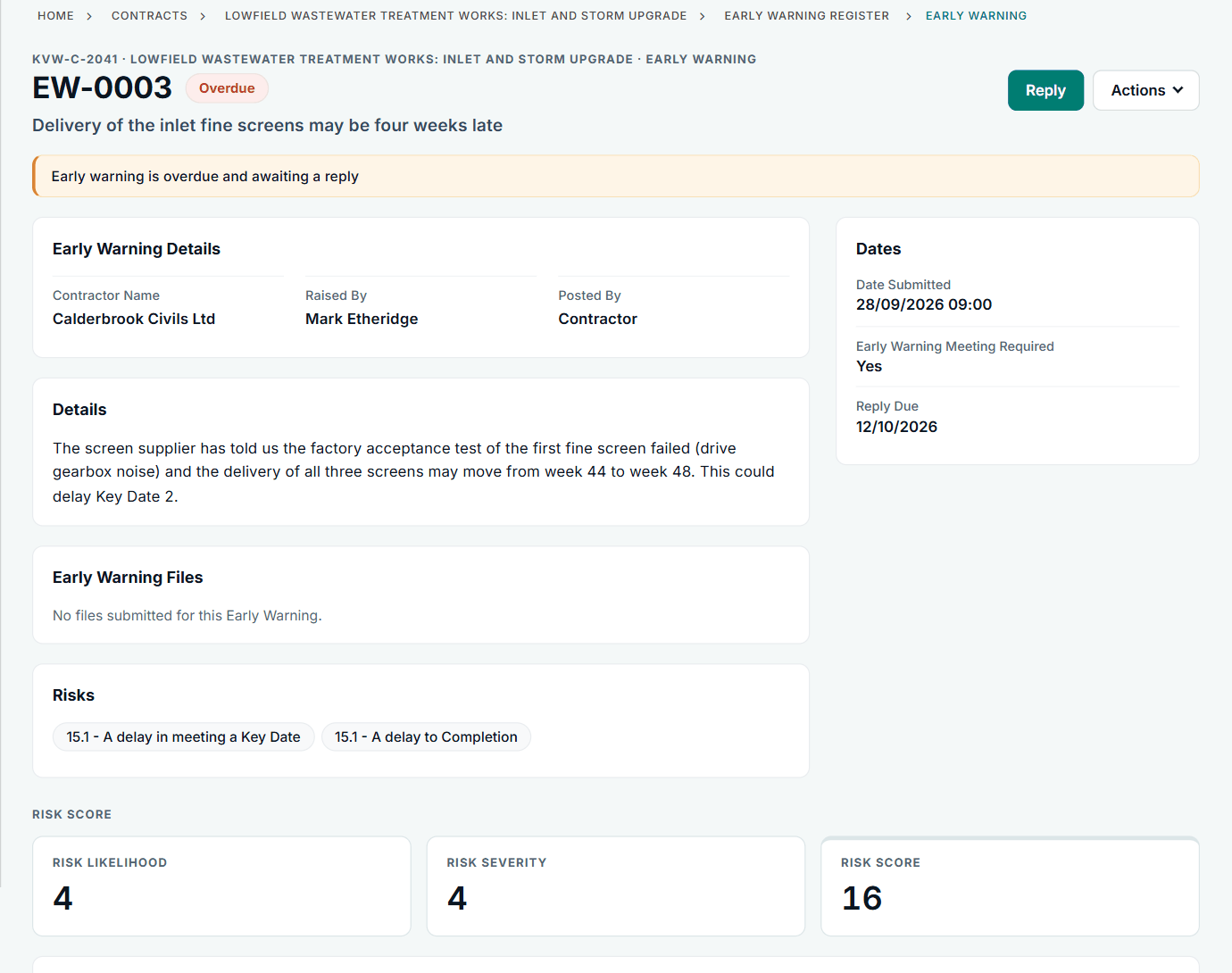
An early warning in Contract Status, with its risks, reply date and score. See the worked example.
See how this works in practice
Click through Contract Status with sample contracts: raise the notice, reply to it, and watch both sides of one record.
Take the guided tour Book a demo
Use the NEC deadline calculator, use the free NEC tools or download free NEC templates.
This guide is general information in our own words, not legal advice. Your contract and its Contract Data always govern. NEC, NEC3 and NEC4 are trade marks of Thomas Telford Ltd; Contract Status is not affiliated with or endorsed by NEC.