
You do, in most cases: a supplier delay under NEC is the Contractor's risk, because your suppliers are excluded from the definition of Others and no compensation event covers them. What could change that is the cause: whether the Client was to supply the item, whether the Scope demands something no longer obtainable, or whether something much bigger than a late delivery stopped the work.
That's the position in NEC3 and NEC4 ECC. It also applies to Subcontractors, as clause 26.1 makes you responsible for subcontracted work as if you had done it yourself.
Check which case you're in
| Cause | Position |
|---|---|
| Your supplier is late: production slot, shortage, transport, insolvency | Your risk. No event |
| You relied on a supplier named or preferred in the Scope | Still a supplier of yours, so it's still normally your risk, unless the Scope says otherwise or a Z clause helps |
| Client was to provide the item by a date on the Accepted Programme | 60.1(3): the Client's risk |
| Delivery late because the Project Manager's acceptance of your design or submission came late | 60.1(6) may apply to the reply. Your supplier's knock-on delay is part of the effect |
| A specified product has been withdrawn, so the Scope can't be met | Notify under 17.2 (NEC3 ECC: 18.1). If the requirement is impossible, an instruction changes the Scope and 60.1(1) applies |
| An event no one could prevent stops the whole job, and it's outside ordinary supply risk | Test it against 60.1(19). A late delivery won't normally pass |
What to tell the Project Manager, and when
- Give an early warning as soon as you know. A late delivery that could delay Completion or a Key Date falls within 15.1 (NEC3 ECC: 16.1). It isn't optional just because the risk is yours.
- Ask for an early warning meeting. Ask the Project Manager whether the Client can help, for example by releasing a different work face, or accepting an alternative product.
- Get a dated recovery commitment from your supplier, and look at second sources straight away.
- Show it honestly on your next programme. Clause 32.1 requires the effect of progress, and how you plan to deal with delay, on each revised programme.
- Review your supply contract. Your remedy, if any, lies there, and there's often a notice period. Check it today.
- Look at delay damages exposure. If Option X7 applies, work out what each week of slip costs you, so you can compare it with the cost of expediting.
Sample warning: "We give an early warning under clause 15.1. [Supplier] now forecasts delivery of [item] on [date], against [date] needed for [activity]. This could delay planned Completion by [X] days. We are exploring [air freight / alternative supplier / resequencing] and propose an early warning meeting this week."
Fictional example
A bridge deck on Option A, with illustrative figures. The bearings' manufacturer warns of a six-week slip, against a planned Completion that has two weeks' float to the Completion Date. Delay damages are £9,000 a week.
| Option | Extra cost to Contractor | Weeks late | Delay damages | Total |
|---|---|---|---|---|
| Accept the slip | £0 | 4 | £36,000 | £36,000 |
| Airfreight, recovering 3 weeks | £14,000 | 1 | £9,000 | £23,000 |
| Change sequence and add a weekend gang, recovering 4 weeks | £30,000 | 0 | £0 | £30,000 |
None of these goes to the Client, but the numbers show the Contractor's cheapest route is airfreight, and they give a clear plan for the next revised programme.
What the Main Option changes
On Options A and B, you carry the cost of recovery yourself. On C and D, those costs are normally Defined Cost, and flow through the share, subject to the Disallowed Cost rules. On Option E, the Client carries more of the cost. In each case the Completion Date doesn't move.
What the Project Manager may say or do
They may ask for a revised programme (32.2), and reject one that doesn't realistically show the delay, under 31.3. They can't instruct you to accelerate. But they can notify you if a Key Date is going to be missed, and pass on the cost under 25.3 where it applies. Expect questions about when you first knew, as a failure to warn can also affect the assessment of any linked compensation event.
Contract position against practice
The contract says the risk is yours, and asks you to warn. In practice, telling the Project Manager early is what gets you help with sequence, substitutes and access, and a Client who knows about the problem has fewer surprises to react badly to. Fear of admitting liability is common, but see the question of whether a warning admits liability. See also rising material prices and NEC questions answered.
Related guides
- NEC Questions Answered: Real Situations on Site
- Material Prices Have Risen Sharply: Can We Recover the Increase?
- We Cannot Get Enough Labour: Is There Any Relief?
- An Event Beyond Anyone's Control Has Stopped Work
- Another Contractor Is Delaying Us: Is That a Compensation Event?
- A Utility Company Is Late: Who Takes the Risk?
How this looks in Contract Status
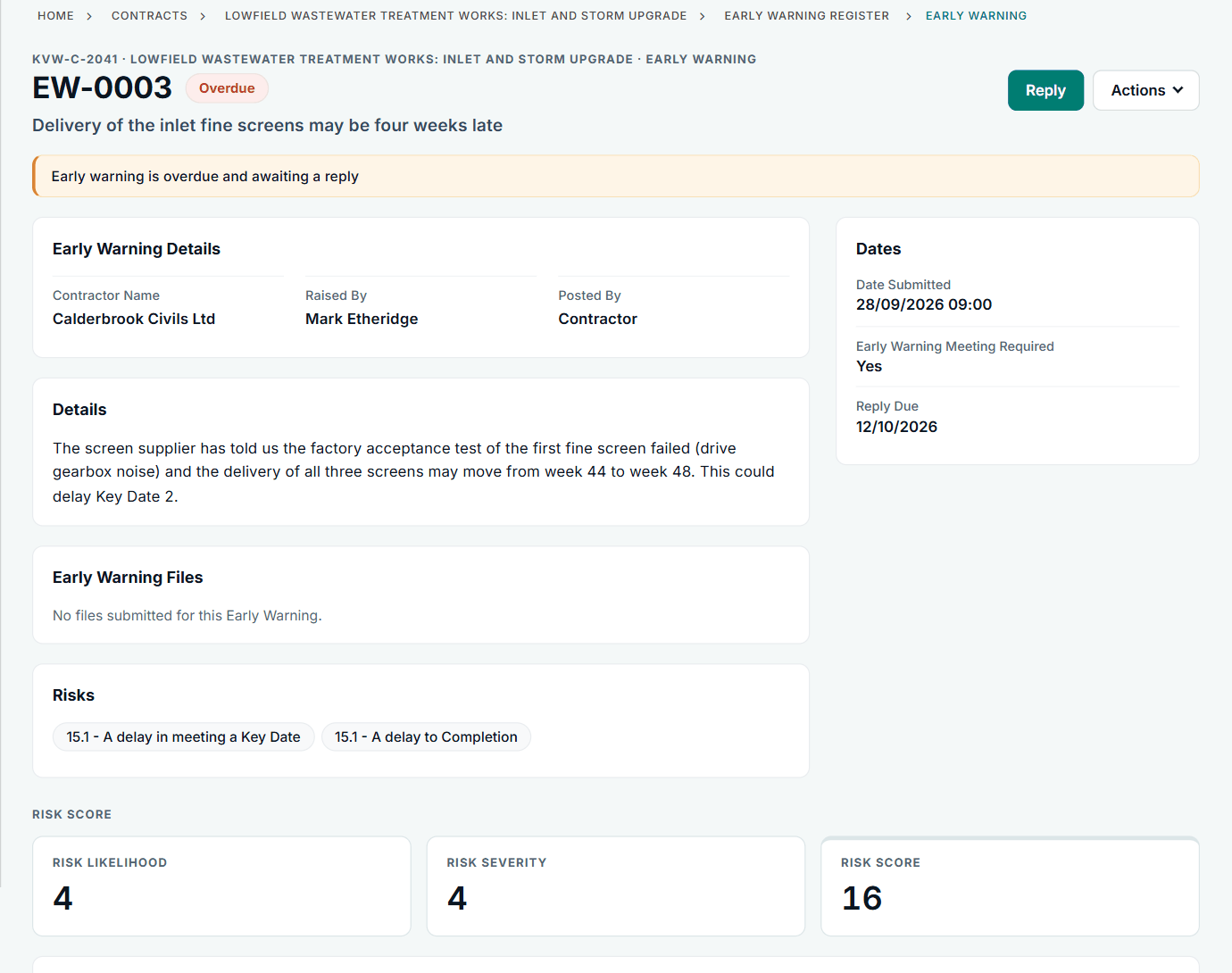
An early warning in Contract Status, with its risks, reply date and score. See the worked example.
See how this works in practice
Click through Contract Status with sample contracts: raise the notice, reply to it, and watch both sides of one record.
Take the guided tour Book a demo
Use the NEC deadline calculator, use the free NEC tools or download free NEC templates.
This guide is general information in our own words, not legal advice. Your contract and its Contract Data always govern. NEC, NEC3 and NEC4 are trade marks of Thomas Telford Ltd; Contract Status is not affiliated with or endorsed by NEC.