
Only if the numbers say so: bad weather is an NEC compensation event when a measurement for a calendar month, recorded before the Completion Date at the place named in the Contract Data, is shown by the weather data to occur less often than once in ten years. How wet the job felt, or how many weeks it lasted, doesn't decide it.
The rule is 60.1(13), in NEC3 and NEC4 ECC. Your own site experience doesn't count towards the test. The figures from the named weather station do.
Do this before the argument starts
- Find the entries in Contract Data part one: the measurements, the place, who supplies them, and which past data applies.
- Get the one-in-ten figure for each month and each measurement, and agree it with the Project Manager if it isn't stated. The guide to proving a weather event shows how.
- Give an early warning now. Weeks of rain threatening Completion is a matter to warn of under 15.1, whatever the eventual test says.
- When the monthly figures come in, compare them straight away. If a measurement passes, notify the event. The time bar is eight weeks from when you become aware it has happened (61.3; seven weeks under NEC4 ECS), and you can notify an event you expect to happen as the figure builds.
- Keep daily records of the effect: what was stopped, why, and what you did instead.
- If no measurement passes, stop spending time on the claim and turn to recovery on the programme.
Why "it's rained for weeks" may not be enough
| What the team says | What the test looks at |
|---|---|
| Six weeks of rain | One calendar month at a time. Two wet halves of two months may each fall short |
| Our rain gauge recorded 160mm | The measurement at the Contract Data place from the named supplier |
| Worst autumn anyone can remember | Past records for the same calendar month, using the one-in-ten comparison |
| We lost 15 days | Only the excess over the one-in-ten level is taken into account |
| Ground is still wet, weeks later | The event is the weather measurement. Lingering effects need to be tied back to the excess |
A worked example
A fictional Option A earthworks contract, with illustrative figures. Across late October and November, the Site has 31 wet days. The named station's results are:
| Month | Days over 5mm, recorded | One-in-ten level | Excess |
|---|---|---|---|
| October | 11 | 12 | None |
| November | 15 | 13 | 2 days |
The team's feeling of a seven-week wash-out comes down to two days of excess in November. The Contractor shows that those two days stopped earthworks and pushed planned Completion by two days. At an illustrative £8,000 a day in running costs and standing plant, the Prices rise by £16,000 plus the Fee, and the Completion Date moves two days. Everything else was a risk the Contractor priced.
The measure doesn't have to be days. Monthly rainfall totals might pass on their own, and the assessment then has to translate those extra millimetres into lost working time with a reasoned method. The detail is in the guide to the weather compensation event.
Where weather falls outside the test, what then?
- Priced Options, A and B. The Contractor carries the cost and time.
- Target Options, C and D. Cost goes into Defined Cost and through the share, but neither target nor date moves.
- Cost reimbursable, E. The Client pays the cost, and the date stays put.
- The prevention event, 60.1(19). Don't count on it as a fallback. Near-miss weather has its own test, and prevention only applies to an event that isn't one of the other compensation events.
What the Project Manager will reply
If no measurement passes, the reply under 61.4 is simple: this isn't an event listed in the contract. If it does pass, expect a challenge on the amount: the excess is small, you could have worked elsewhere, and your programme had time for the wet months. If you're a Project Manager, ask for the source data and the method linking excess to lost time.
In practice
The contract gives you a hard rule, and it's worth saying so to site teams early, before they promise anything to subcontractors. Be careful with terms in subcontracts too, as a main contract weather test doesn't help a subcontractor unless its own terms and data line up. Show realistic wet-weather allowances on your programme, using the time risk allowance. For the wider position on weather damage rather than lost time, see the site flooded, and for other reader questions, NEC questions answered.
Related guides
- NEC Questions Answered: Real Situations on Site
- How Do We Prove a Weather Compensation Event?
- Snow or High Wind Stopped Work: Is That Covered?
- The Site Flooded: Who Is Responsible Under NEC?
- We Found Asbestos During the Works: What Do We Do?
- We Found Archaeology on Site: Who Pays?
How this looks in Contract Status
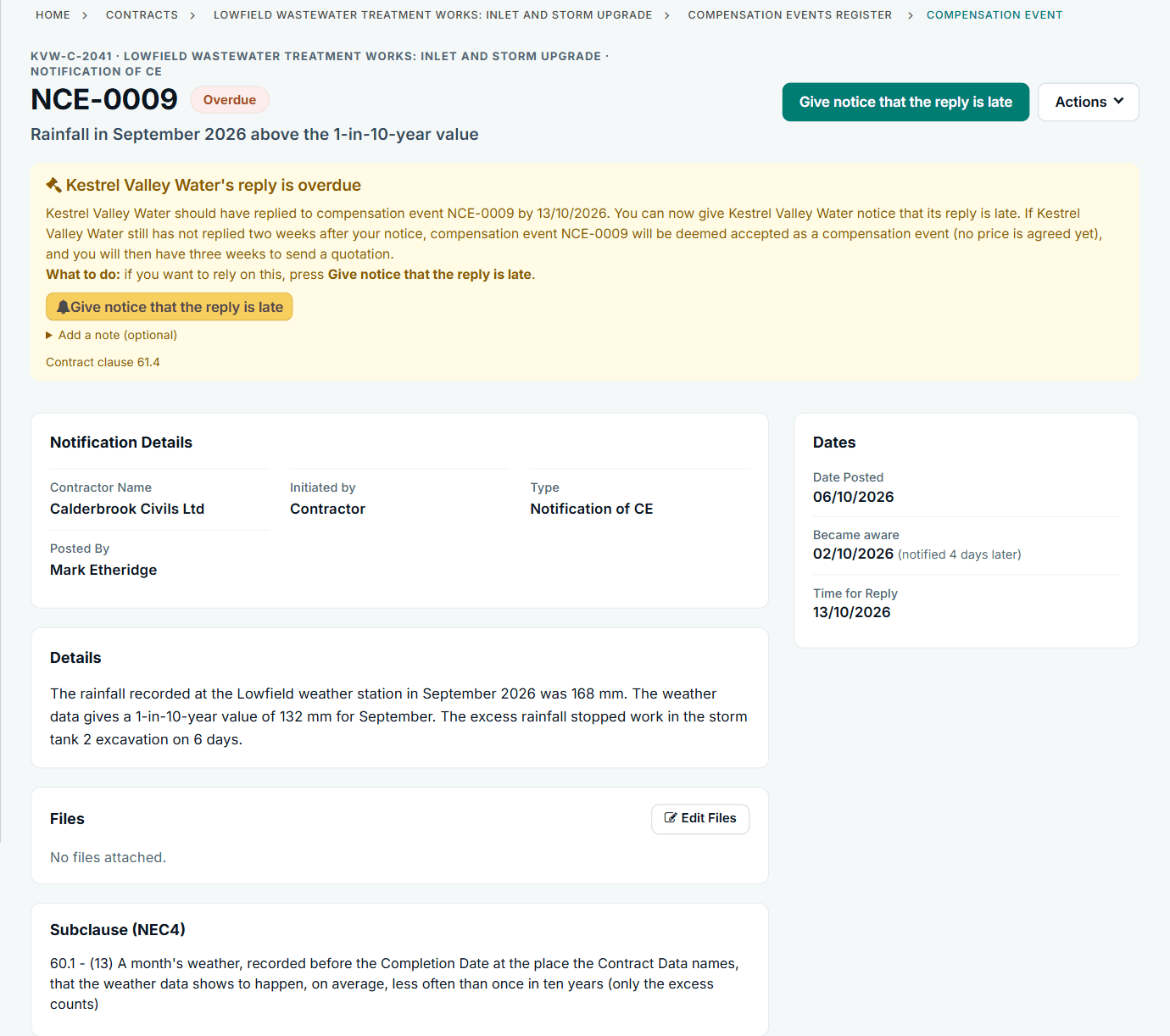
A weather event notified with the recorded figure against the one-in-ten value. See the worked example.
See how this works in practice
Click through Contract Status with sample contracts: raise the notice, reply to it, and watch both sides of one record.
Take the guided tour Book a demo
Use the NEC deadline calculator, use the free NEC tools or download free NEC templates.
This guide is general information in our own words, not legal advice. Your contract and its Contract Data always govern. NEC, NEC3 and NEC4 are trade marks of Thomas Telford Ltd; Contract Status is not affiliated with or endorsed by NEC.