
It depends on what caused the danger. If you stop work for safety because of your own failing, the cost is yours; if the cause sits on the Client's side of the contract, or the Project Manager instructs the stop, it can be a compensation event. Stopping isn't itself on the 60.1 list, so the cause is what decides who pays.
Make the site safe first and argue about money later. Nothing in the contract's commercial rules overrides your legal safety duties. The clauses below are NEC4 ECC, and NEC3 is the same except where noted.
What to do, with the clock
- Stop and make safe. Record who decided, when and why, with photographs.
- Tell the Project Manager straight away, and give an early warning under 15.1 if time or cost could be affected.
- Ask for an instruction. Ask the Project Manager to instruct under 34.1 that the work stays stopped, or how to deal with the hazard. An instruction gives you a cleaner event.
- Identify the event using the table below, and diarise eight weeks from your awareness of it under 61.3 (seven in the NEC4 subcontract).
- Keep daily records of people and plant stood down, and what you did to reduce the cost.
- Restart only when it's safe, and record the date and the reason.
Follow the cause
| Cause of the danger | Likely route | Notes |
|---|---|---|
| Your own unsafe method, or a Subcontractor's | No event | Clause 27.4 requires you to follow the Scope's health and safety requirements, and 26.1 makes you answerable for Subcontractors |
| The Project Manager instructs a stop | 60.1(4) | Unless it arises from your fault, which removes the benefit through 61.2 and 61.4 |
| The Client or Others on site work outside the Accepted Programme or the Scope's conditions | 60.1(5) | For example, a Client's other contractor undermines your excavation |
| Unforeseeable physical conditions within the Site, such as an unrecorded live service | 60.1(12) | Only the difference from what you should have allowed for counts |
| A matter the conditions list among the Client's liabilities | 60.1(14) | NEC3 refers to the Employer's risks |
| A very unlikely event neither Party could prevent, which stops you completing | 60.1(19) | A high test. The Project Manager may instruct under 19.1 |
| The Client breaching a duty, with no other event fitting | 60.1(18) | See when no event fits |
A fictional example
A groundworks gang smells gas while excavating near a boundary. The Contractor clears the area and calls the gas network, which finds an unrecorded main. Work in that zone stops for six days. The drawings in the Site Information don't show it, and a survey wouldn't have found it. The Contractor warns the same day, asks for an instruction, and notifies under 60.1(12) the next day. The evidence is the network's report, the survey and its daily records of the stood-down gang. Figures are illustrative: £9,000 and four days' delay to planned Completion.
Had the Contractor's own permit system been ignored and a known main struck, the same six days would have been its own cost.
Sample wording
"We stopped work at [location] at [time] on [date] because [hazard]. Nobody has returned to the area. We believe this arises from [cause] and is a compensation event under clause [60.1(x)]. Please instruct under clause 34.1 or say how you wish the matter dealt with. Records of stood-down resources are attached and will continue daily."
Contract against practice
The contract says what changes the Prices and dates. It doesn't list "the Contractor decided to stop" as an event, so naming the cause matters. In practice, never let that delay a safety decision. Nobody should stay in danger because a compensation event looks uncertain. Your statutory duties come from the law, including the health and safety legislation that applies to construction work, and they apply whatever the commercial result turns out to be.
What the Project Manager may say
Expect "your risk assessment should have spotted it", or "an experienced contractor would have allowed for that". Answer with what the Site Information showed, and what a reasonable check would have revealed. The Project Manager may also ask whether the whole site had to stop, so record why the area and duration were needed.
A serious, continuing breach by the Contractor can itself lead to termination reason R15, after notice. If the Project Manager has instructed the stop, see what to do after a stop instruction. Similar site problems are collected in the NEC questions hub.
Related guides
- NEC Questions Answered: Real Situations on Site
- The PM Told Us to Stop Work: What Should We Do?
- The Work Has Been Suspended for Months: Can We Terminate?
- The Client Wants to End the Contract: What Are the Options?
- Our Main Contractor Has Not Paid Us: What Can a Subcontractor Do?
- Should a Subcontractor Warn the Main Contractor or the PM?
How this looks in Contract Status
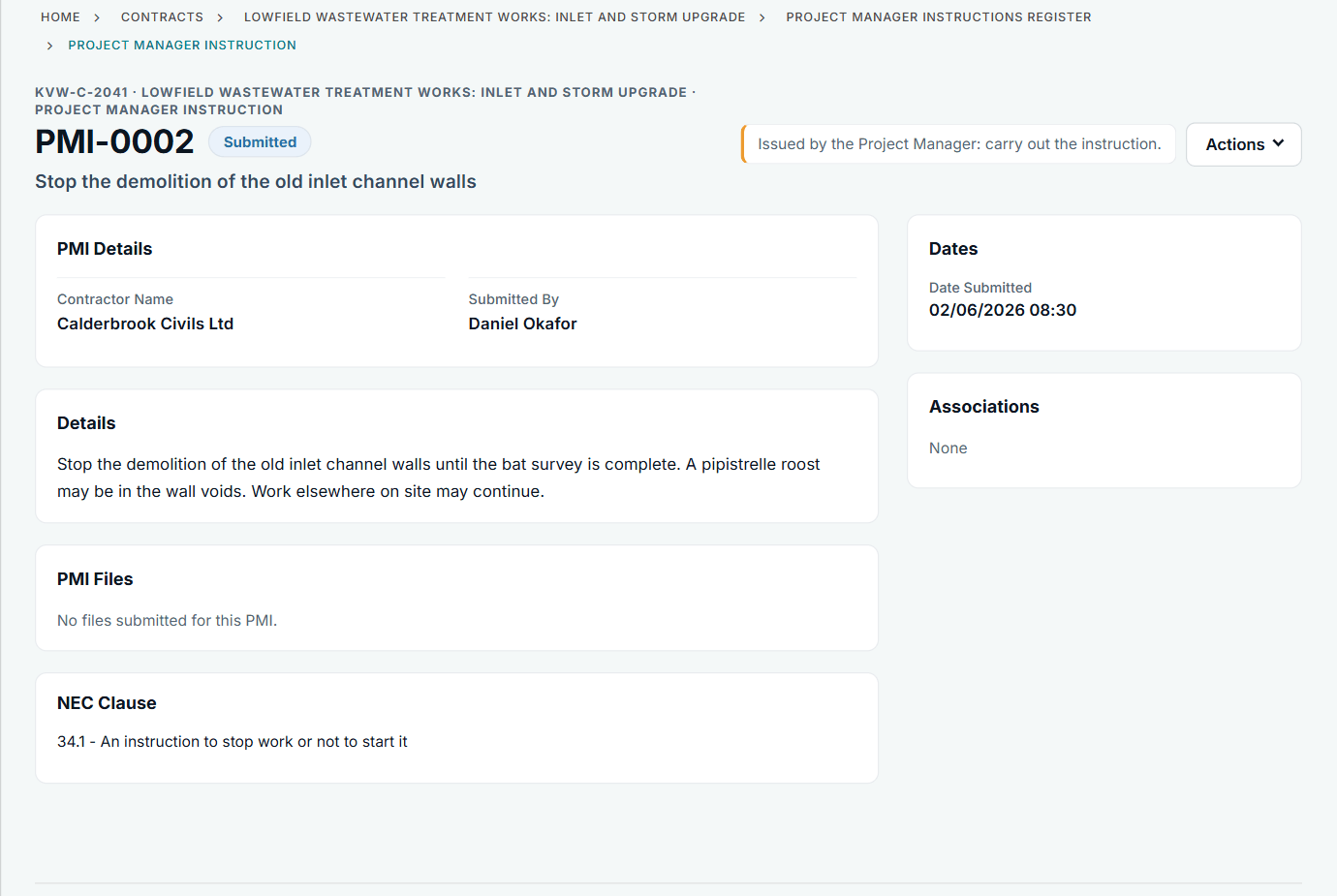
A stop instruction under 34.1, from the Contractor side. See the worked example.
See how this works in practice
Click through Contract Status with sample contracts: raise the notice, reply to it, and watch both sides of one record.
Take the guided tour Book a demo
Use the NEC deadline calculator, use the free NEC tools or download free NEC templates.
This guide is general information in our own words, not legal advice. Your contract and its Contract Data always govern. NEC, NEC3 and NEC4 are trade marks of Thomas Telford Ltd; Contract Status is not affiliated with or endorsed by NEC.