
Possibly, if the work stopped because of a Project Manager's instruction and it has run for the full stated period. A long suspension under clause 91.6 lets a Contractor terminate only where substantial work or all work was stopped by instruction, no restart has been given, and the instruction wasn't due to the Contractor's default.
A job that's just gone quiet with no instruction doesn't meet that test. Who caused the stop then decides the reason and the amount you'd be paid.
The test and the count
| Form | Period without a restart |
|---|---|
| NEC4 ECC | 13 weeks |
| NEC3 ECC | 13 weeks |
| NEC4 subcontract | 14 weeks, and removing the work from the Subcontract Scope also ends the count |
These are the unamended forms, and amended contracts may differ, so read your own 91.6 too. Count from the date of the stop instruction. Under NEC4, an instruction taking the work out of the Scope also answers the stop, so check nothing like that has come in.
Who may use it, and what it pays
| Why the instruction was given | Reason | Who may terminate | Amount due |
|---|---|---|---|
| Client's default | R19 | Contractor | A1, A2 and A4, which includes a fee on the unearned balance |
| Anything else, such as a third party or planning problem | R20 | Either Party | A1 and A2, with no fee on the balance |
| Contractor's default | R18 | Client only | A1 and A3, with the forecast extra cost of completion deducted |
The difference between R19 and R20 can be large, so expect it to be the main argument. The amount due on termination explains the items. Note that R20 also lets the Client end the contract, so a long pause can work in either direction.
What to do now
- Find the instruction. Note its date, what it covers and the reason given. If there isn't one, ask the Project Manager to confirm the position in writing.
- Check that "substantial work or all work" fits. A pause on one small section probably won't.
- Keep the compensation event alive. Clause 60.1(4) continues to run, whatever you decide about termination. Update assumptions and quotations as the stop goes on.
- Write before the period ends. Ask when a restart is expected. This gives the Client a fair chance to act, and it helps your evidence.
- Work out the numbers both ways. Often, a settled exit or a restart at a revised price is worth more than the Table.
- Take legal advice, then notify the Project Manager and the Client, giving the reason (90.1).
- Wait for the certificate. The Project Manager issues it promptly if the reason complies. Don't leave site before then.
If there's no stop instruction
When work has dried up because access, information or decisions haven't arrived, 91.6 doesn't help directly. You'd look to the specific compensation events such as 60.1(2), 60.1(3) or 60.1(6), or to breach under 60.1(18). Unpaid sums have their own route through R16: see all the Contractor's termination reasons. It's reasonable to ask the Project Manager to issue a formal instruction, which would start the count and bring clarity.
A dated example
A fictional water treatment job. On 6 January, the Project Manager instructs all work on the process building to stop because the Client's permit has been challenged. By 7 April, 13 weeks have passed with no restart. There's no Client default in the permit challenge, so the Contractor looks at R20. It would receive A1 and A2, but not the fee on the unearned balance. It offers the Client a restart with revised dates first, and diarises a decision date. Dates are illustrative.
Sample letter
"You instructed us on [date] under clause 34.1 to stop [work]. No instruction allowing the work to restart, or removing it from the Scope, has been given. The period in clause 91.6 ends on [date]. Please tell us by [date] when you expect to instruct a restart. We reserve our rights under Section 9."
What the other side may argue
- The stopped work isn't substantial.
- The stop was due to your default, so you can't use R19 or R20.
- A partial restart ended the count.
- The cause wasn't a Client default, so R20 rather than R19 applies.
Terminating without a valid reason can leave you in breach, and the Project Manager should refuse to issue a certificate. Disputes about a refusal go through your W Option. See what to do when the PM stops work, the wider list of termination reasons and the NEC questions hub.
Related guides
- NEC Questions Answered: Real Situations on Site
- The Client Wants to End the Contract: What Are the Options?
- Can a Contractor Terminate an NEC Contract?
- Our Contractor Has Gone Insolvent: What Does the Client Do?
- We Stopped Work for a Safety Reason: Who Pays?
- The PM Told Us to Stop Work: What Should We Do?
How this looks in Contract Status
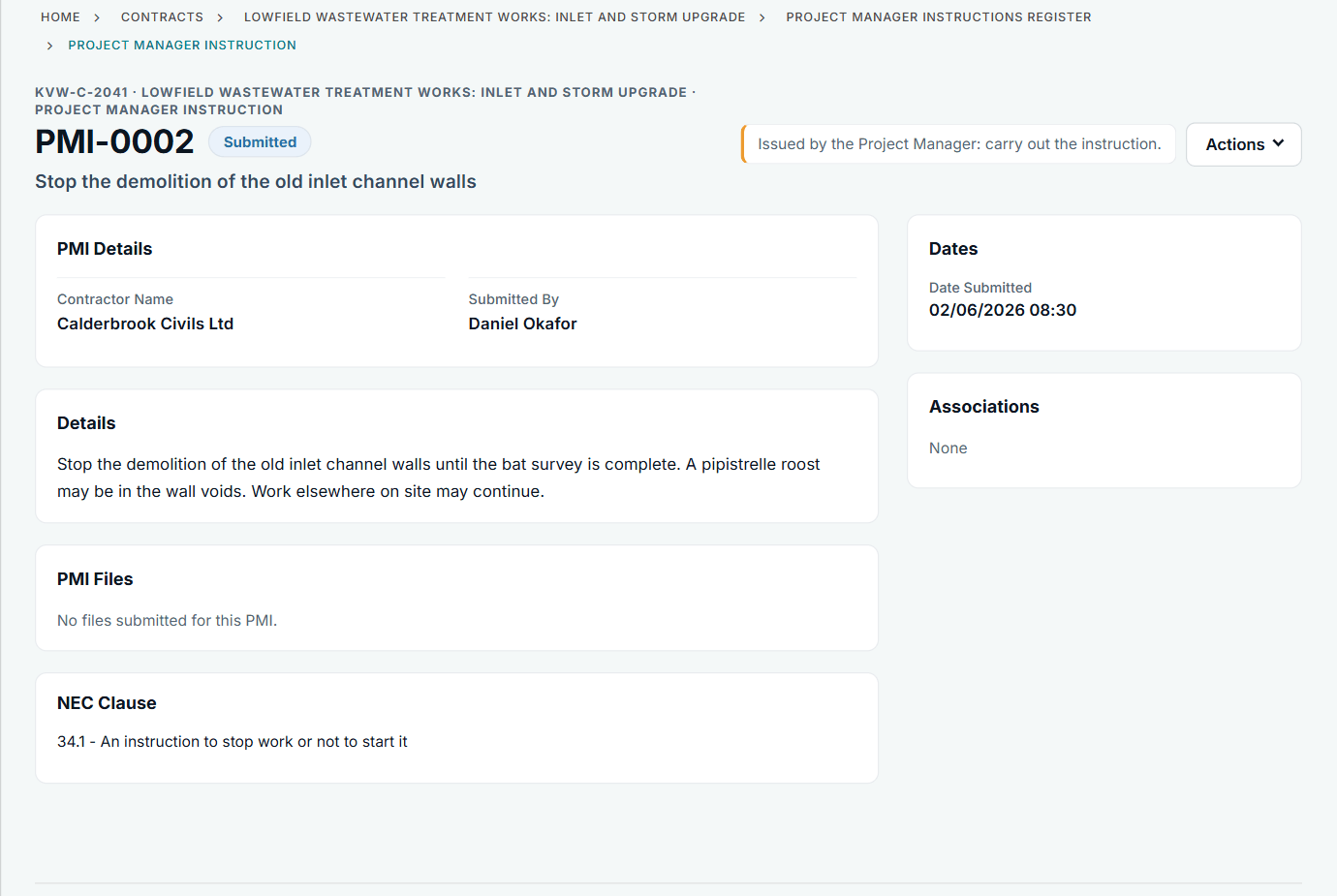
A stop instruction under 34.1, from the Contractor side. See the worked example.
See how this works in practice
Click through Contract Status with sample contracts: raise the notice, reply to it, and watch both sides of one record.
Take the guided tour Book a demo
Use the NEC deadline calculator, use the free NEC tools or download free NEC templates.
This guide is general information in our own words, not legal advice. Your contract and its Contract Data always govern. NEC, NEC3 and NEC4 are trade marks of Thomas Telford Ltd; Contract Status is not affiliated with or endorsed by NEC.