
Yes, you have a remedy: if the contractor won't correct a defect under NEC, the Project Manager assesses what it costs the Client to have other people do it, and the Contractor pays that amount. It depends on two facts: the Defect was notified, and the Contractor was given access but didn't correct it within the defect correction period.
That rule is clause 46.1 of the NEC4 Engineering and Construction Contract (ECC), and 45.1 in NEC3. Get these conditions in place before you bring anyone else in, because doing it in the wrong order is the most common mistake here. The parent page is NEC questions answered.
Steps, in the order that protects the Client
- Check the notification. Is there a written notification from the Supervisor? If not, send one today and note the date. See notifying Defects.
- Work out the due date. The period runs from Completion for Defects notified before Completion, and otherwise from notification. If it needs access to a taken-over part, it starts when access is given (44.4).
- Offer access in writing, with dates and any conditions. The offer is your evidence.
- Send a dated reminder before the period ends. The contract doesn't require this, but it removes arguments.
- When the period has passed, get a price. Keep the quotation or invoice, along with records of the Client's own management cost.
- Project Manager: assess and notify. State the Defect, dates, access given and the cost. It then goes into the amount due as a sum payable by the Contractor (clause 50).
- Record the closure. The Scope is then treated as changed to accept the Defect, so the item comes off the register as closed by assessment.
Sample wording, in our own words
"Defect [reference] was notified on [date]. The defect correction period ended on [date]. Access was offered on [dates] and the Defect hasn't been corrected. Under clause 46.1 I have assessed the cost to the Client of having other people correct it at [£], made up as attached. This will be included in the next assessment as an amount to be paid by the Contractor."
Answers to the reasons you are likely to hear
| Contractor says | Position |
|---|---|
| "It's not a Defect" | Then it should say why against the Scope. If it isn't one, 46.1 doesn't apply. A search instruction (43.1) or the dispute route can test this. See when the two sides disagree |
| "It's the Subcontractor's fault" | The duty is the Contractor's. Its Subcontractor is its own problem |
| "We've no one available" | Not a reason. The period can be longer only if the Parties agree |
| "You didn't let us in" | Then the access point is live, and a different, lower rule may apply. See no access to fix a defect |
| "We'll fix it, but only if you pay the final account" | The duties aren't linked in the contract. A dispute over payment has its own route |
| "Your price is too high" | A fair challenge. The assessment is of the cost, so keep evidence that the price is reasonable |
The numbers, with a fictional example
A housing association's new block, with illustrative figures. After Completion, failed render on a gable is notified on 3 March, with a four-week correction period and access given. It isn't corrected by 31 March. The Project Manager gets a quotation.
| Item | Amount |
|---|---|
| Specialist's price, including scaffold | £28,000 |
| Client's own project management and inspection | £2,200 |
| Assessed sum under 46.1 | £30,200 |
Clause 46.1 assesses the cost to the Client, which can be a higher sum than the original Contractor's cost. That is different from a 46.2 assessment, which only uses the Contractor's own saving.
Other tools
- Retention. Under Option X16, retention isn't a pot for defects. The route is the assessment. See when retention should be released.
- Repeated failure. A pattern can be a substantial failure to comply with obligations, which is the start of the default route under 91.2, reason R11. Take legal advice before notifying a default.
- Bonds or guarantees, if your contract has them.
- Dispute. Under Option W2, either side can adjudicate. Under W1, four weeks is running from when a Party became aware.
Contract position, against what works in practice
The contract doesn't require a meeting or a final warning, but one short call at director level has fixed plenty of these, because the Contractor can usually fix it for less than the 46.1 sum. Bringing in someone else before access has been offered and the period has passed risks the Client ending up with its own cost and a lower-value assessment, or none at all. If the issue is urgent, such as a safety risk, act to make it safe, write to the Contractor at once and keep costs apart. Then take advice on recovering them.
Related guides
- NEC Questions Answered: Real Situations on Site
- The Client Will Not Give Us Access to Fix a Defect
- The Supervisor Says the Work Is Defective but We Disagree
- A Test Failed: Who Pays for Retesting?
- A Defect Appeared After Completion: Who Fixes It?
- A Defect Appeared After the Defects Date: What Now?
How this looks in Contract Status
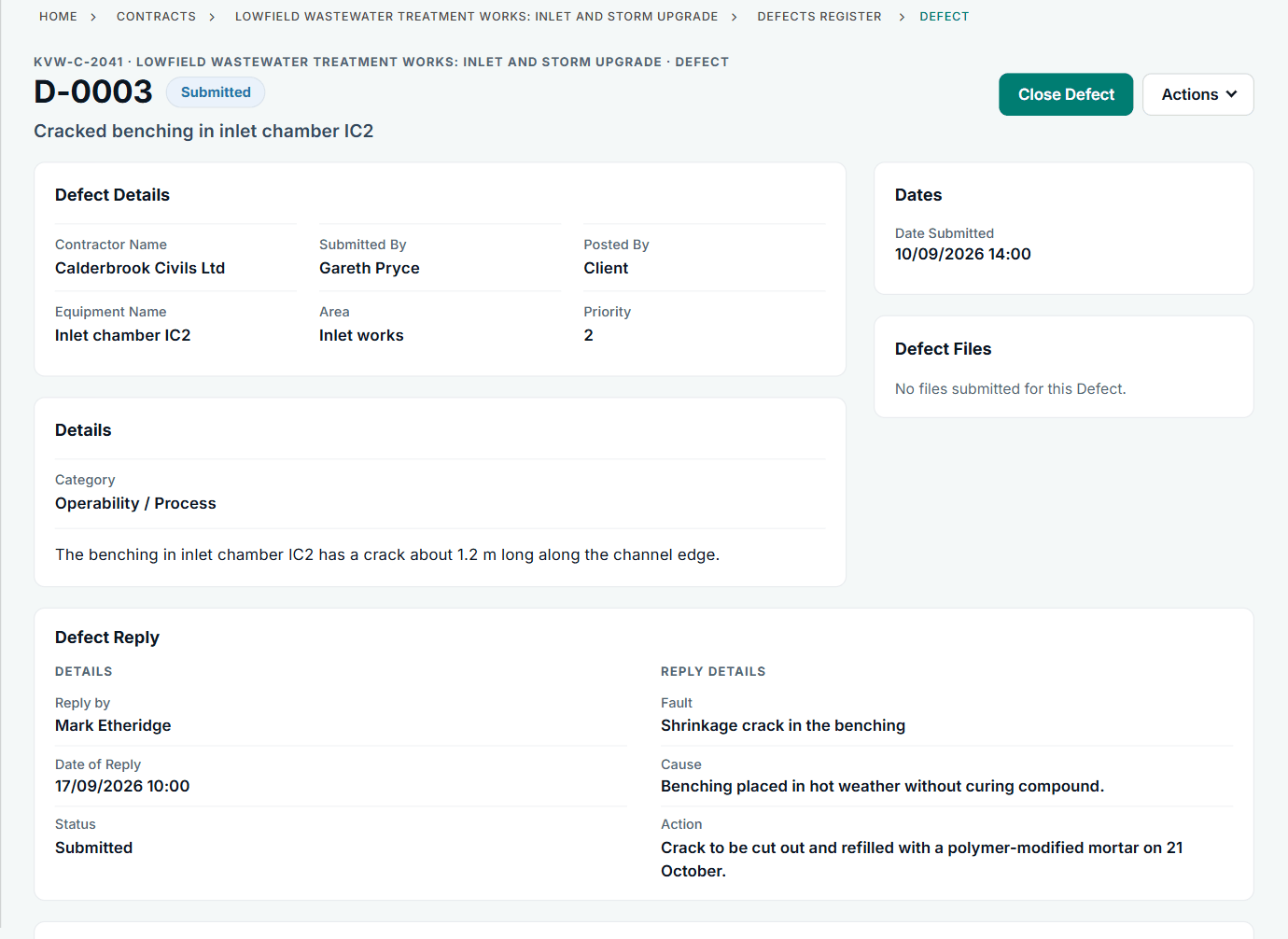
A Defect from the Client side, with the Contractor's reply on the record. See the worked example.
See how this works in practice
Click through Contract Status with sample contracts: raise the notice, reply to it, and watch both sides of one record.
Take the guided tour Book a demo
Use the NEC deadline calculator, use the free NEC tools or download free NEC templates.
This guide is general information in our own words, not legal advice. Your contract and its Contract Data always govern. NEC, NEC3 and NEC4 are trade marks of Thomas Telford Ltd; Contract Status is not affiliated with or endorsed by NEC.