
It depends on why the test failed. If the result shows a Defect, the Contractor corrects it, the test is repeated, and the Contractor pays the Client's assessed cost of the repeat. If there is no Defect, because the test itself was at fault or the Client let it down, the failed test cost may come back to the Contractor as a compensation event.
The rules are clauses 41.4 and 41.6 of the NEC4 ECC (40.4 and 40.6 in NEC3). The wider process is in our guide to NEC tests and inspections.
What to do this week
- Get the result in writing and note the date you learned of it. If a compensation event is possible, the eight weeks under 61.3 (seven in the NEC4 subcontract) count from your awareness of the event.
- Keep the evidence: retained samples, calibration records, the test method and who carried it out. Don't let them be thrown away while the cause is open.
- Decide the question: does this work actually fail the Scope? That is what makes it a Defect. A low reading alone doesn't.
- Give an early warning if the failure could delay Completion or a Key Date.
- Correct it within the defect correction period if it is a Defect, and arrange the repeat with proper notice under 41.3.
Who carries what
| Why it failed | Result under the contract | Clause (NEC4 ECC) |
|---|---|---|
| The work doesn't meet the Scope | Contractor corrects, test repeated, Contractor pays the Client's assessed repeat cost | 41.4, 41.6 |
| The Contractor's own design breaches the law or its accepted design | Also a Defect, with the same result | 11.2 definition, 41.4 |
| The work meets the Scope, but the Scope's requirement can't be achieved or is wrong | Not a Defect. A Project Manager's instruction changing the Scope is a compensation event | 60.1(1) |
| The Supervisor's test was badly run and caused needless delay | Compensation event | 60.1(11) |
| The Client didn't supply the materials, facilities or samples the Scope promised | Compensation event | 60.1(16) |
The money differs by main Option
Clause 41.6 only covers the cost to the Client of repeating the test, such as the Supervisor's testing house. The Contractor's own cost of correcting and retesting is treated separately.
- Options A and B: no extra payment. The Prices don't change, so the Contractor carries it.
- Options C, D and E: the cost of correcting a Defect after Completion is Disallowed Cost, as is one caused by ignoring a constraint stated in the Scope. A Defect corrected before Completion may therefore remain recoverable as Defined Cost, feeding through the target on C and D. These Options also state (41.7; 40.7 in NEC3) that the 41.6 assessment leaves out the Contractor's own cost of carrying out the repeat. See Disallowed Cost.
A worked example
A fictional culvert on Option A, with illustrative figures. Three of six cube results come back below the Scope's strength. The Contractor checks the supplier's dockets and the batch was wrong. It breaks out and recasts a section at £14,000 of its own cost. The Supervisor's lab charges £900 to repeat the tests, which the Project Manager assesses and the Contractor pays. Neither figure changes the Prices.
Now change one fact. The cores from the same pour pass, and the lab admits its curing tank failed. There is no Defect. The Contractor notifies 60.1(11) for the three days lost, with the lab's letter as evidence.
Sample wording if you dispute the result
"We notify the following as a compensation event under clause 60.1(11). The Supervisor's test on [date] of [work] reported a failure. Our investigation, attached, shows the work meets the Scope and the failure arose from [cause]. The repeat test on [date] passed. The delay to [activity] is [x] days. We will provide quotations when instructed."
What the other side will probably say
Expect the Supervisor to say a failed result is a Defect until proved otherwise. The contract doesn't state who has to prove what, but in practice the party with the better records tends to carry the argument, so independent retests and calibration certificates are worth having. A Project Manager may also assess a repeat cost that includes more than the repeat itself. Ask for the breakdown: the clause reaches the repeat, not the whole testing regime.
If you still disagree, the question can be referred under your disputes Option. The NEC questions hub lists related problems, including a Supervisor rejecting work.
Related guides
- NEC Questions Answered: Real Situations on Site
- The Supervisor Made Us Open Up Work and Found Nothing
- The PM Wants a Member of Our Team Removed: Can They?
- We Need to Replace a Key Person: What Is Required?
- The Client Will Not Give Us Access to Fix a Defect
- The Supervisor Says the Work Is Defective but We Disagree
How this looks in Contract Status
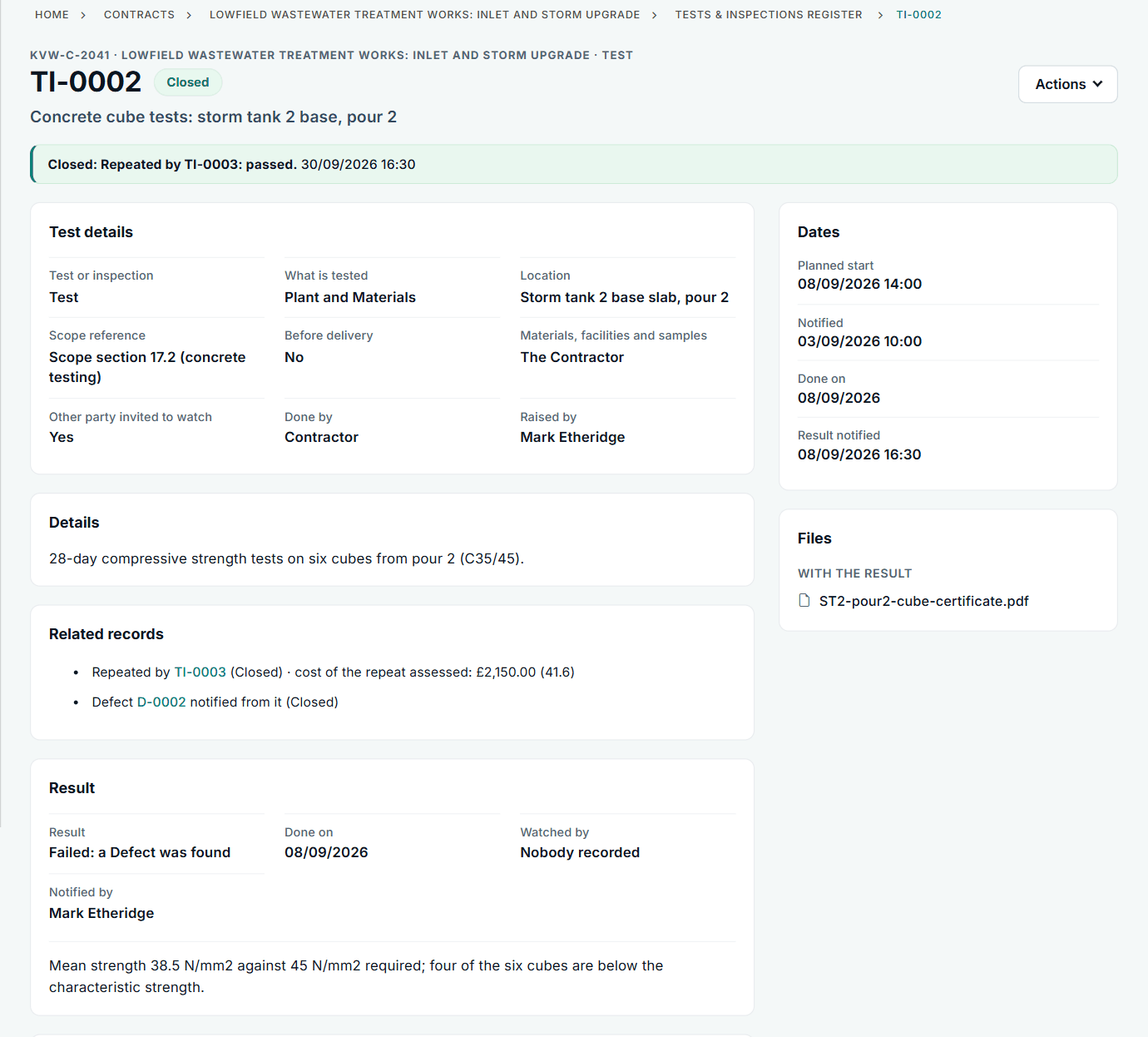
A failed test linked to its Defect and its repeat, with the cost of the repeat. See the worked example.
See how this works in practice
Click through Contract Status with sample contracts: raise the notice, reply to it, and watch both sides of one record.
Take the guided tour Book a demo
Use the NEC deadline calculator, use the free NEC tools or download free NEC templates.
This guide is general information in our own words, not legal advice. Your contract and its Contract Data always govern. NEC, NEC3 and NEC4 are trade marks of Thomas Telford Ltd; Contract Status is not affiliated with or endorsed by NEC.