
No, not on its own: a labour shortage under NEC is the Contractor's risk, so no compensation event gives you extra time or money for being unable to hire. Relief is possible only if something on the list of events is the real cause, such as Client-caused delay that pushed your work into a tighter market.
This is the same in NEC3 and NEC4 ECC. Clause 30.1 expects you to reach Completion by the Completion Date, and resourcing is part of that. Clause 26.1 means a Subcontractor's shortage is treated the same as your own.
Is it really just a shortage?
Before you write this off as your own problem, check the actual cause:
| Cause of the gap | Route |
|---|---|
| General market shortage, a Subcontractor can't staff the job, or people have left | None. Your risk |
| Named key person leaves | No relief. You replace them, with acceptance, under 24.1 |
| Client's late access or information moved your work into a period when your specialists are booked | Effect may be part of the underlying event, such as 60.1(2) or 60.1(6), if you can show the link |
| Project Manager instructs extra work needing more people | 60.1(1), assessed as a Scope change, at forecast Defined Cost |
| Strike by your own workforce | Your risk |
| Wider industrial action or a national event that stops the whole job | Test it against 60.1(19). A shortage alone won't pass |
| New law limiting who can work, after the Contract Date | Only if Option X2 is in your contract |
The liabilities list at 80.1 mentions strikes and similar events not confined to the Contractor's employees, but that deals with loss of or damage to the works, not with lost productivity. Don't quote it for a pure labour gap.
What to do now
- Size the gap by trade and week, against the resources stated on your Accepted Programme. Clause 31.2 asks the programme to identify principal resources, so the Project Manager has a baseline too.
- Give an early warning if Completion or a Key Date could slip (15.1; NEC3 ECC 16.1). There's no benefit in waiting, and you may also pick up ideas at the meeting.
- Check your subcontracts. If a Subcontractor can't staff the job, look at your rights against them and the notice periods.
- Price the recovery options against your delay damages exposure. Overtime, agency labour, off-site manufacture, or re-sequencing might each be worth it.
- Issue a revised programme showing the plan (32.1). Don't leave an optimistic programme in place that the Project Manager can reject as unrealistic.
- Separate genuine events from the shortage in your records, and notify any events within eight weeks of becoming aware (61.3; seven weeks under NEC4 ECS).
Worked example: a shortage and an event side by side
A fictional fit-out on Option C, with illustrative figures. M&E labour runs at 70% of plan for ten weeks. A separate instruction adds a plant room. The Contractor has to keep the two apart.
- The shortage costs an estimated three weeks. Agency cover at a premium gets back two, at an extra £44,000. Those costs are generally Defined Cost, subject to the Disallowed Cost rules, and the overrun passes through the share. The target and Completion Date don't move.
- The plant room is a compensation event. It's priced at the forecast Defined Cost of the extra work plus Fee, with the labour assumed at the rates and premiums reasonably expected at that time. The Contractor can't load the agency premium for the rest of the job into that quotation, because it isn't caused by this event.
How the Project Manager may respond
They may ask for a recovery plan and, under 32.2, a revised programme, and they may reject that programme if it isn't realistic (31.3). They can't instruct you to work faster, since acceleration needs agreement under clause 36. They may reasonably raise it at early warning meetings and keep track for delay damages. On cost-based Options they may query whether agency premiums are properly allowed.
Contract position against practice
The contract says no relief, but it does ask you to warn and to show a realistic programme. In practice, a labour problem told early is often easier to deal with than a programme that slips with no explanation. The Client may rather see a phased handover, or relax a working-hours restriction through a change to the Scope, than lose months. If it offers something like that, it may be a compensation event in your favour or may reduce the Prices, so agree how it's being treated first. If you're already behind, see what to tell the Project Manager, and find related situations in NEC questions answered.
Related guides
- NEC Questions Answered: Real Situations on Site
- An Event Beyond Anyone's Control Has Stopped Work
- The Client Wants Us to Finish Early: Must We Agree?
- We Are Running Behind Programme: What Should We Tell the PM?
- Our Materials Are Delayed by the Supplier: Who Takes the Risk?
- Material Prices Have Risen Sharply: Can We Recover the Increase?
How this looks in Contract Status
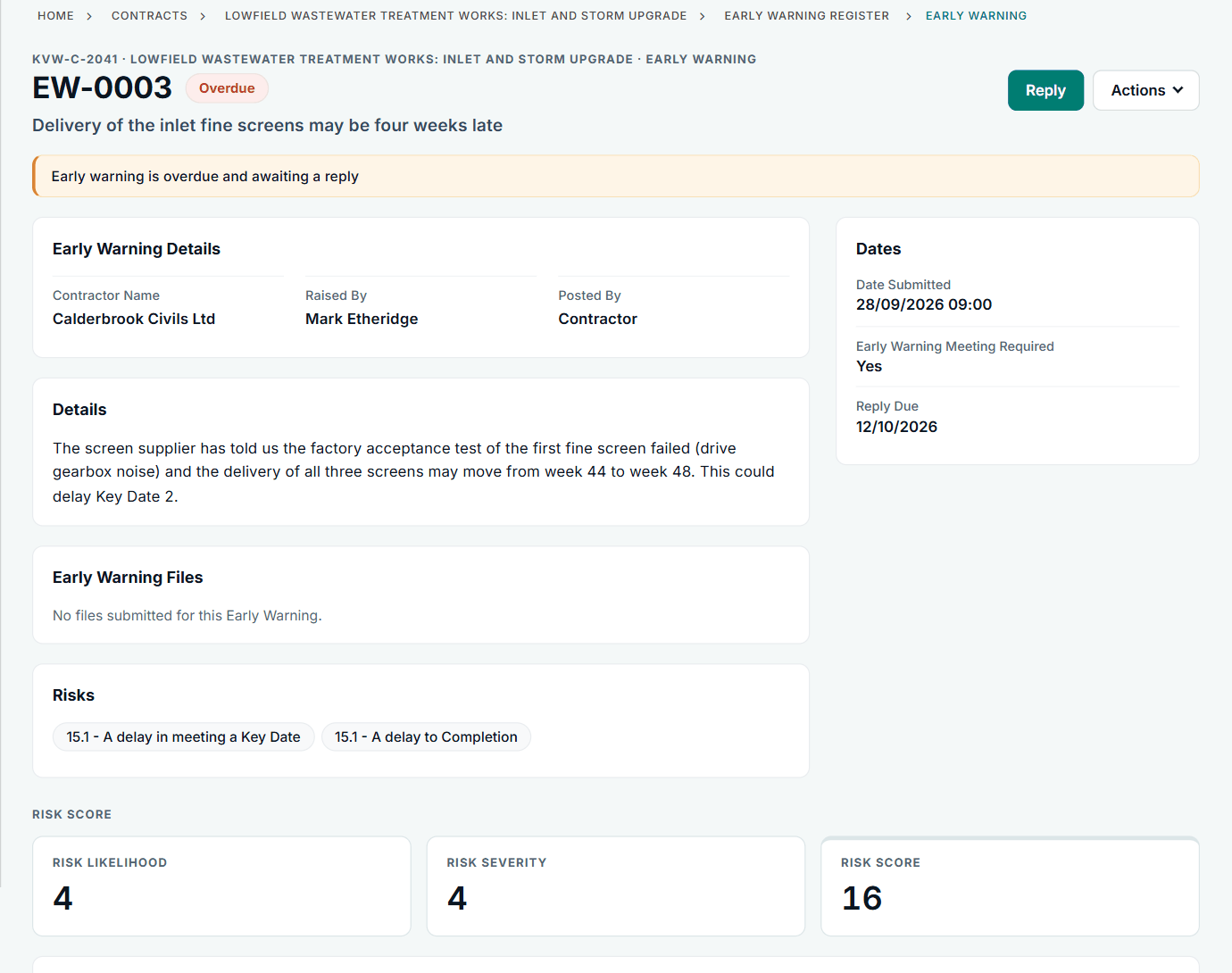
An early warning in Contract Status, with its risks, reply date and score. See the worked example.
See how this works in practice
Click through Contract Status with sample contracts: raise the notice, reply to it, and watch both sides of one record.
Take the guided tour Book a demo
Use the NEC deadline calculator, use the free NEC tools or download free NEC templates.
This guide is general information in our own words, not legal advice. Your contract and its Contract Data always govern. NEC, NEC3 and NEC4 are trade marks of Thomas Telford Ltd; Contract Status is not affiliated with or endorsed by NEC.