
You can usually still pursue the Contractor, but no longer through the contract's notify-and-correct routine. A defect after the defects date under NEC falls outside the duty to notify, so the Contractor has no period in which to come back, and the Client's remedy becomes a claim under the general law. It depends on any end of liability date under Option X18 and on limitation.
Clause 44.3 of the NEC4 Engineering and Construction Contract (ECC) keeps the Client's rights over a Defect that wasn't found or notified, even after the Defects Certificate is issued. NEC3 has the same idea. This is a question for legal advice if the sum is significant; this page sets out the contract position. It is linked from NEC questions answered.
What changes at the defects date
| Subject | Before the defects date | After, for a Defect not previously notified |
|---|---|---|
| Notifying (43.2) | Supervisor and Contractor have a duty | That duty has ended |
| Search instruction (43.1) | Available | Ended |
| Correction within a stated period (44.2) | Available | Doesn't apply to a Defect first found now |
| Assessment under 46.1 | Available, if access was given and the period was missed | Not available |
| Client's underlying rights | Preserved | Preserved (44.3), under the general law |
| Payment route | Through the amount due | A claim, or a dispute under the contract's dispute clauses |
Check the dates, because a Defect notified before the defects date still gets the contract's process, even if correction falls later. See the defects date explained guide.
What to do first
- Record it. Photographs, dates, who found it. Stop further damage, but keep the evidence: don't strip it out before an expert has seen it, if the sum is material.
- Dig out the contract. You want the Contract Data, Option X18 entries, Z clauses, any bond, parent guarantee, warranty or third party rights, and whether it was signed as a deed.
- Write to the Contractor promptly, describing it and asking for it to inspect. There is no contract period forcing the point, but a reasonable chance to look reduces later arguments, and your general-law remedy is damages rather than a right to have it fixed.
- Work out the end of liability date. Under Option X18, the Contractor isn't liable unless details are notified before that date: X18.6 in NEC4, X18.5 in NEC3. If X18 applies, this may be your most urgent date.
- Work out limitation. In England and Wales, the general periods are six years for a simple contract and twelve for a deed, usually counted from the breach. These run regardless of when you found the problem in many cases, and other rules apply in Scotland and for homes. Get advice on your facts.
- Tell insurers, if any latent defect or property cover exists.
Limits to check under X18
| Limit (NEC4 numbering, from the subcontract text) | Effect |
|---|---|
| X18.4 | Cap on liability for Defects due to its design that aren't listed on the Defects Certificate |
| X18.5 | Overall cap, with some matters excluded |
| X18.6 | Cut-off: no liability unless notified before the end of liability date |
Each applies only if your Contract Data fills it in. Option X18 covers these in more detail, and limitation of liability looks at the wider picture.
A fictional example
A warehouse with a defects date of 1 March 2028 and an end of liability date stated as six years after Completion. In October 2028, the roof sheeting starts to leak at the laps, which don't match the fixing detail in the Scope. Nobody knew earlier. The Contractor has no duty to correct under clause 44, but the Client writes, asks it to inspect and offers access. The Contractor agrees to carry out the repair for commercial reasons, without admitting liability. Had it refused, the Client would have repaired the roof, kept its costs and had a claim for damages, and a court or Adjudicator would then ask if the laps failed the Scope. The fictional dates are for illustration.
What the Contractor will probably say
- "The defects date has passed, so it isn't our problem." Wrong on the standard wording. 44.3 preserves the rights, unless a Z clause or X18 says otherwise.
- "You should have found it earlier." Relevant if it was obvious and missed, and worth checking against the inspection record. It doesn't by itself end the claim for a truly hidden Defect.
- "It's wear, or poor maintenance." Keep your maintenance records ready.
- "The Defects Certificate says there's nothing outstanding." It lists what had been notified. It isn't a release of what hadn't.
Practically, the original Contractor may still be the cheapest and best-informed party to fix the problem, so a commercial approach is often sensible. Consider the designer, supplier warranties and collateral warranties as well: each might give you a different route. Take legal advice before spending significant sums or relying on any of the dates.
Related guides
- NEC Questions Answered: Real Situations on Site
- The Contractor Will Not Fix a Defect
- The Client Will Not Give Us Access to Fix a Defect
- The Supervisor Says the Work Is Defective but We Disagree
- When Should Retention Be Released?
- A Defect Appeared After Completion: Who Fixes It?
How this looks in Contract Status
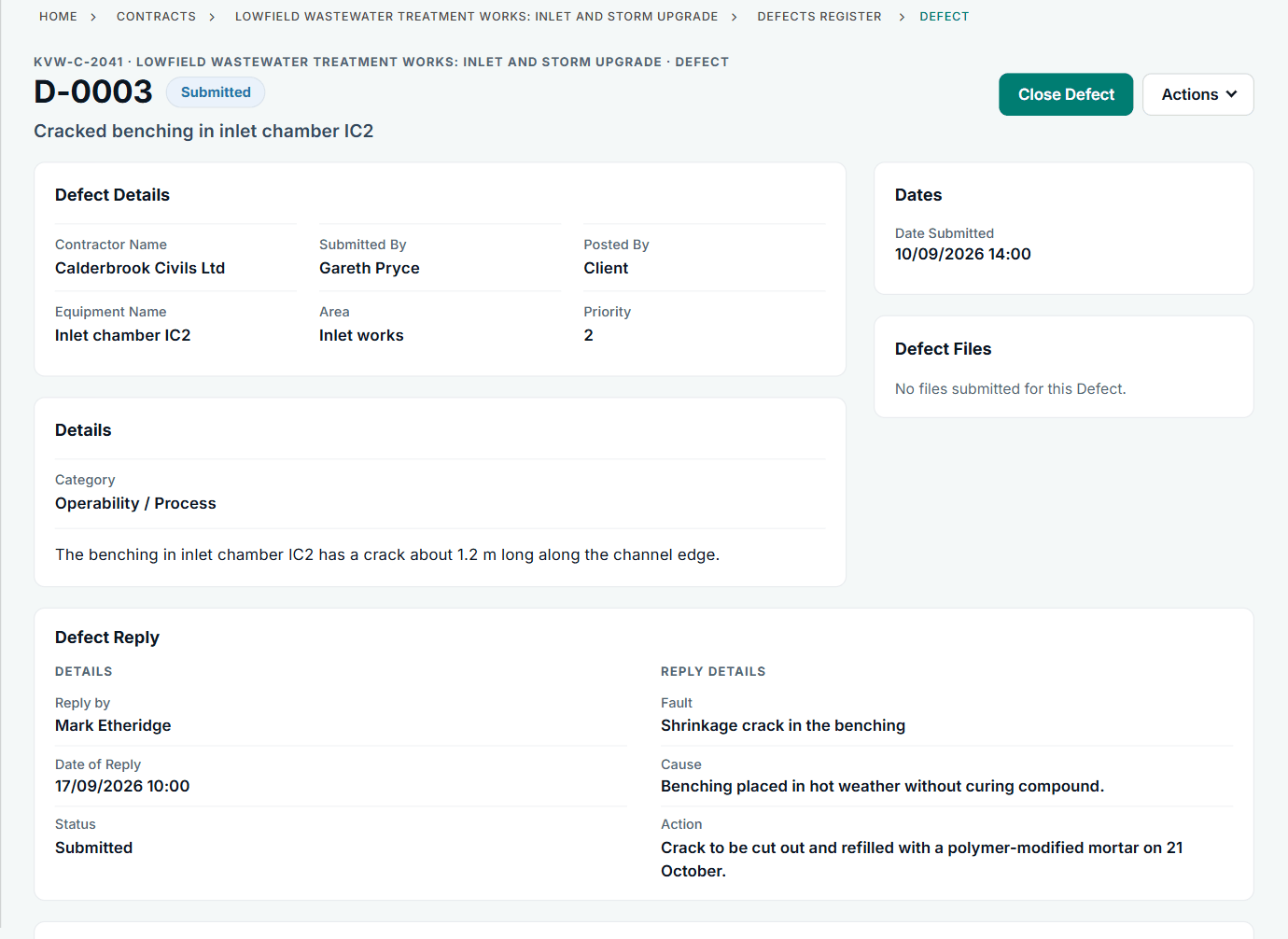
A Defect from the Client side, with the Contractor's reply on the record. See the worked example.
See how this works in practice
Click through Contract Status with sample contracts: raise the notice, reply to it, and watch both sides of one record.
Take the guided tour Book a demo
Use the NEC deadline calculator, use the free NEC tools or download free NEC templates.
This guide is general information in our own words, not legal advice. Your contract and its Contract Data always govern. NEC, NEC3 and NEC4 are trade marks of Thomas Telford Ltd; Contract Status is not affiliated with or endorsed by NEC.