
Ask the Project Manager to use a proposed instruction: under NEC4 ECC clause 65.1 the Contractor prices the change first, and nothing happens on site unless the instruction is later given. What decides whether it works for you is the date the Project Manager sets, because a late or missing reply means the price falls away.
This is one of the NEC questions we are asked most by people on live jobs. For the clause itself, see the guide to NEC4 proposed instructions.
What to do now
- Brief the Project Manager. Describe the change and the latest date you can decide. The Client doesn't instruct the Contractor directly; the Project Manager does.
- Issue the instruction to quote (65.1). It states the date by which the instruction may be given. Don't leave the date out.
- Allow for the quotation period. The Contractor has three weeks under the ECC (65.2). The NEC4 subcontract allows two.
- Decide before the stated date. The Project Manager's reply is due by then. Leave time for a revised quotation and for your own approvals.
- Reply in one of the three ways below. If the answer is yes, the instruction and the acceptance go together, and the event is implemented on that price (66.1).
What each reply does
| Project Manager's reply | Result |
|---|---|
| Asks for a revised quotation, giving reasons | The Contractor prices it again; check the stated date still works |
| Gives the instruction, notifies it as a compensation event and accepts the quotation | The change is on, at that price and with that effect on time |
| Says the quotation is not accepted | The change doesn't go ahead on this basis, and that notice is itself a compensation event under 60.1(20) |
| No reply by the date | The quotation counts as not accepted. Silence never gives you the change |
The contract position against the practical one
The contract says the quotation is priced on the same basis as a compensation event. It is built from forecast Defined Cost plus Fee, with risk allowances, rather than from a commercial offer. It also shows the effect on Completion and any Key Dates. The change to time therefore comes in the same package as the money.
In practice, three things catch Clients out:
- The Project Manager can still issue the instruction after a quotation fails (65.3), but it then runs as an ordinary compensation event. You lose the point of the exercise, which was knowing the price first.
- Asking for several options means several quotations, and each one that is refused can lead to a claim for the cost of preparing it. Narrow the options first.
- A short date on a complicated change invites a heavily risk-priced figure. If the risk is what you are paying for, give the Contractor more information or more time.
A worked example
A fictional Option A highways scheme, with illustrative figures. The Client is considering 60 metres of extra noise barrier and has a board meeting in five weeks.
- On day 1, the Project Manager instructs a quotation and states day 35 as the date the instruction may be given.
- On day 20, the Contractor quotes £86,000 and one week's delay to Completion.
- On day 24, the Project Manager asks for a revised quotation, with reasons, because the barrier foundation can follow the adjacent drainage run.
- On day 30, the revised quotation shows £74,000 and no delay.
- On day 33, the board approves, and the Project Manager replies with the instruction and acceptance. The Prices rise by £74,000.
Sample wording
In our own words, for you to adapt:
What the Contractor is likely to say
Expect a request for more time if the change isn't fully defined. The period can be extended by agreement before it runs out, so settle that promptly. Expect, too, a query about who pays for the quotation if the change is dropped. Under NEC4 the answer lies in 60.1(20), and only the effect that can be shown is assessed.
If you are on NEC3
The route exists but sits at 61.2, with the reply at 62.3, which gives the Project Manager two weeks rather than a stated date. NEC3 has no equivalent of 60.1(20). For how any quotation should be built up and reviewed, see quotations for compensation events. And if a change has already been instructed, read changes to the Scope as a compensation event instead.
Related guides
- NEC Questions Answered: Real Situations on Site
- We Can Save the Client Money: How Do We Propose It?
- The Client's Budget Is Being Exceeded: What Controls Exist?
- The Contractor Has Stopped Sending Forecasts
- We Gave an Early Warning and the PM Ignored It
- The Client Changed Their Mind on the Design: How Is It Handled?
How this looks in Contract Status
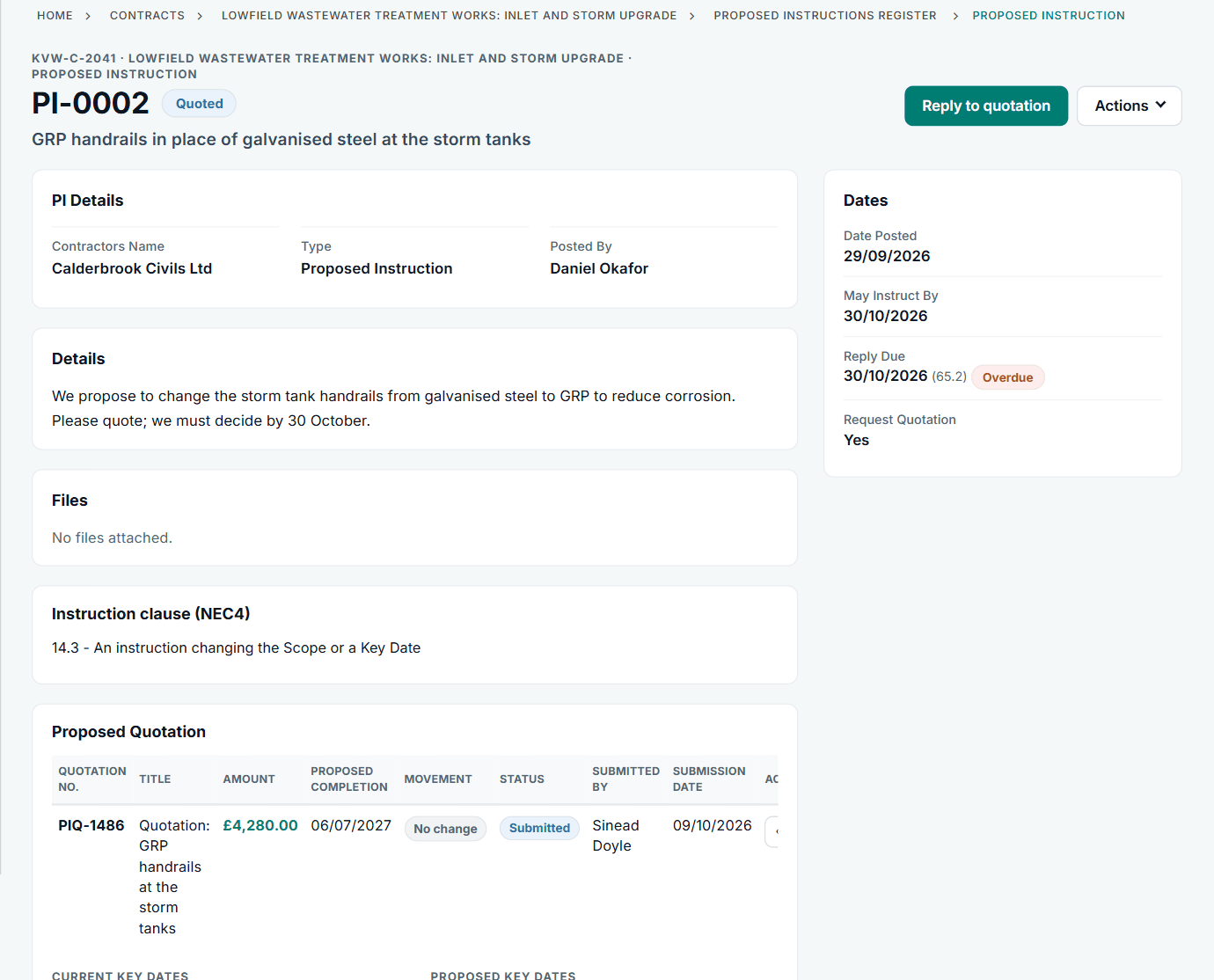
A proposed instruction with the Contractor's quotation and the date to decide by. See the worked example.
See how this works in practice
Click through Contract Status with sample contracts: raise the notice, reply to it, and watch both sides of one record.
Take the guided tour Book a demo
Use the NEC deadline calculator, use the free NEC tools or download free NEC templates.
This guide is general information in our own words, not legal advice. Your contract and its Contract Data always govern. NEC, NEC3 and NEC4 are trade marks of Thomas Telford Ltd; Contract Status is not affiliated with or endorsed by NEC.