
Instruct the Project Manager to attend an early warning meeting. If a PM ignored your early warning, clause 15.2 lets you do this yourself, and it's a much stronger step than a further email. The silence doesn't by itself give you a compensation event, so you then need to protect your position in other ways.
What decides how much this matters is whether the matter also is, or could become, a compensation event, and whether anyone is still looking for a way to reduce its effect. The clauses are NEC4 ECC. In NEC3, the same steps fall under clause 16, with a risk reduction meeting and Risk Register.
Steps, in order
- Check it arrived. A warning has effect through the communication system the Scope names or, if none is named, when it's received at the recipient's address. Check it was sent separately from other communications (13.7).
- Check the Early Warning Register. The contract has the Project Manager entering matters in it. Is yours there?
- Instruct a meeting. Either side can instruct the other to attend (15.2). Pick a date, and say what's to be discussed.
- Check for a compensation event. If it qualifies, notify under 61.3. The eight weeks run regardless, and silence on your warning won't stop them.
- Carry on and reduce the effect yourself where you reasonably can, and record what you did.
- Keep the date record. Your warning protects you against a later statement under 61.5 for this matter.
- Escalate at senior level if the meeting doesn't happen.
Sample instruction to attend
"We gave an early warning on [date] of [matter], which could [delay Completion / raise the Prices]. It hasn't yet been discussed. Under clause 15.2, we instruct you to attend an early warning meeting at [time] on [date], at [place or online]. We propose an agenda of: [matter], options to avoid or reduce its effect, and who does what next. If the date doesn't suit you, please offer another by [date]."
What the silence means under the contract
| Question | Contract position |
|---|---|
| Is the warning treated as accepted? | No. It isn't a submission for acceptance, and there's no such rule for it |
| Is it a compensation event under 60.1(6)? | That entry is for a failure to reply to a communication where the contract requires a reply. It sets no yes-or-no reply to a warning, so it's weak here. A failed reply to something else, such as an RFI within the Scope, is a separate matter |
| Does the Project Manager have duties here? | Yes. Entering it on the register, attending meetings and updating the register after them (15.1, 15.2 and 15.4) |
| Is failing those a breach? | Clause 10 and the wider rule to act as stated apply. 60.1(18) speaks of the Client's breach, so whether it fits is arguable. Take advice before relying on it |
| Does it help you? | Yes. If the Project Manager did nothing after your warning, the contract's reduction in 61.5 and 63.7 for a missing warning has no footing |
A fictional example
A Contractor warns in week 12 that a Client-appointed utility hasn't confirmed a diversion date, which could delay Key Date 1. No reply comes. In week 14, the Contractor instructs a meeting, but the Project Manager sends a junior who can't decide anything. The Contractor records that in the register update it asks for. In week 19, the diversion is late against the Accepted Programme, and the Contractor notifies under 60.1(5). When the Project Manager later claims it could have mitigated if told sooner, the week 12 warning and week 14 instruction answer that point directly.
The other side's likely answers
- "I didn't see it." Point to the delivery record, and move on. The meeting matters more than the argument.
- "It's your risk, so there's nothing to discuss." The meeting is about reducing the effect, whoever pays. Liability isn't the test, as explained in does a warning admit fault?
- "We'll cover it at the next monthly meeting." That may be fine if it's soon enough. If not, say why it can't wait.
If you're the Project Manager
A quick reply saves trouble. You don't need to accept responsibility, or to agree with the warning. Enter it on the register, say when it'll be discussed and ask anything you need to know. If you're short of time, delegate under 14.2, and tell the Contractor who is covering. Our guide to the Early Warning Register covers its upkeep, and early warning meetings explains how to run them.
In practice, an ignored warning is often a symptom of a wider problem, with too many open items for one person. If that's the case here, see when the PM keeps replying late, or look through the NEC questions hub.
Related guides
- NEC Questions Answered: Real Situations on Site
- The Client Changed Their Mind on the Design: How Is It Handled?
- How Does the Client Get a Price Before Instructing a Change?
- We Can Save the Client Money: How Do We Propose It?
- Can We Give Too Many Early Warnings?
- Does an Early Warning Count as Notifying a Compensation Event?
How this looks in Contract Status
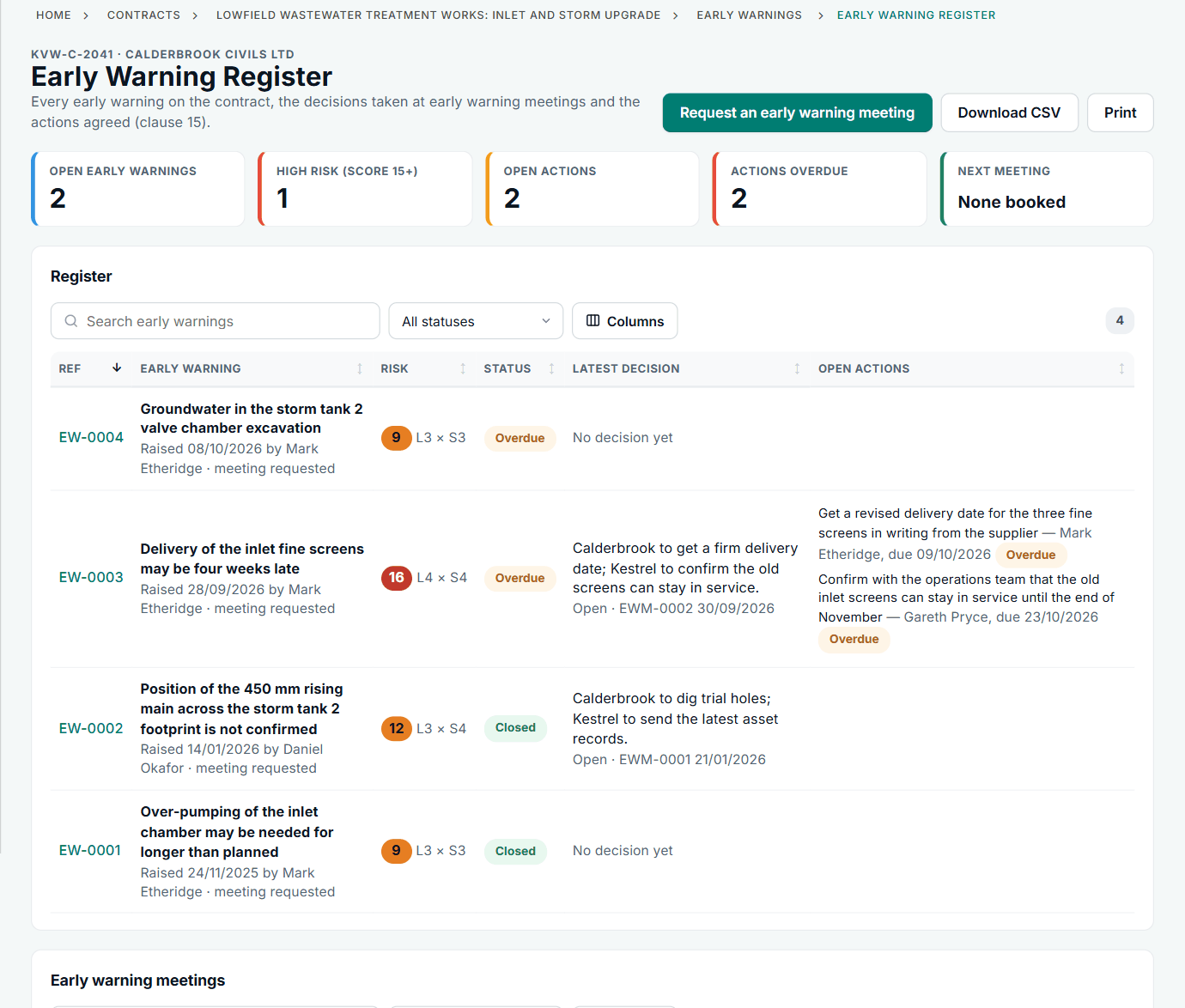
The Early Warning Register page, with risk scores, decisions and open actions. See the worked example.
See how this works in practice
Click through Contract Status with sample contracts: raise the notice, reply to it, and watch both sides of one record.
Take the guided tour Book a demo
Use the NEC deadline calculator, use the free NEC tools or download free NEC templates.
This guide is general information in our own words, not legal advice. Your contract and its Contract Data always govern. NEC, NEC3 and NEC4 are trade marks of Thomas Telford Ltd; Contract Status is not affiliated with or endorsed by NEC.