
The contract protects you here, provided you can show you asked. With no access to correct a defect under NEC, the correction period for a taken-over part doesn't start until access is given (clause 44.4), and if access never comes before the defects date, you pay only what correcting it would have cost you (46.2). What decides it is your written record.
In exchange, the Scope is treated as changed to accept the Defect, so the item is closed. This page follows the NEC4 Engineering and Construction Contract (ECC). NEC3's numbers are 43.4 and 45.2. Other questions are in NEC questions answered.
Do this now
- Ask in writing, and name a date. Say which area you need, the hours, how long for, any isolation or permit needed and what the Client needs to do. Ask the Project Manager, since it arranges for the Client to allow this.
- Offer more than one window. It is then harder to say you were unhelpful. Include out-of-hours options, and say if they would cost more.
- Keep a log: date of request, reply, access given, refusal, or any visit where you were turned away.
- Diary the defects date. It is what changes the rule. Repeat the request well before it.
- Prepare a realistic estimate of your cost. If the Project Manager makes the 46.2 assessment, you want your own figure ready, with evidence.
- Keep the Defect on your programme while the main works are running. The plan for dealing with notified Defects belongs in a revised programme (32.1).
Sample request, in our own words
"To correct Defect [reference], notified on [date], we need access to [area] for [duration], with [isolation or permit]. We can attend on [dates], or on [out-of-hours dates]. Clause 44.4 has you arrange for the Client to allow this access. The defect correction period starts once it has been given. Please confirm which date suits. We note that the defects date is [date]."
Which rule applies to you?
| Facts | Result | What you pay |
|---|---|---|
| Access given, Defect corrected in time | Closed normally | Your own cost of correcting it |
| Access given, you didn't turn up or finish within the period | 46.1: cost to the Client of other people correcting it | Usually much more |
| No access before the defects date | 46.2: your own cost of correcting it, as the Project Manager assesses | What you saved |
| Limited access, too short to do the work | Unclear: expect argument | Say at the time that it wasn't enough, and why |
The difference between the third and fourth rows makes your access log valuable. The guide to uncorrected Defects covers the mechanism in more depth.
A fictional worked example
Illustrative figures. A hospital ward won't release a corridor with a failed ceiling grid, notified after take over. Your estimate to fix it is £7,500, using your own subcontractor. A different contractor would charge £14,000, plus £2,000 for the Client's costs. You ask three times in writing and are refused each time, up to the defects date.
- Under 46.2: you pay £7,500, and the Scope is treated as changed. You may in effect have the same outlay as if you had fixed it, without having to mobilise.
- If the Client later says you were offered access: your log decides whether this stays at £7,500 or becomes £16,000 under 46.1.
What the Client or Project Manager may say
| Likely argument | Reply |
|---|---|
| "You were given access: the building's open every day" | Open to the public isn't necessarily the access and use the work needs. Be specific about what's required |
| "You should be working at night" | If the contract or Scope has no such restriction, this is a question of what is reasonable. Offer it at a cost, or say why it can't be done |
| "Your 46.2 figure is too low" | The Project Manager assesses it. Provide your build-up, and dispute it if needed |
| "The Defect's still your liability, so come back later" | After 46.2, the Scope counts as changed to accept it, so no further correction should be due for that Defect |
A question the contract doesn't answer directly
If the wait costs you more, such as a crew standing by because the Client cancelled an agreed access date, can you recover that? The Defects clauses don't deal with it. It may be argued as a Client's breach under 60.1(18), in which case the eight-week limit in clause 61.3 applies from awareness, so notify promptly if it matters, and take advice on a large sum. On Options C to E, remember that the cost of correcting Defects after Completion is disallowed, so that affects how you price the arrangement. If a dispute is brewing over whether it's a Defect at all, see the Supervisor says the work is defective.
Related guides
- NEC Questions Answered: Real Situations on Site
- The Supervisor Says the Work Is Defective but We Disagree
- A Test Failed: Who Pays for Retesting?
- The Supervisor Made Us Open Up Work and Found Nothing
- A Defect Appeared After the Defects Date: What Now?
- The Contractor Will Not Fix a Defect
How this looks in Contract Status
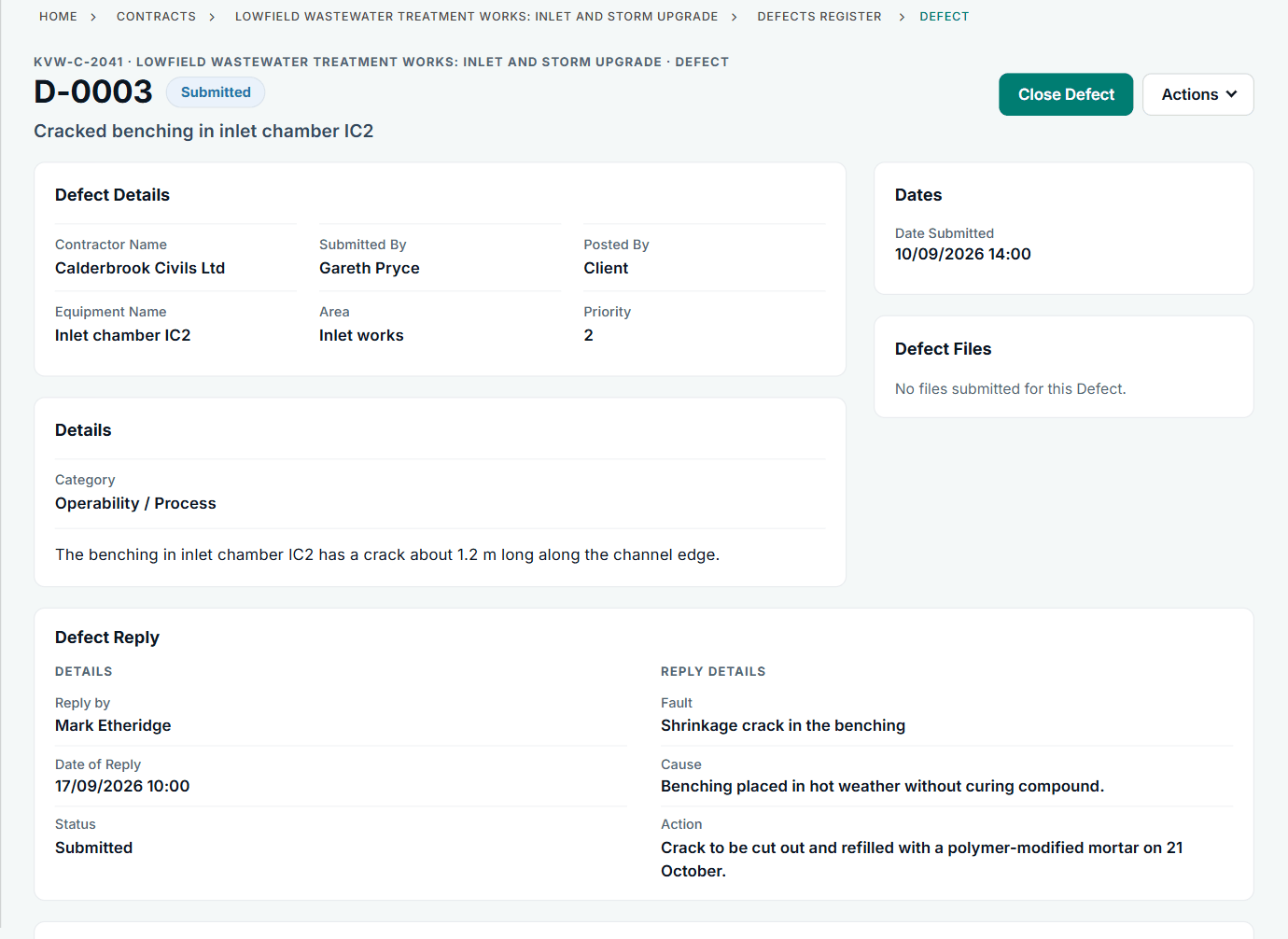
A Defect from the Client side, with the Contractor's reply on the record. See the worked example.
See how this works in practice
Click through Contract Status with sample contracts: raise the notice, reply to it, and watch both sides of one record.
Take the guided tour Book a demo
Use the NEC deadline calculator, use the free NEC tools or download free NEC templates.
This guide is general information in our own words, not legal advice. Your contract and its Contract Data always govern. NEC, NEC3 and NEC4 are trade marks of Thomas Telford Ltd; Contract Status is not affiliated with or endorsed by NEC.