
It depends: unforeseen ground conditions are the Client's cost under NEC only for the part an experienced contractor couldn't reasonably have allowed for at the Contract Date. Everything up to a reasonable allowance stays with the Contractor. What decides it is what the Site Information and other available information showed, not how surprised your team was.
The route is the compensation event at 60.1(12), the same in NEC3 and NEC4 ECC. Many contracts amend or delete it through a Z clause, so read yours before doing anything else.
Today, this week, within eight weeks
- Today: photograph and record it before it's dug out. Location, depth, date and quantities, ideally measured jointly with the Project Manager's team. An obstruction that has gone in a skip is very hard to prove.
- Today: give an early warning (15.1) if the price or the programme could be affected, and ask for an early warning meeting.
- This week: notify the compensation event. The eight-week time bar in 61.3 runs from when you became aware (seven weeks in NEC4 ECS). No Project Manager instruction caused this, so the bar applies in full. See the guide to clause 61.3.
- Project Manager replies within one week (61.4). If it doesn't, notify the failure; two further weeks of silence counts as acceptance that it's an event and an instruction to quote.
- Quote within three weeks of the instruction (62.3). If the extent is unknown, ask the Project Manager to state assumptions under 61.6, so you aren't guessing the volume.
The questions that decide it
| Question | Clause | Why it matters |
|---|---|---|
| Is it within the Site? | 60.1(12) | Conditions outside the boundary need another route |
| Is it physical and not weather? | 60.1(12) | Ground softened by rain may be pushed to the weather test |
| What did the information show? | 60.2 | You're taken to have considered the Site Information, public material it refers to, what a look at the Site shows, and what an experienced contractor could reasonably have or obtain |
| Do the boreholes conflict? | 60.3 | You are assumed to have taken the conditions better for doing the work |
| What would have been a reasonable allowance? | 60.1(12) | Only the excess counts |
The full test, with a borehole example, is in the guide to physical conditions.
Evidence to gather
- The Site Information, with every report it refers to, as it stood at the Contract Date.
- Your tender method, programme and allowance. It doesn't decide the objective test, but it shows how you read the risk.
- Daily records of what was encountered, with sketches and photos tied to grid references.
- Records of what stopped or changed: plant, gangs, disposal tickets and survey data.
- A specialist's view of what a reasonable reader would have taken from the reports, if the sums justify it.
If it isn't a compensation event: who pays then?
| Main Option | Where the cost goes when the event fails |
|---|---|
| A and B | The Contractor bears the extra cost and time |
| C and D | The cost goes into Defined Cost, but the target doesn't move, so it flows through the share |
| E | The Client pays Defined Cost plus Fee anyway, but the Completion Date doesn't move |
A win on the event can move the Completion Date under any Option, if it delays planned Completion, which also matters if delay damages are in play.
What the Project Manager will say
Expect some of these: the borehole near that spot showed something similar; the geological map or history of the Site gave warning; an experienced contractor would have dug trial pits; your own quotation prices all the material, not the excess. They may also say the condition falls within your own method risk, or that you didn't warn early. A late warning doesn't lose the event, but the assessment can then be made as if you had warned (63.7).
The contract says only the difference between what you met and what was reasonable counts. In practice, it pays to agree a working assumption early and keep the work moving, with a correction later under 60.1(17) if needed. A dispute over the principle can sit alongside that without stopping the job. If you're the Project Manager, an early joint inspection helps you as much as the Contractor. More answers are in NEC questions answered.
Related guides
- NEC Questions Answered: Real Situations on Site
- We Found Unmarked Utilities: Is It a Compensation Event?
- We Found Contaminated Ground: What Happens Under NEC?
- We Found Asbestos During the Works: What Do We Do?
- The Drawings and Specification Disagree: Which One Applies?
- We Priced the Job Wrong: Can We Get It Changed?
How this looks in Contract Status
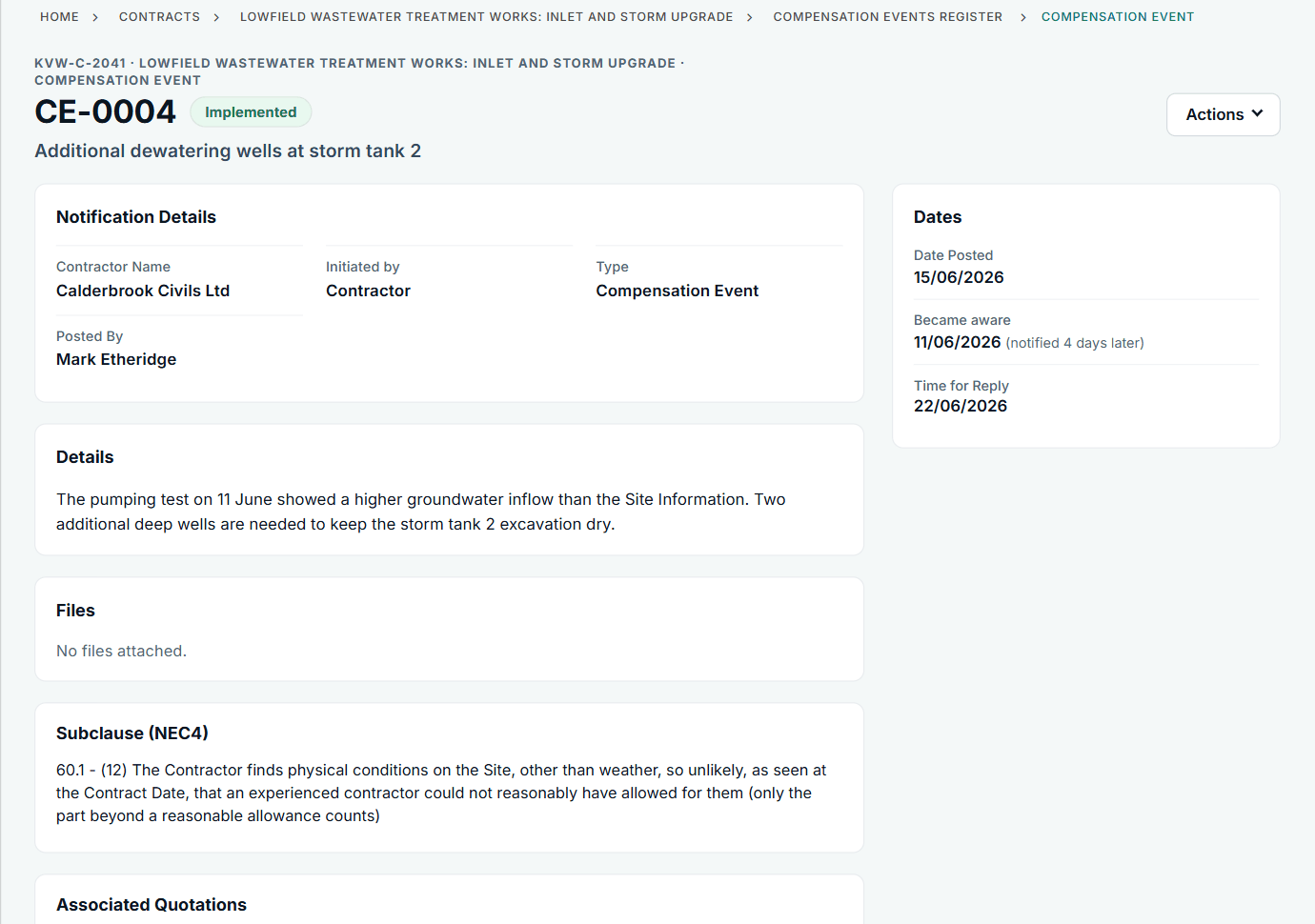
A 60.1(12) event, notified four days after the test that showed the inflow. See the worked example.
See how this works in practice
Click through Contract Status with sample contracts: raise the notice, reply to it, and watch both sides of one record.
Take the guided tour Book a demo
Use the NEC deadline calculator, use the free NEC tools or download free NEC templates.
This guide is general information in our own words, not legal advice. Your contract and its Contract Data always govern. NEC, NEC3 and NEC4 are trade marks of Thomas Telford Ltd; Contract Status is not affiliated with or endorsed by NEC.