
The Client usually pays once the Project Manager gives an instruction: archaeology becomes an NEC compensation event under 60.1(7) when the Project Manager instructs you how to handle a valuable or historically interesting object found within the Site. What decides it is whether you found something the Scope already dealt with, and whether an instruction has actually been given.
The clauses are 73.1 and 60.1(7), the same in NEC3 and NEC4 ECC.
The order to do things in
- Stop around the find and don't move it. Clause 73.1 is clear: you tell the Project Manager and wait for instructions.
- Tell the Project Manager the same day, in a form the contract recognises. Photograph it where it lies and fence it off.
- Call the right authority if the law requires it. Possible human remains need the police or coroner's officer straight away. Planning conditions and heritage rules can also apply; the Client's archaeologist or the local authority's adviser can confirm.
- Ask for the 73.1 instruction in writing and state the date you need it by. If there's no reply within the period for reply, that may be an event in its own right under 60.1(6).
- Give an early warning (15.1) where the find could delay Completion or change the Prices.
- Notify the event yourself if the Project Manager doesn't. It should be notified with the instruction (61.1). Events arising from an instruction sit outside the 61.3 time bar, but for anything you are treating as a different event, such as ground conditions, assume eight weeks are running.
Sample wording: "On [date], at [grid reference], our team uncovered what appears to be [description]. In accordance with clause 73.1 we have stopped work within [area] and not moved the object. Please instruct us how to deal with it by [date]. Work at [activity] is held; a delay beyond [date] will affect planned Completion."
What decides who pays
| Situation | Likely contract position |
|---|---|
| Unexpected find, Project Manager instructs how to deal with it | 60.1(7), a compensation event assessed under 63.1 |
| Scope already requires a watching brief or a set archaeological procedure, and you price that | The planned process isn't an event. Only what goes beyond the Scope may be |
| Client's archaeologist overruns against the Accepted Programme, or works outside Scope conditions | 60.1(5), as Others (or the Client) |
| The authority stops the work without any instruction | Press for the instruction. Other routes are stop work under 60.1(4), or the physical conditions test at 60.1(12) |
| Find has no historical or other interest | Not under 60.1(7). An old foundation may be a ground condition instead |
Unlike 60.1(12), the entry at 60.1(7) doesn't turn on whether the find was foreseeable. Being told about the possibility doesn't remove the event if the Project Manager has to instruct. But when the Scope sets out the procedure in advance, your price already includes it and a Project Manager may say no new instruction is needed. Read the planning conditions, written schemes and Scope closely. The guide to objects of value events has more on the entry.
Fictional example
A pipeline job on Option A, with illustrative figures. The Scope requires an archaeologist's watching brief on topsoil strip, which the Contractor has priced. In week 12, at chainage 2+400, the strip reveals what the archaeologist suspects is a Roman ditch. The Project Manager instructs a stop on 80 metres of the route, and a full excavation by the Client's archaeologist.
Items go into the quotation: redeploying the pipe gang to another length, moving plant, and leapfrogging the area later. These come to a forecast Defined Cost of £41,000, plus a 10% Fee. On the programme, planned Completion moves by nine days, so the Completion Date moves nine days. The watching brief itself stays in the original Prices. The instruction date is the dividing date.
What the Project Manager may say
- "The Scope covered archaeology." Check exactly what it covers. A brief to monitor is different from excavating a feature.
- "You could work elsewhere." Partly true, and clause 63.9 assumes a competent reaction. Show the alternatives you looked at, and their cost.
- "There's no instruction, so there's no event." If they're delaying on purpose, ask for a decision, and notify on the alternative routes above.
In practice
The biggest cost usually comes from waiting for a decision, so hold an early warning meeting within days. Ask the archaeologist what the likely timeline is, and agree an assumption if needed (61.6). Then keep records of what stood idle and what was moved. Who ultimately owns a find, and any duties about reporting it, are matters of law beyond the contract: on that point, follow the specialist's and the Client's advice. See also NEC questions answered.
Related guides
- NEC Questions Answered: Real Situations on Site
- It Has Rained for Weeks: Can We Claim for Weather?
- How Do We Prove a Weather Compensation Event?
- Snow or High Wind Stopped Work: Is That Covered?
- We Found Contaminated Ground: What Happens Under NEC?
- We Found Asbestos During the Works: What Do We Do?
How this looks in Contract Status
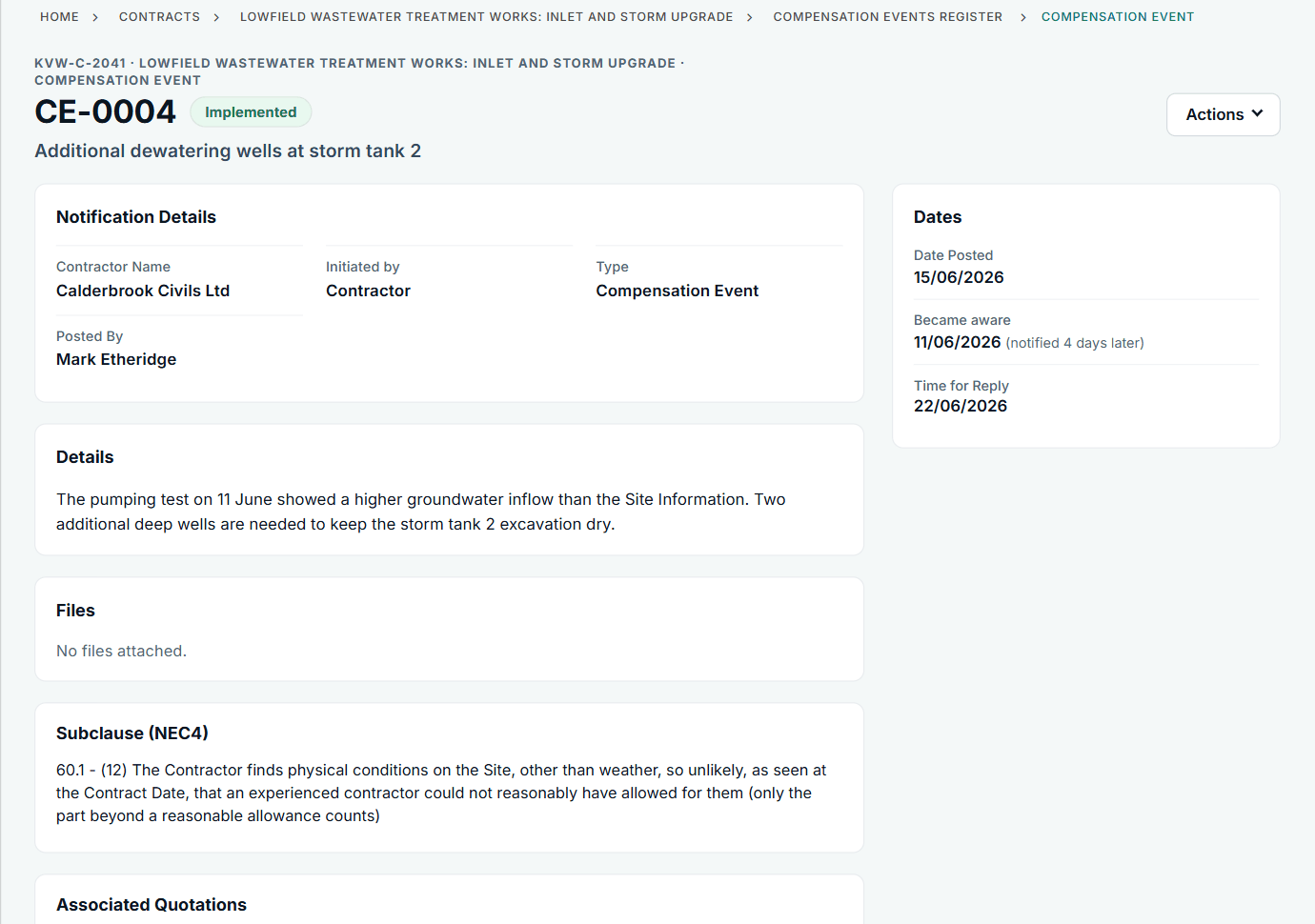
A 60.1(12) event, notified four days after the test that showed the inflow. See the worked example.
See how this works in practice
Click through Contract Status with sample contracts: raise the notice, reply to it, and watch both sides of one record.
Take the guided tour Book a demo
Use the NEC deadline calculator, use the free NEC tools or download free NEC templates.
This guide is general information in our own words, not legal advice. Your contract and its Contract Data always govern. NEC, NEC3 and NEC4 are trade marks of Thomas Telford Ltd; Contract Status is not affiliated with or endorsed by NEC.