
It depends on what caused the water and what it damaged: a flood under NEC is usually the Contractor's liability for damage to the works, insured under the Insurance Table, while lost time and extra cost only move to the Client if a compensation event applies. So split the problem in two straight away: repair and insurance on one side, time and money on the other.
Numbers below are for NEC4 ECC. In NEC3 ECC the liabilities are at 80.1 and 81.1 as Employer's and Contractor's risks, and insurance is at clause 84 rather than 83.
First 48 hours
- Make people and the Site safe. Check for electrical hazards, excavation stability and pollution. Tell your insurer as soon as you can, and follow the policy's conditions on notifying and on not disposing of damaged items before inspection.
- Photograph and record: water level, source, time, and every damaged item. Save weather figures, pump logs and anything from the Environment Agency or the water company.
- Tell the Project Manager and give an early warning (15.1). Ask for an early warning meeting about the recovery plan.
- Identify where the water came from, as that decides the next table.
- Diary the eight-week time bar now (61.3; seven weeks under NEC4 ECS), from the day you became aware, for any compensation event you may want to notify.
The source decides the route
| Cause | Possible compensation event | Comment |
|---|---|---|
| Heavy rainfall | 60.1(13) weather test | A monthly measurement at the named place, compared with one-in-ten. Only the excess counts |
| River or sea flooding the Site | Weather test if rain drove it; possibly 60.1(19) | Prevention needs all of its tests to be met, and an event neither Party could prevent. Check the Site's flood history |
| Burst main or failure by a utility | 60.1(5) only if they were working outside what was stated; otherwise look at 60.1(12) | Their fault may give you a route against them outside the contract |
| Client's works, drains or instructions | 60.1(14), 60.1(18) or 60.1(1) | A fault of the Client, or a design fault in the Scope, sits with the Client under 80.1 |
| Groundwater well beyond what was reported | 60.1(12), physical conditions | Not weather, so the experienced contractor test applies. Weather-driven water will be challenged |
| Your dewatering failed, or your stockpile blocked a ditch | None | Contractor's own risk, and possibly its liability to neighbours as well |
Who pays for the damage?
The contract says that if the works, Plant and Materials or Equipment are lost or damaged, that's a Contractor's liability (81.1), unless it's listed as a Client's liability. The Client's list (80.1) doesn't mention floods. It names war, certain strikes and riots, and radioactive contamination, and a fault of the Client or a design fault in Scope that the Client provided. Additional Client's liabilities can be stated in the Contract Data, so check that entry.
The Insurance Table in clause 83 requires the Contractor's cover for this loss in joint names, unless the Contract Data has the Client insuring. So check three things: who insures, the deductibles, and any flood exclusions or sub-limits. Amounts an insurer doesn't pay stay with the Party who is liable. The guide to insurance under NEC sets the structure out.
Two separate items often get muddled. Insurance can pay to rebuild a damaged pour, but it may not pay for standing time or for delay damages. A weather or other event gives Prices and time, but only for the effect stated in the entry.
Fictional example
A culvert replacement on Option A, with illustrative figures. A November storm brings a river over the temporary bund, wrecking formwork and Materials worth £85,000 and stopping work for three weeks.
- The Contractor's insurer pays the £85,000, less a £10,000 excess the Contractor carries as its own loss.
- The rainfall at the named station passes the one-in-ten test by a small margin. The Contractor argues that about one week of the delay comes from the excess, and notifies 60.1(13). The Prices and Completion Date change for that week.
- The other two weeks of stoppage stay with the Contractor, as does the cost of raising the bund. The Scope required a bund designed for a stated flood level, and the storm stayed within it, which weakens any prevention argument.
The responses to expect
From the Project Manager: the Site's flood risk was known, your temporary works should have dealt with it, and the weather test doesn't help with damage. From the insurer: questions about method and maintenance. If you're on the Client side, ask for the source of the water to be established before replying, and remember your one-week reply period under 61.4. Where the facts are complex, liability for neighbours or pollution is a question for lawyers and insurers. More answers are in NEC questions answered.
Related guides
- NEC Questions Answered: Real Situations on Site
- We Have Not Been Given Access to the Site: What Do We Do?
- The Client Restricted Our Access Part Way Through
- Another Contractor Is Delaying Us: Is That a Compensation Event?
- How Do We Prove a Weather Compensation Event?
- Snow or High Wind Stopped Work: Is That Covered?
How this looks in Contract Status
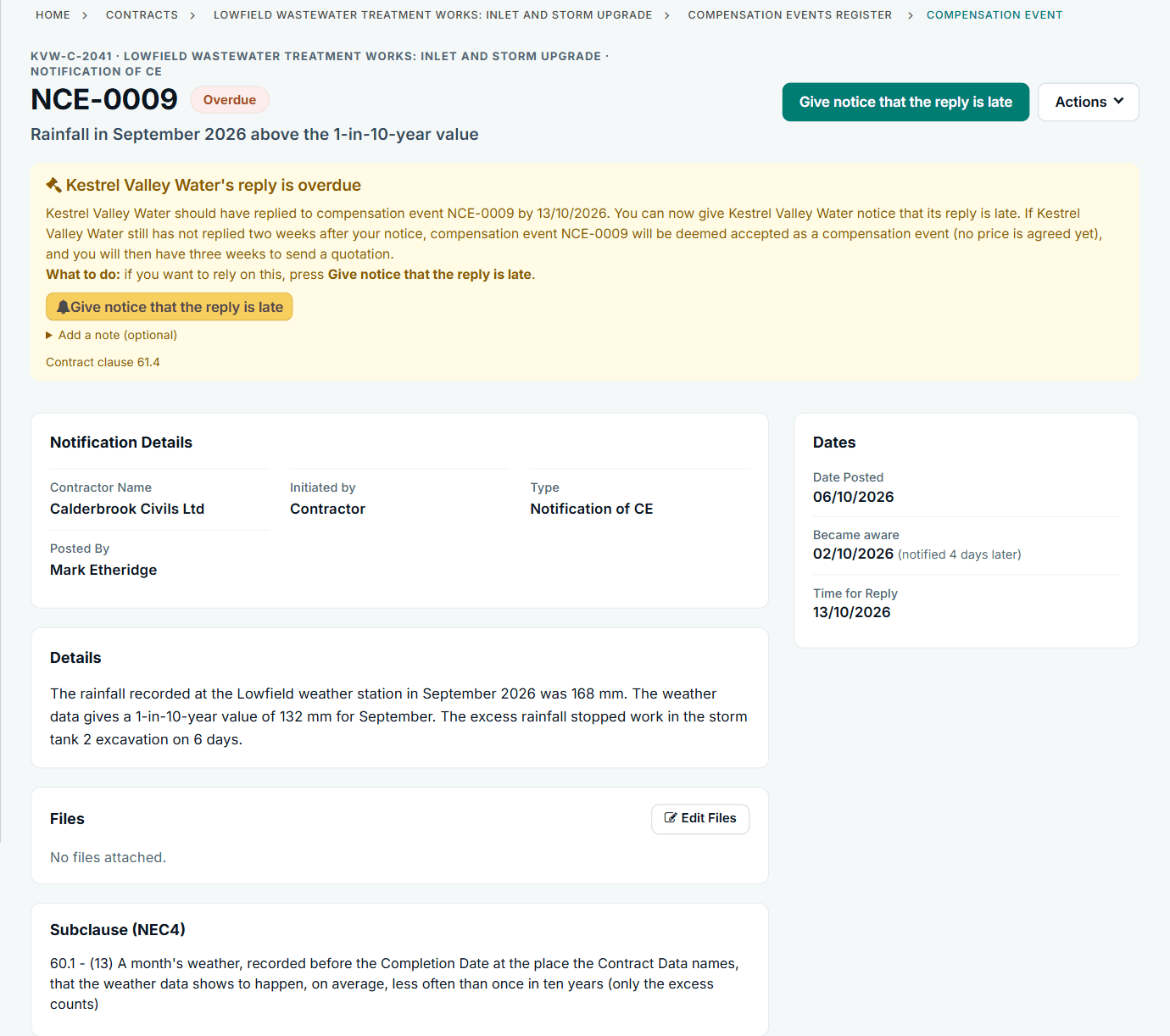
A weather event notified with the recorded figure against the one-in-ten value. See the worked example.
See how this works in practice
Click through Contract Status with sample contracts: raise the notice, reply to it, and watch both sides of one record.
Take the guided tour Book a demo
Use the NEC deadline calculator, use the free NEC tools or download free NEC templates.
This guide is general information in our own words, not legal advice. Your contract and its Contract Data always govern. NEC, NEC3 and NEC4 are trade marks of Thomas Telford Ltd; Contract Status is not affiliated with or endorsed by NEC.