
No, the contract sets no limit, so you can't breach NEC by giving too many early warnings. The duty in clause 15.1 covers any matter that could affect the Prices, Completion, a Key Date or performance in use. What you can do is make your warnings useless, if every small thing is flagged and the important ones get lost.
The deciding question for each one is whether a meeting or a decision could change something. The rule sits at 16.1 in NEC3, with the same basic test. The guide on what to warn about has more examples.
The test to apply
| Situation | Warn? | Why |
|---|---|---|
| Could delay Completion or a Key Date, or could raise the Prices | Yes. It's required | A listed matter, once you're aware of it |
| Could raise only your own total cost | You may, though it's optional | NEC4 lets you warn of this, and the required list doesn't include it |
| Already notified as a compensation event | Not required | The contract says no warning is needed for it |
| Weather forecast for next week, with float in hand and no effect | No | "Could" still needs a realistic link |
| Generic "ground risk" with no specifics | No, or make it specific | Nobody can act on it |
| Twenty small delays, each harmless, together eating into float | Yes, as one warning about the combined effect | The combined effect is the real matter |
What "too many" really looks like
- A register too long to get through at a meeting, so items just roll forward.
- Warnings copied from the tender risk list, with no change in the facts.
- Warnings sent to set up a claim rather than to find a solution.
- Warnings on matters already closed, or passed, that nobody removes.
None of those is a breach. They just remove the benefit, and they make it easier for a Project Manager to miss the warning that matters.
What to do if the list has got out of hand
- Clean the register at the next meeting. The meeting decides which matters have been dealt with or have passed, and those come off under 15.3.
- Merge duplicates, keeping the original date for each.
- Rank what's left by possible effect, and spend meeting time on the top items.
- Assign an owner and a date to each, as the meeting has to decide what's to be done.
- Agree a short format for warnings: what, where, possible effect and a suggested action.
- Ask for a closer interval if the volume is real. The Contract Data sets a maximum interval, and either side can instruct a meeting under 15.2 at any time.
If the Project Manager objects
A Project Manager can't refuse to take a warning, as the contract has it going on the Early Warning Register. It may fairly ask for one to be clearer, or ask to group several together. Reply along these lines:
"We've given these warnings under clause 15.1 because each could affect [Completion or a Key Date]. We're happy to go through them at the next meeting, and to agree which can be closed. We'd rather warn and close them quickly than find later that a warning could have been given."
The last sentence matters. Saying nothing risks a statement under clause 61.5 and an event assessed as though you'd warned. Don't reduce your warnings to please anyone, if the effect is real.
Advice for Project Managers
The same applies in your direction. You have your own duty to warn. A long list from a Contractor can also tell you something: the job may really be in trouble. Before you complain about volume, check if the Contractor's warnings are accurate. If they're simply copied from the tender, ask for specifics at the meeting. Treat a warning as the start of a conversation, not as a claim you need to fight. Our guide to early warning meetings covers how to run that discussion.
A note on bundled warnings
The contract says a required notification is sent separately from other communications (13.7). So don't tuck warnings into a monthly report or the minutes. You can still group related points about the same matter in one warning. Separate matters should get their own notices.
A fictional example
A Contractor on a rail bridge job has 74 items on the register by month five. At a joint review, 41 are closed as passed, 12 merge into three, and 21 remain. Meeting time falls, and the Project Manager's attention goes to a possession risk that had been sitting at number 38. The numbers are illustrative. For more on this, see the Early Warning Register, or the NEC questions hub.
Related guides
- NEC Questions Answered: Real Situations on Site
- Does an Early Warning Count as Notifying a Compensation Event?
- We Gave an Early Warning and the PM Ignored It
- The Client Changed Their Mind on the Design: How Is It Handled?
- The Relationship Has Broken Down: What Does Clause 10 Actually Require?
- Does Giving an Early Warning Admit Fault?
How this looks in Contract Status
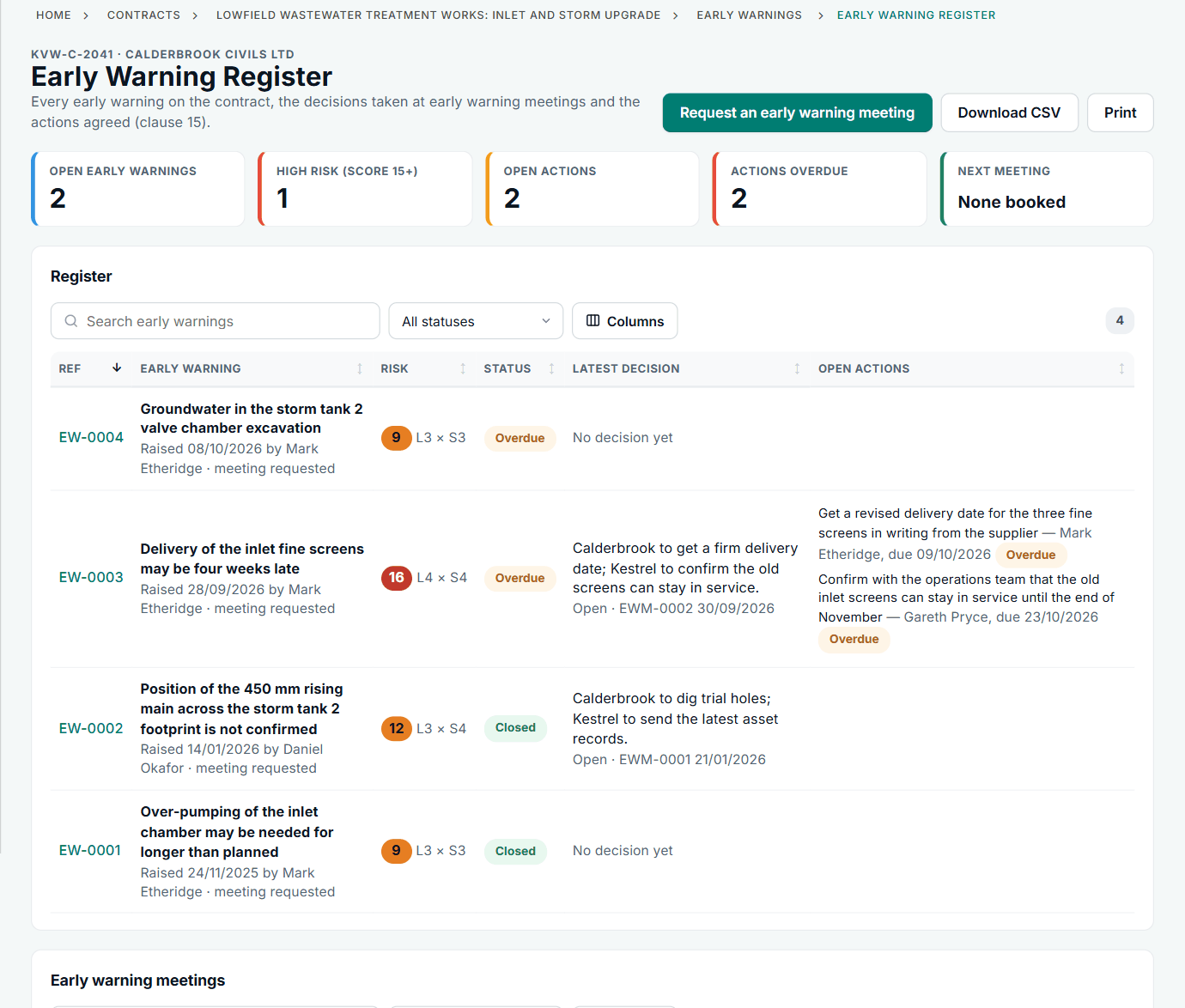
The Early Warning Register page, with risk scores, decisions and open actions. See the worked example.
See how this works in practice
Click through Contract Status with sample contracts: raise the notice, reply to it, and watch both sides of one record.
Take the guided tour Book a demo
Use the NEC deadline calculator, use the free NEC tools or download free NEC templates.
This guide is general information in our own words, not legal advice. Your contract and its Contract Data always govern. NEC, NEC3 and NEC4 are trade marks of Thomas Telford Ltd; Contract Status is not affiliated with or endorsed by NEC.