
No: when a client wants to accelerate under NEC, the Contractor isn't obliged to agree, and the Completion Date can't be brought forward by instruction. Clause 36 works by quotation, and the date only moves if a quotation is accepted. What decides your next step is which edition you're on and how you were asked.
How you were asked changes your reply
| What you've received | Contract position | What to do |
|---|---|---|
| A suggestion at a meeting | No formal step yet | Ask what the Client really needs and by when |
| NEC4 ECC: a proposal under 36.1 | Either side can propose. If both are prepared to consider it, the Project Manager instructs a quotation | Say whether you're prepared to consider it. If you aren't, no instruction follows |
| NEC3 ECC: instruction to quote under 36.1 | Contractor has to reply within the period for reply | Either quote, or give your reasons for not doing so (36.2) |
| An instruction to finish earlier, or "just add shifts" | Not something 14.3 reaches: it covers the Scope and Key Dates, not the Completion Date | Query it in writing. Ask for clause 36 if that's what's meant |
| An instruction changing a Key Date | Allowed under 14.3, and a compensation event at 60.1(4) | Notify if the Project Manager doesn't, and quote the effect |
| A Scope change with new hours or sequence | 60.1(1), assessed as a normal event | Quote on Defined Cost plus Fee. The Completion Date stays where it is unless a delay results |
The time limits
Periods depend on the form. NEC3 ECC uses the period for reply. NEC4 ECS gives two weeks for the quotation and four for the reply. For NEC4 ECC, read clause 36 of your own contract rather than assuming the subcontract periods carry across. There's no eight-week time bar here, since acceleration isn't a compensation event.
Replying in practice
- Find out what's driving it. Is it a whole-job date, or one area or a handover? A Key Date or an earlier section may meet the need for far less money.
- Check what you could actually do. Look at resources, supply chain, permits and any logic that can't be compressed.
- Reply in writing. Even if you're interested, don't start any work until there's an accepted quotation.
- If you quote, include the full package. Under 36.2, that means the change to the Prices, a revised programme with the new, earlier Completion Date and any changed Key Dates, and details of your assessment.
Sample reply: "We have considered your request to finish by [date]. We are prepared to consider acceleration under clause 36 and expect the cost to be significant. Please instruct us to quote, stating the Key Dates you want included. Until a quotation is accepted, the Completion Date and our programme remain as they are." Or if you are not interested: "We have reviewed the request and aren't prepared to provide a quotation, because [reasons]. The Completion Date and Accepted Programme stand. We're happy to discuss a phased handover."
How the price works: fictional example
A fictional office fit-out on Option A, with illustrative figures. The Client wants the building three weeks early, for a tenant moving in. Clause 36 doesn't use the compensation event formula, so the price is a commercial offer.
| Item | Amount |
|---|---|
| Weekend working, M&E and finishes | £62,000 |
| Extra supervision and security | £11,000 |
| Earlier delivery premiums | £6,000 |
| Saving in site running costs | (£15,000) |
| Risk and margin for working closer to limits | £21,000 |
| Quotation, with a Completion Date three weeks earlier | £85,000 |
Delay damages under X7 will then run from the new date if it's missed, so account for that risk in the offer. The guide to acceleration covers the clause in more detail.
What the Project Manager might say
- "That's too high, because it's more than cost plus Fee." It isn't assessed that way, and if the quotation isn't accepted, nothing changes. Under 60.1(9), refusing an acceleration quotation isn't a compensation event, so you get nothing for the cost of preparing it.
- "You're behind anyway, so you'd need to accelerate regardless." Recovering your own delay is a different thing, and doesn't change the Completion Date. See running behind programme.
- "Just do what you can and we'll sort it out." Politely don't. Work done without an accepted quotation has no route to payment under clause 36.
Traps to avoid
Don't confuse finishing early on your own plan with acceleration. A Contractor can plan to finish before the Completion Date, leaving terminal float, and that doesn't move the date. Open compensation events are also worth settling or carrying explicitly in the quotation, or an unclear starting point will affect the new date. An Option X6 bonus, if your contract has one, gives its own reward for early Completion. For similar questions, see NEC questions answered.
Related guides
- NEC Questions Answered: Real Situations on Site
- We Are Running Behind Programme: What Should We Tell the PM?
- The PM Will Not Accept Our Programme: What Now?
- There Is No Accepted Programme: How Are Events Assessed?
- We Cannot Get Enough Labour: Is There Any Relief?
- An Event Beyond Anyone's Control Has Stopped Work
How this looks in Contract Status
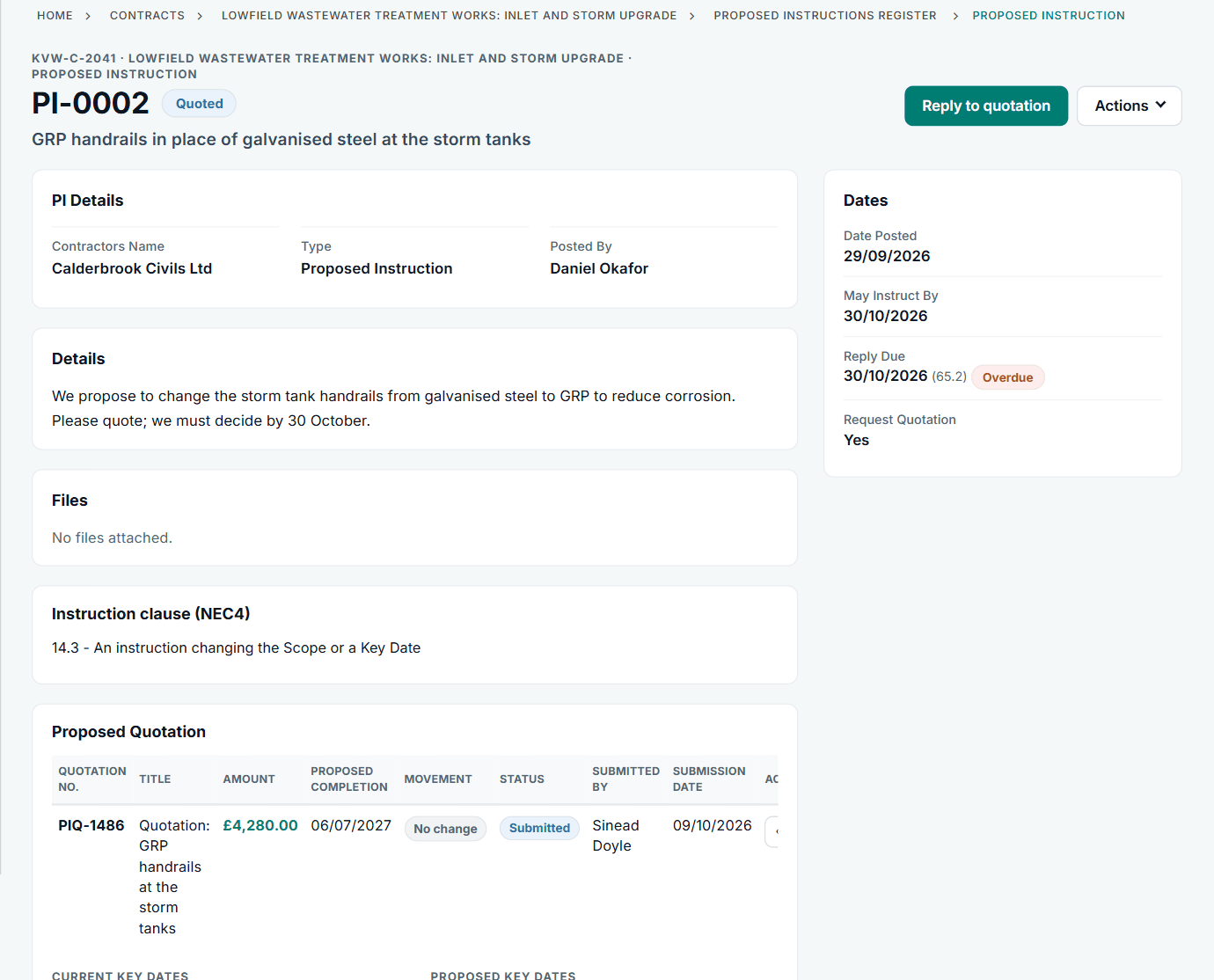
A proposed instruction with the Contractor's quotation and the date to decide by. See the worked example.
See how this works in practice
Click through Contract Status with sample contracts: raise the notice, reply to it, and watch both sides of one record.
Take the guided tour Book a demo
Use the NEC deadline calculator, use the free NEC tools or download free NEC templates.
This guide is general information in our own words, not legal advice. Your contract and its Contract Data always govern. NEC, NEC3 and NEC4 are trade marks of Thomas Telford Ltd; Contract Status is not affiliated with or endorsed by NEC.