
No, not safely. A verbal instruction under NEC doesn't meet clause 13.1, which requires communications the contract calls for to be in a form people can read, copy and keep on record, so changed work done on a conversation alone may earn you no compensation event.
What decides your next move is how urgent the work is, and whether the person speaking has authority. Our answers on an instruction from the Client on site deal with the second point. This page assumes the Project Manager or a delegate said it, and nothing has followed in writing. For other questions like this, see NEC questions answered.
The same-day routine
- Write down what was said: who, when, where and the exact change.
- Email the Project Manager the same day. Set out your understanding, and ask for the instruction in writing before you start.
- Hold the work if you can. If holding it would be unsafe or costly, say so, say what you'll do meanwhile, and ask for an answer by a stated time.
- Notify a compensation event under clause 61.3. Don't rely on the exemption for instructions; if the conversation wasn't an instruction, the exemption may not help you. Count eight weeks from when you became aware, and notify well before that.
- Record cost as it's incurred. Work done by the dividing date is assessed at actual Defined Cost, so keep the labour, plant and material records for this change apart.
Three risks of carrying on
| Risk | How it plays out |
|---|---|
| No event | 60.1(1) needs an instruction changing the Scope. With no instruction, the Project Manager can reply under 61.4 that it isn't one of the listed events |
| A Defect | Work that departs from the Scope without an instruction may be a Defect, and you could be asked to correct it at your cost, even though someone told you to do it |
| A memory contest | Project Managers change, people recall conversations differently, and the records you need are those that exist now |
NEC has no rule that makes a spoken instruction valid if nobody contradicts your confirmation within a set time. Your email is good evidence and it starts a paper trail, but it isn't itself an instruction. It's a request for one.
Sample email
Where the position differs
- Urgent safety matters. Clause 27.4 expects you to act in line with the health and safety requirements in the Scope (the same number in NEC3), and sensible people don't wait for an email if someone could be hurt. Make it safe, then write it up the same day. Whether the cost is recoverable depends on the cause: see stopping work for safety.
- A stop instruction. If you're told to stop, it's normally sensible to do so and to ask for confirmation at once. An instruction to stop is event 60.1(4), once given. See when the Project Manager says stop.
- A communication system. Under NEC4 13.2, if the Scope names a system, a communication takes effect through it. An email outside it may not be enough, so check first.
Expect this response
The most common reply is "I didn't instruct anything; I was only suggesting." That's why your email states what was said at the time. Another is a late instruction with a new date. If so, use the date of the written instruction for the dividing date, and keep your records for anything you've already done. Should the answer be "no change intended", take that at face value: go back to the Scope, and ask for clarification if the two can't be reconciled.
The contract's route is simple; the difficulty is holding your nerve when the site wants to keep moving. Agree a quick route with your Project Manager at the start of the job, such as a same-day instruction form filled in on a phone. It's cheaper than any argument later. Clause-by-clause detail on form is in clause 13.
Related guides
- NEC Questions Answered: Real Situations on Site
- The Client Told Us on Site to Change Something: Is That Valid?
- The Client Keeps Instructing the Contractor Directly: What Should We Do?
- The PM Issued an Instruction but No Compensation Event: What Now?
- Our RFI Has Not Been Answered: What Can We Do?
- The Project Manager Replied Late: Is It Automatically a Compensation Event?
How this looks in Contract Status
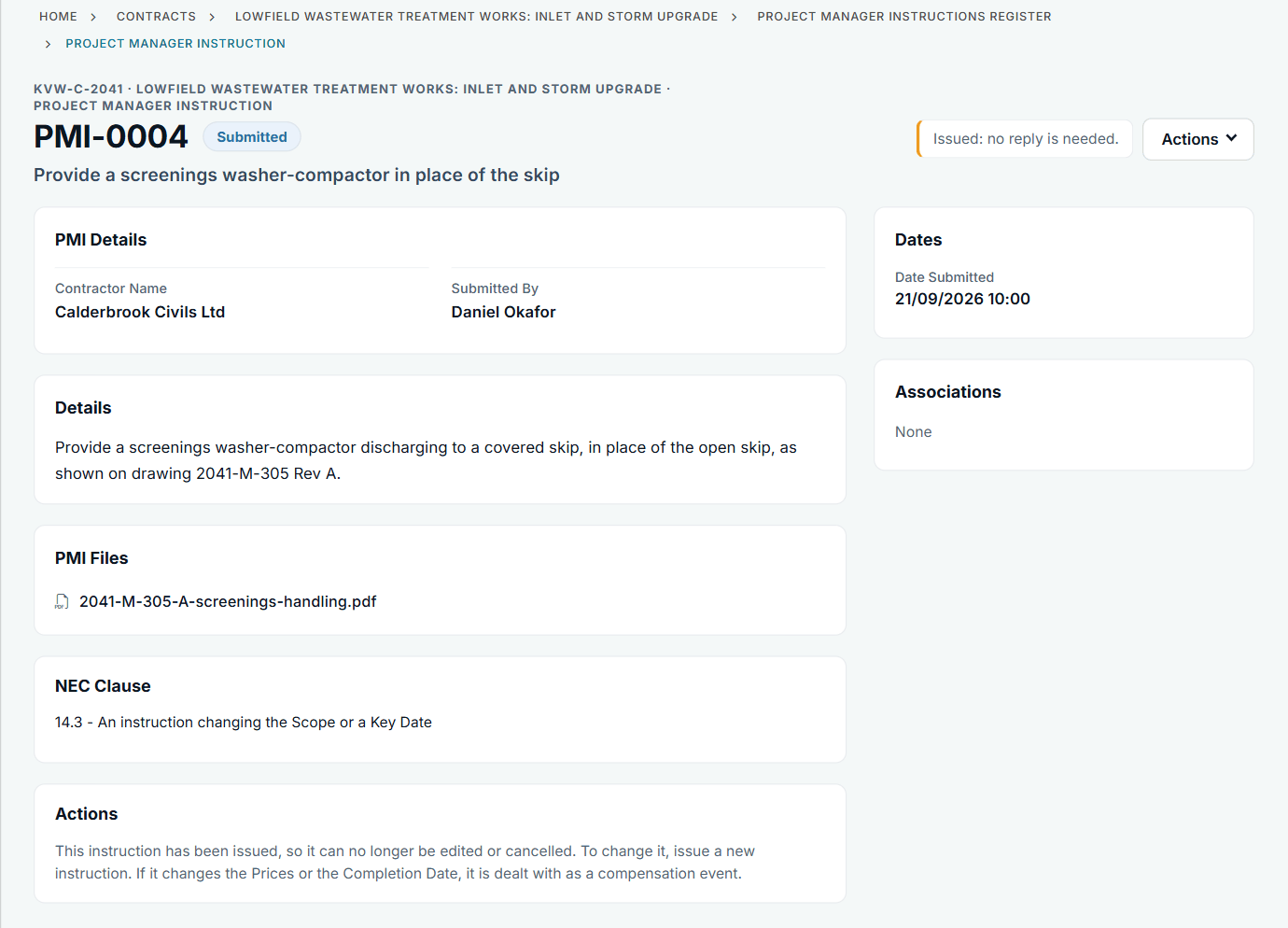
An issued instruction with its file and clause. See the worked example.
See how this works in practice
Click through Contract Status with sample contracts: raise the notice, reply to it, and watch both sides of one record.
Take the guided tour Book a demo
Use the NEC deadline calculator, use the free NEC tools or download free NEC templates.
This guide is general information in our own words, not legal advice. Your contract and its Contract Data always govern. NEC, NEC3 and NEC4 are trade marks of Thomas Telford Ltd; Contract Status is not affiliated with or endorsed by NEC.