
The Project Manager makes its own programme for the remaining work and uses that: with no Accepted Programme under NEC, clause 64.2 moves control of the delay assessment from the Contractor to the Project Manager. The event can still be notified and assessed, so what's at stake is who controls the baseline and how much your time claim will depend on someone else's view.
The rule is 64.2 in both NEC3 and NEC4 ECC. It also applies when the Contractor hasn't submitted a required programme, and when the latest one was rejected for a reason the contract gives.
What changes when there's no Accepted Programme
| Item | With an Accepted Programme | Without one |
|---|---|---|
| Delay to the Completion Date | Measured against planned Completion on the programme current at the dividing date (63.5) | Measured on the Project Manager's assessed programme (64.2) |
| Who assesses the event | Contractor quotes; the Project Manager replies (62.3) | The Project Manager can assess, if the required programme or alterations weren't submitted or the last one was rejected for a stated reason (64.1) |
| Access: 60.1(2) | The later of the Contract Data date and the programme date | Only the Contract Data date remains to test. Expect a debate |
| Others: 60.1(5) | Times shown on the programme | Only the Scope's conditions and unstated work remain easy to test |
| Payment | No effect | If the Contract Data names no programme, a quarter of each assessed Price for Work Done to Date is held back until a first programme with the required information is submitted (50.5; NEC3 ECC: 50.3) |
What to do now
- Find out why there isn't one. Was a first programme ever due or submitted? Did the Contract Data name one? Has the Project Manager replied? Each answer has a different fix. First programmes and the Accepted Programme set out the rules.
- Contractor: submit a compliant programme today if none has gone in. Show everything 31.2 lists, and if there's been no response, chase the two-week reply (31.3).
- Contractor, on NEC4 ECC: use deemed acceptance. Notify the missed reply. If there's still no answer a further week later, the programme is treated as accepted. NEC3 ECC has no such rule, though a late reply can be 60.1(6).
- Keep notifying events. The eight-week time bar in 61.3 doesn't wait for the programme (seven weeks under NEC4 ECS).
- Project Manager: notify your assessment on time. Under 64.3 you have the time the Contractor had for its quotation (three weeks in NEC4 ECC), starting when the need for your assessment became apparent. If you don't, the Contractor can notify the failure, and two weeks later its quotation is treated as accepted (64.4).
- Quote anyway, with your own programme attached. It may be overruled, but it gives the Project Manager a clear starting point and puts your plan on the record.
Worked example
A fictional water treatment job on Option C, with illustrative dates. The Contract Data names no programme. The Contractor's first submission in January was rejected for missing float and resources, and nothing has been accepted by April. On 10 April, the Project Manager instructs a new tank, a compensation event.
The Contractor sends a quotation for £210,000 and six weeks, with its own unaccepted programme showing planned Completion on 18 October. The Project Manager decides under 64.1 and 64.2 to assess. It builds a programme for the remaining work from a progress survey and shows planned Completion on 1 November. The new tank delays that by four weeks, because a parallel activity had already absorbed part of the time. The Completion Date moves four weeks, and its assessment for the Prices is £184,000.
What's the problem here? The programme used has the Contractor's own delays baked in. A later-starting baseline leaves the event less room to affect planned Completion. Had an accepted programme existed from January, the assessment would have started from the Contractor's own plan.
What each side should expect
Contractor: the Project Manager's assessment can be low on time, and it will rarely use your preferred logic. You can dispute it. See when the Project Manager has assessed too low and the guide to Project Manager assessments.
Project Manager or Client: expect the Contractor to say that you caused the problem by refusing reasonable programmes. If the refusals weren't for a reason stated in 31.3, they may be a compensation event in themselves, and the rule in 64.1 only helps you where the reason was valid.
Contract position against practice
The contract says no accepted baseline leads to a Project Manager's programme, and it doesn't stop the event being assessed. In practice, both sides are better off fixing the baseline than arguing around it. A joint workshop that agrees actual progress and remaining logic can produce an acceptable programme in days. For related issues, see NEC questions answered.
Related guides
- NEC Questions Answered: Real Situations on Site
- The Contractor Has Stopped Updating the Programme
- The Contractor Has Not Submitted a First Programme
- The Client's Change Used Up Our Float: Can We Claim?
- We Are Running Behind Programme: What Should We Tell the PM?
- The PM Will Not Accept Our Programme: What Now?
How this looks in Contract Status
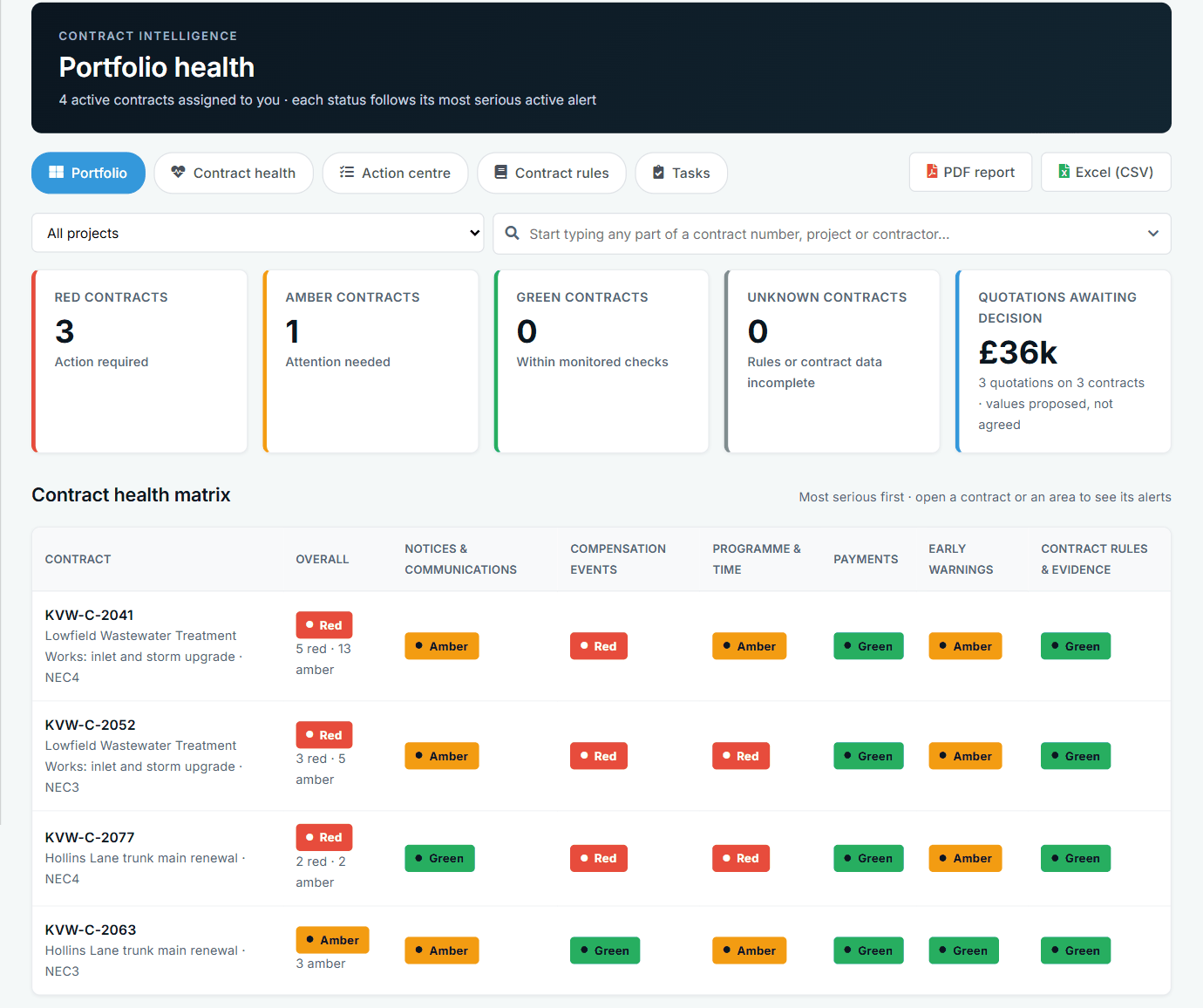
Portfolio health across contracts, by area. See the worked example.
See how this works in practice
Click through Contract Status with sample contracts: raise the notice, reply to it, and watch both sides of one record.
Take the guided tour Book a demo
Use the NEC deadline calculator, use the free NEC tools or download free NEC templates.
This guide is general information in our own words, not legal advice. Your contract and its Contract Data always govern. NEC, NEC3 and NEC4 are trade marks of Thomas Telford Ltd; Contract Status is not affiliated with or endorsed by NEC.