
No: the NEC process has no route for a single global claim. Under NEC4 ECC each compensation event is notified, quoted and implemented separately, so a global claim NEC Project Managers receive has no procedure to run through, and it can be answered with a notice that the Prices and dates are not changing.
That doesn't leave a contractor with a big unresolved position stuck. What decides your options is how many of the underlying events are still in time, and whether you can show what each one caused.
Why a rolled-up figure doesn't fit the contract
Four parts of the mechanism assume one event at a time:
| Rule | NEC4 ECC | Why a global figure struggles |
|---|---|---|
| The eight-week time bar runs from awareness of each event | 61.3 | A single date can't cover events spread over months |
| Each event has its own dividing date | 63.1 | Actual and forecast cost split at a different point for each event |
| Delay is measured against the Accepted Programme current at that date | 63.5 | There's no single programme to measure against |
| Each must fall on the list of events | 60.1, 61.4 | Contractor's own inefficiency hidden in the total can't be assessed |
Clause 63.6 adds that changes to the Prices and dates are the only rights the Parties have for a compensation event. The same structure applies in NEC3 ECC, where that rule is 63.4 and the delay rule is 63.3. See how compensation events are assessed for the detail.
What to do with a pile of unresolved events now
- Check the clock on every item today. List each event, the date you became aware of it, and whether it came from a Project Manager's instruction or notification. Those are outside the time bar. The rest fall within the eight-week limit (seven weeks under NEC4 ECS).
- Notify everything still in time, separately, this week. One line per event is enough to stop the clock: what happened, when, and the 60.1 entry.
- Link related events rather than merging them. Ten late drawings caused by one design package can be separate notices with one shared schedule. Check whether they are one continuing event or several; the answer changes the time bar, so record your reasoning.
- Quote the first ones soon. Each implemented event updates the baseline for the next, which is the proper way to capture cumulative effect.
- Separate what you can't link. Costs with no event behind them are your risk under the priced Options and don't belong in the schedule.
A worked example
A fictional Option A depot refurbishment, with illustrative figures. At month 10 the Contractor forecasts a £640,000 overrun and sends a letter asking for that sum plus 14 weeks. Going through its records produces this picture:
| Item | Status | Amount |
|---|---|---|
| Six Project Manager instructions never notified | Not time-barred; notify and quote | £210,000 |
| Late access to Block C, 5 weeks ago | In time; notify now | £95,000 |
| Others overrunning, 5 months ago | Probably barred; ask the Client for a commercial agreement | £60,000 |
| Rework and low output with no linked event | Contractor's own risk | £275,000 |
The letter asked for £640,000 and could have been rejected whole. The schedule gives £305,000 with a good contractual footing, shows where the argument really lies, and exposes the part that was never recoverable.
What the other side will say
Expect the Project Manager to reply that the letter doesn't identify a compensation event, that any events in it are late, and that nothing changes. Under the contract that reply is available to them under 61.4, and it starts the argument on bad ground for you. A well-advised Client will also ask which part of the figure is down to your own performance, and a total with no breakdown can't answer that.
Contract position against practice
The contract says event by event. In practice, the Parties can settle a batch of events for a single figure if both want to. That's an agreement, and clause 12.3 needs a change to the contract to be agreed, confirmed in writing and signed, so record it properly and say exactly which events are closed. Disruption from several events combined is a harder case, because separating the effects can be genuinely difficult. Showing your best attempt at cause and effect, with honest allowances for your own delays, is more persuasive than a total. Whether a broader claim could succeed in adjudication or court is a legal question on your facts, so take advice before referring it. The guide to adjudication under NEC covers the route, and other situations are in NEC questions answered.
Related guides
- NEC Questions Answered: Real Situations on Site
- Can We Recover Loss of Profit on Omitted Work?
- The Client Wants to Omit Work: Can They?
- The Drawings and Specification Disagree: Which One Applies?
- How Do We Claim Prolongation Under NEC?
- How Is Disruption Recovered Under NEC?
How this looks in Contract Status
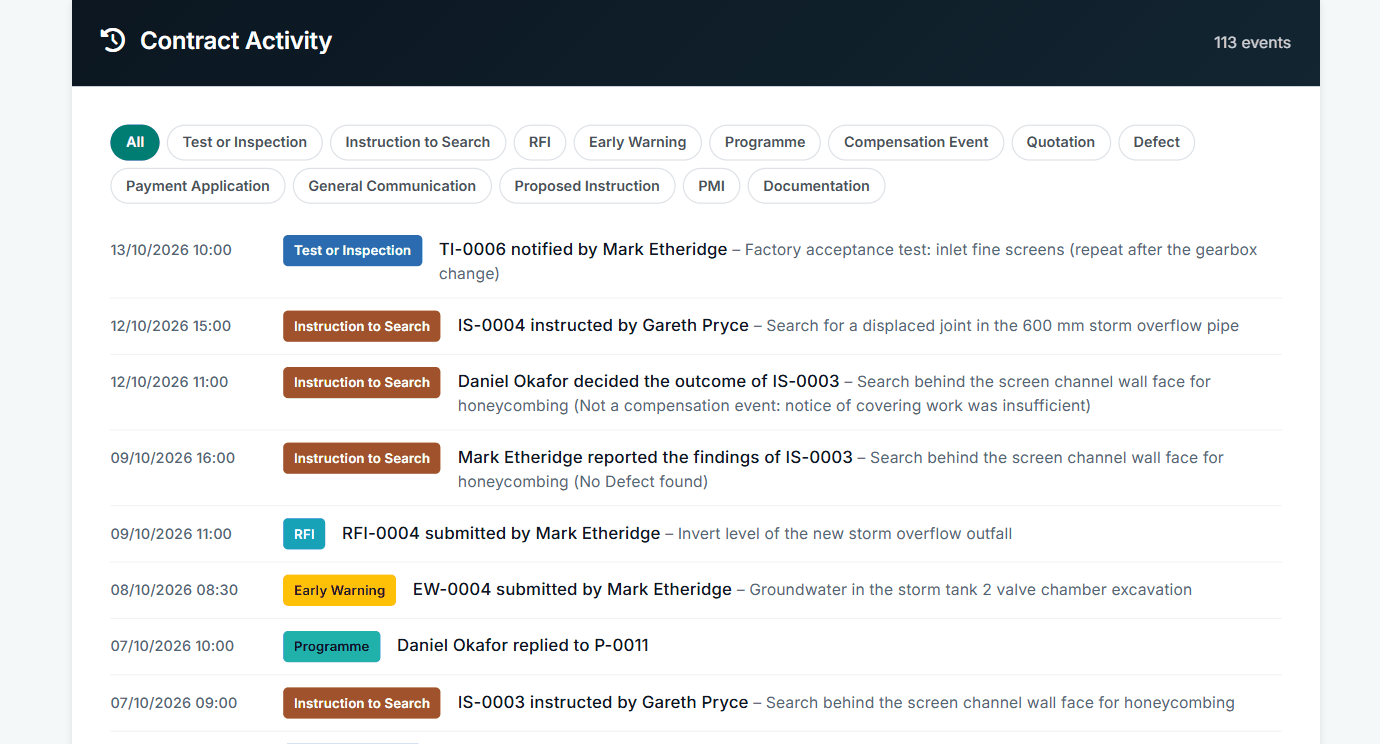
Contract Activity: every step, dated and named. See the worked example.
See how this works in practice
Click through Contract Status with sample contracts: raise the notice, reply to it, and watch both sides of one record.
Take the guided tour Book a demo
Use the NEC deadline calculator, use the free NEC tools or download free NEC templates.
This guide is general information in our own words, not legal advice. Your contract and its Contract Data always govern. NEC, NEC3 and NEC4 are trade marks of Thomas Telford Ltd; Contract Status is not affiliated with or endorsed by NEC.