
It depends: unmarked services can be an NEC compensation event under 60.1(12), but only if an experienced contractor couldn't reasonably have allowed for them at the Contract Date. A line missing from one drawing doesn't settle it. What decides the point is everything you are treated as having looked at, including what you could have seen or obtained.
What to do on the day
- Stop digging around it and make it safe. Treat any unidentified service as live until the owner says otherwise. Safety comes before the contract.
- Find out who owns it and whether it's live, and record who you spoke to and when.
- Photograph and survey it in place, with depth, position, and how it relates to any records you hold. Show the Project Manager before it's moved or covered.
- Give an early warning if it could affect price or programme (15.1).
- Notify the compensation event promptly. The time bar is eight weeks from becoming aware (61.3; seven weeks under NEC4 ECS). Don't wait for the owner's report.
Sample notice: "On [date], at [location], we uncovered an unidentified [type] at [depth]. It does not appear in [Site Information references]. We notify this as a compensation event under clause 60.1(12). Work at [activity] has stopped and we expect an effect on planned Completion. Please attend to inspect by [date] and state any assumptions for quotation."
Would an experienced contractor have allowed for it?
Clause 60.2 says you're taken to have considered four sources. Work through them in order, because this is where the answer comes from.
| Source | Questions to ask |
|---|---|
| Site Information | Did it show this service, a similar one or a survey covering this area? Did it warn that records were unreliable? |
| Public information it refers to | If it names service records or plans, you are treated as having read them |
| A visual inspection | Were there manhole covers, marker posts, cabinets, reinstatement scars or street lights nearby? |
| What you could reasonably have or obtain | Would a normal utility search have shown it? Would you be expected to survey at tender stage for a job like this? |
If the sources conflict, clause 60.3 assumes you took the conditions more favourable to doing the work. So one plan showing a clear corridor against another showing a duct favours you for the Site Information. Remember the test is about chance as well as records. In a busy town-centre street, some unrecorded services might reasonably be expected, so an allowance may be reasonable even where each specific line isn't shown. On a green-field site, far from any route, the argument is quite different. Only the excess over that allowance counts.
A fictional example
A highway drainage job on Option A, with illustrative figures. The Site Information includes utility plans showing a water main and a telecom duct along the verge. Excavation hits a redundant-looking cable duct bank across the trench line, well away from anything recorded, with no surface markers.
The Contractor allowed for hand digging around the known services and two small unrecorded crossings. This one needs a redesign of the manhole and a three-week wait for the owner to confirm and divert it. Only the extra work beyond the allowance for two small crossings goes in the quotation. The wait for the owner could also be a separate point: if the Scope or Accepted Programme showed nothing about this owner's work, the delay flows from the first event. If the diversion had been programmed, see when a utility company is late.
Where the Contractor's position gets weaker
- You didn't run the checks your own safe-digging procedure requires, or the Scope required a survey before digging. If the survey would have found it, the Project Manager will say the delay is yours.
- You damaged the service. Damage to property of Others from Providing the Works is generally a Contractor's liability (clause 81.1), whatever happens on the event itself. Tell your insurer.
- The service is off Site, or outside the trench you're entitled to work in. Check the Site boundary.
- A Z clause passes all service risk to you.
The reply to expect
The Project Manager is likely to reject it under 61.4 on the grounds that it's not a listed event, because services in that area were foreseeable. The contract says they have to judge it against the 60.2 sources at the Contract Date, not with hindsight. In practice, the strongest reply is a one-page map showing each source, and why nothing in it pointed to this line. Get that ready before the reply arrives. The physical conditions guide covers the test in full, and related situations are in NEC questions answered.
Related guides
- NEC Questions Answered: Real Situations on Site
- We Found Contaminated Ground: What Happens Under NEC?
- We Found Asbestos During the Works: What Do We Do?
- We Found Archaeology on Site: Who Pays?
- We Priced the Job Wrong: Can We Get It Changed?
- We Hit Unexpected Ground Conditions: Who Pays?
How this looks in Contract Status
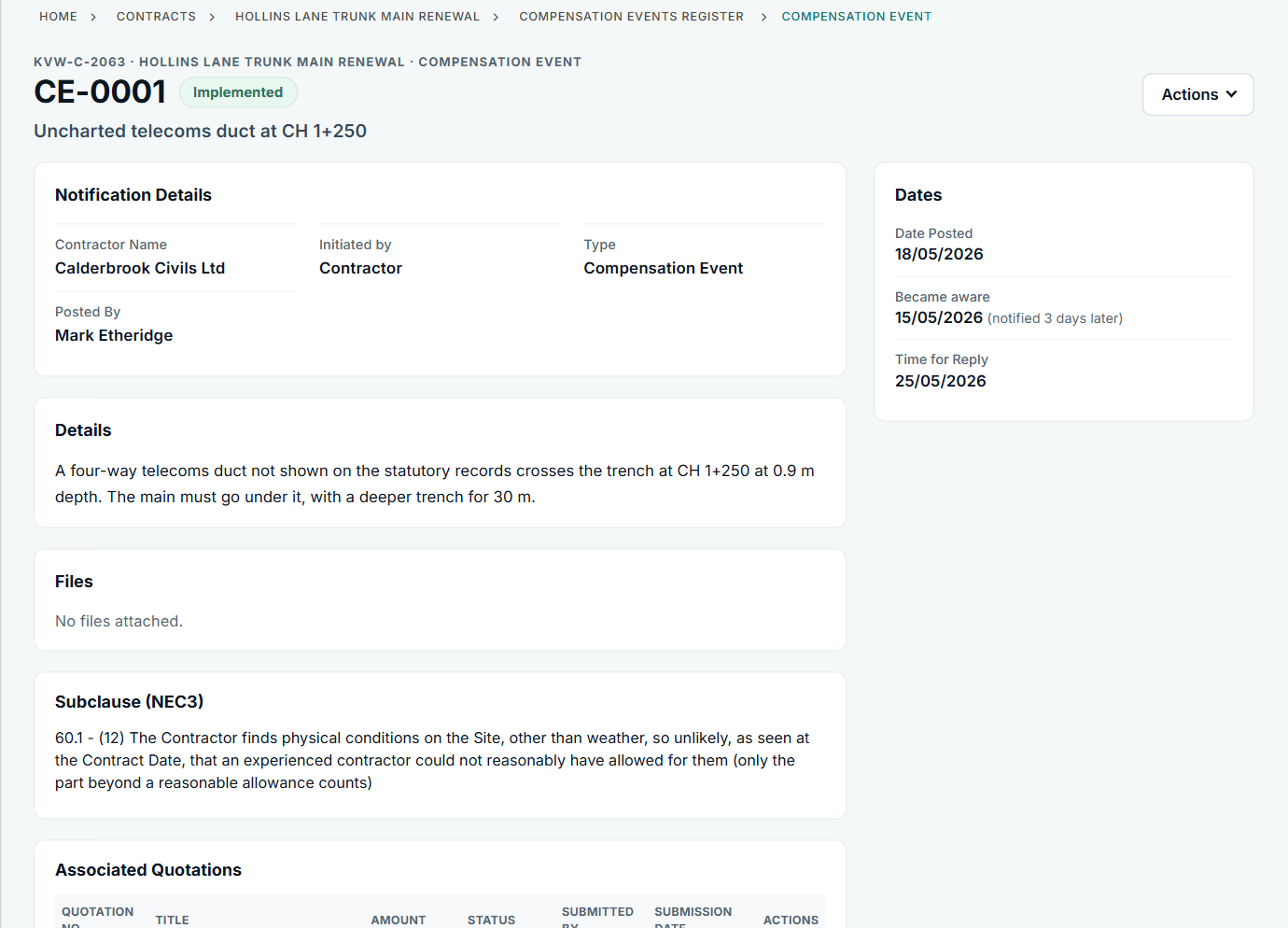
An uncharted duct notified as a compensation event on an NEC3 contract. See the worked example.
See how this works in practice
Click through Contract Status with sample contracts: raise the notice, reply to it, and watch both sides of one record.
Take the guided tour Book a demo
Use the NEC deadline calculator, use the free NEC tools or download free NEC templates.
This guide is general information in our own words, not legal advice. Your contract and its Contract Data always govern. NEC, NEC3 and NEC4 are trade marks of Thomas Telford Ltd; Contract Status is not affiliated with or endorsed by NEC.