
No NEC clause stops spending when the client budget runs out, because the budget isn't a contract term unless Option X22 applies. It depends on the main Option how much you can see and change, but the working controls are forecasting, early warnings, priced decisions on change, and changes to the Scope.
The Contractor's entitlement doesn't shrink because your approval has. That is the first thing to say to a board. See the wider set of NEC questions answered for related situations. This page is written for NEC4 ECC.
What to do this week
- Work out the true exposure. Add implemented events, notified events not yet priced, and open early warnings. The compensation event register should give you the first two. If it can't, that is the first thing to fix.
- Stop unpriced change. Ask the Project Manager to use a proposed instruction for anything discretionary, so the price comes before the decision.
- Warn the Contractor. A matter that could raise the total of the Prices can be raised under 15.1 and taken to a meeting under 15.2. Say what the problem is. The Contractor may have ideas.
- Invite proposals. Clause 16 lets the Contractor propose cheaper changes to the Scope you provided.
- Decide on scope. If money can't be found, the Project Manager can change the Scope under 14.3. Read how an omission is valued first, as it may save less than the tender price suggests.
The controls, and what each one does
| Control | Clause | What it gives you | Its limit |
|---|---|---|---|
| Forecast of total Defined Cost | Options C, D and E clauses | A regular view of the outturn, with reasons for changes | Not on A or B, and only as good as the inputs |
| Early warning | 15.1 to 15.4 | A forum to reduce a problem before it is priced | Doesn't change entitlement by itself |
| Proposed instruction | 65.1, 65.2 | A price before commitment | Refusal is an event under 60.1(20) |
| Contractor's proposal | 16.1, 16.2 | A saving with an agreed design change | The Contractor has to offer one |
| Instruction changing the Scope | 14.3, 60.1(1) | Reduces what is built | Assessed as a compensation event |
| Stopping work | 34.1, 60.1(4) | Holds spending while you decide; a follow-up can take the work out of the Scope | Standing time is a cost too |
| Budget (Option X22 only) | X22.6, X22.7 | A defined Budget with an incentive, where early contractor involvement is used | Has to be in the contract from the outset |
How the main Option changes the answer
| Option | What moves the Client's cost | Where to look |
|---|---|---|
| A | Compensation events | The register |
| B | Compensation events and final quantities | The register, and remeasured quantities against the Bill |
| C and D | Events move the target. Actual cost against target moves the share | The register, the forecast and the share calculation |
| E | Actual Defined Cost plus Fee, with no target | The forecast, and the accounts and records |
A worked example
A fictional Option C depot, with illustrative figures. The approved budget is £5.40m and the original target is £5.00m. Implemented events add £0.30m. Notified events, not yet priced, are estimated at £0.25m. Open early warnings could add £0.20m if nothing is done.
The target is therefore heading for £5.55m to £5.75m, which is already past the budget before any overspend share. Looking only at implemented events would show a comfortable £5.30m. That gap is why unpriced items need an estimate in the Client's report, even though it has no contract status.
What you can't do
- Reject a compensation event because the budget is gone. The grounds for saying an event isn't one are listed in 61.4, and budget isn't among them.
- Delay assessment to hold the figure down. Missed replies can lead to treated acceptance under 61.4, 62.6 and 64.4, on the Contractor's figures.
- Withhold payment without following the process. A shortage of funds isn't a ground, and late payment carries interest (51.2).
- Tell the Contractor directly to do less. It has to come through the Project Manager's instruction.
What the Contractor will say
Expect the Contractor to protect its Fee and its programme. It may say that omissions disrupt the planned sequence and bring their own cost, or that stopping and restarting costs more than finishing. Ask to see that in a quotation. If the funding gap is serious, take legal advice early, as it may affect your ability to meet your payment obligations and the Contractor's rights.
On NEC3, proposed instructions are at 61.2 and there is no clause 16 or 60.1(20). The early warning equivalent is at clause 16.
Related guides
- NEC Questions Answered: Real Situations on Site
- The Contractor Has Stopped Sending Forecasts
- New Regulations Mean Extra Work: Who Pays?
- Our Permit Has Been Delayed: Who Takes the Risk?
- How Does the Client Get a Price Before Instructing a Change?
- We Can Save the Client Money: How Do We Propose It?
How this looks in Contract Status
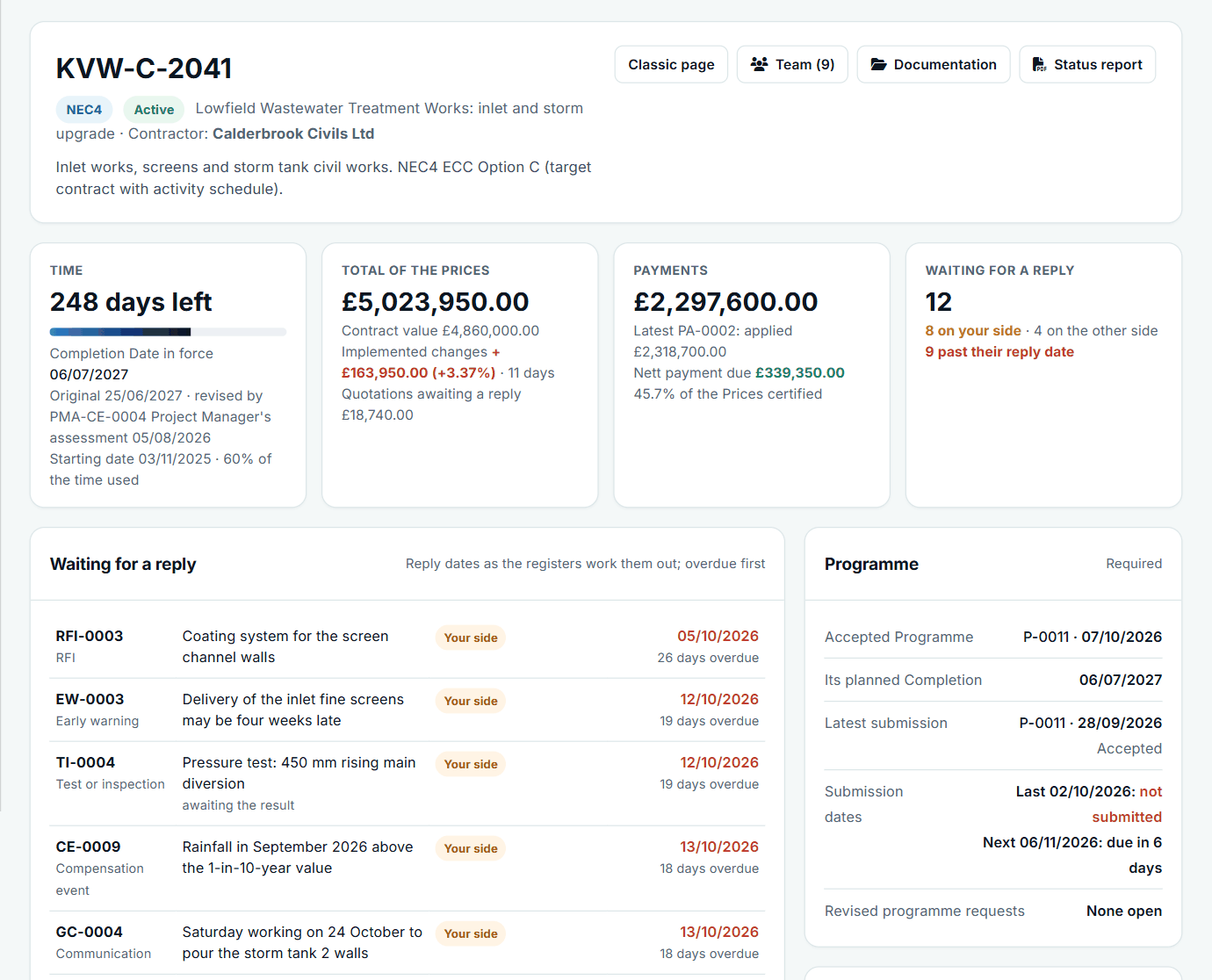
A contract at a glance: time, the total of the Prices, payments and replies waiting. See the worked example.
See how this works in practice
Click through Contract Status with sample contracts: raise the notice, reply to it, and watch both sides of one record.
Take the guided tour Book a demo
Use the NEC deadline calculator, use the free NEC tools or download free NEC templates.
This guide is general information in our own words, not legal advice. Your contract and its Contract Data always govern. NEC, NEC3 and NEC4 are trade marks of Thomas Telford Ltd; Contract Status is not affiliated with or endorsed by NEC.