
It depends on what the information showed: contamination can be an NEC compensation event under 60.1(12) if an experienced contractor couldn't reasonably have allowed for it at the Contract Date. There's no separate contamination clause in the core contract. Before the contract question, though, comes your legal duty to deal with it safely.
This applies to NEC3 and NEC4 ECC alike, as the entry and its numbering match. Contaminated land is one of the risks Clients often move with a Z clause or a detailed Scope entry, so those come first when you read your documents.
What to do first
- Stop work in the affected area and protect people. Bring in your health, safety and environmental advisers. Unusual smells, staining, fibres, drums or oily water should be treated as hazardous until tested.
- Prevent spread. Control runoff and stockpiles. Do not move material off Site until it has been classified, as waste law applies whatever the contract says.
- Tell the Project Manager straight away, and give an early warning (15.1). Regulators may need to be told as well; your environmental adviser will confirm who and when.
- Sample and map it. Agree the testing plan with the Project Manager if you can, so both sides trust the results.
- Notify the compensation event no later than eight weeks after you became aware (61.3; seven weeks under NEC4 ECS). Don't wait for lab results to do this.
- Ask for assumptions. If the extent isn't known when your quotation is due, the Project Manager can state assumptions under 61.6, which are corrected later as 60.1(17) events.
Who pays depends on the documents
| What the documents show | Likely contract position |
|---|---|
| Site Information reports contamination of this type and extent | You are taken to have allowed for it. No event, unless what you found went beyond it, in which case only the excess counts |
| Site report is clean, with a credible desk study | Stronger case, subject to what an inspection or public records would have shown (60.2) |
| Reports conflict with each other | Clause 60.3 assumes the more favourable condition for doing the work |
| Former industrial site, with no investigation provided | Weaker. The history is what an experienced contractor might reasonably find out, so a reasonable allowance may be expected |
| Scope says the Contractor handles all contamination | The event is likely to be out, or heavily limited. Read the words |
| Project Manager instructs extra treatment or a change to the Scope | A compensation event under 60.1(1), whatever the ground test would have said |
The physical conditions guide covers the test in more depth, and unexpected ground conditions gives the general steps and deadlines.
Fictional example
A housing scheme on Option C, with illustrative figures. The site investigation shows slightly elevated hydrocarbons in two trial pits and classes the made ground as non-hazardous. The Contractor priced disposal on that basis for 3,000m³.
Digging finds a buried fuel tank and 800m³ of hazardous soil around it, in an area between trial pits, with nothing visible from the surface. The event assesses the extra of hazardous over non-hazardous disposal for the 800m³, tank removal, testing and the delay. The non-hazardous 2,200m³ stays as priced. The target rises and the Completion Date moves for the critical delay. Had the desk study mentioned a former filling station here, the Contractor's case would be much harder.
Points that catch people out
- Disposal is often yours to organise. Under 73.2, the Contractor has title to excavated and demolition materials, unless the Scope says otherwise. That carries responsibility, so don't assume the Client will deal with it.
- Keep the paper trail. Waste classification records and transfer notes are your evidence of both quantity and cost.
- The Contract Date view. Reports issued after that date can't show what you should have known then, though they can show what was really there.
- Consider other routes. If the Client or Others spill or tip material during the job, this is a matter of fault and may go elsewhere, such as a Client's liability.
What the other side will argue
The Client's team will point to the land's history and say any contractor would have expected contamination. They'll also query volumes and ask why the work couldn't continue elsewhere. If you're on the Client side, ask for sampling records and check whether the soil could have been reused on Site. Either way, the Project Manager has one week to reply to the notification (61.4). In practice, cleaning up can't wait for an argument about who pays, so agree the safe method first and keep the entitlement question running separately, with costs recorded. Who bears liability under environmental law is a separate question from the contract, so take legal advice if a regulator gets involved. More situations are in NEC questions answered.
Related guides
- NEC Questions Answered: Real Situations on Site
- We Found Asbestos During the Works: What Do We Do?
- We Found Archaeology on Site: Who Pays?
- It Has Rained for Weeks: Can We Claim for Weather?
- We Hit Unexpected Ground Conditions: Who Pays?
- We Found Unmarked Utilities: Is It a Compensation Event?
How this looks in Contract Status
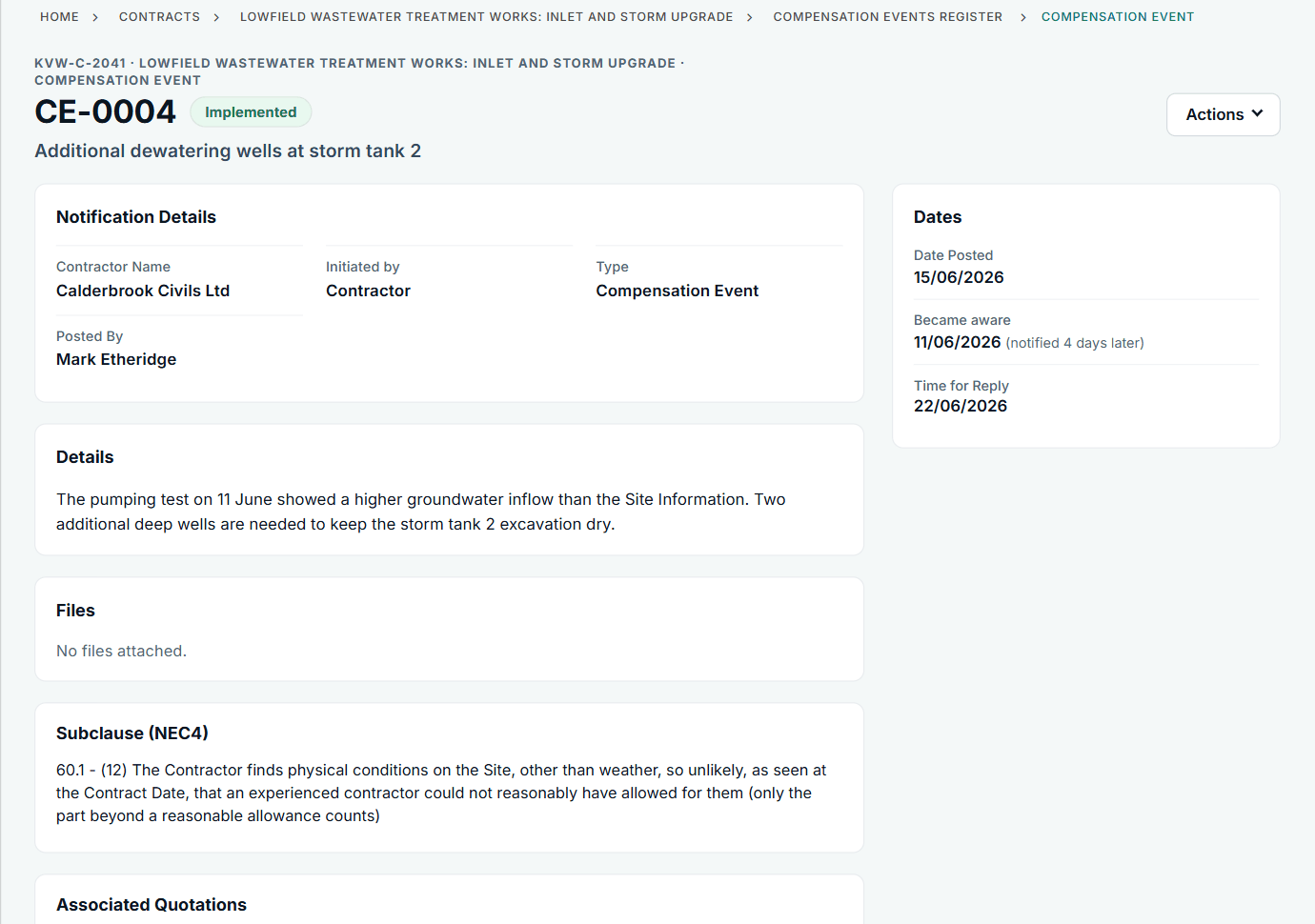
A 60.1(12) event, notified four days after the test that showed the inflow. See the worked example.
See how this works in practice
Click through Contract Status with sample contracts: raise the notice, reply to it, and watch both sides of one record.
Take the guided tour Book a demo
Use the NEC deadline calculator, use the free NEC tools or download free NEC templates.
This guide is general information in our own words, not legal advice. Your contract and its Contract Data always govern. NEC, NEC3 and NEC4 are trade marks of Thomas Telford Ltd; Contract Status is not affiliated with or endorsed by NEC.