
It depends on who the contract made responsible for getting the permit: NEC has no clause on permits, so a permit delay is the Client's risk only if it fits a listed compensation event. The Scope usually settles who applies, and the Accepted Programme usually settles whether the delay counts.
That applies to a street works permit, an environmental consent, a planning condition or a possession. The numbers below are NEC4 ECC and the same in NEC3 unless stated. More live situations are in NEC questions answered.
What to do today
- Give an early warning. Do it now, whoever you think is responsible (15.1; NEC3 16.1). If you could have warned and didn't, any later event can be assessed as if you had.
- If you may have an event, notify it. You have eight weeks from becoming aware it has happened (61.3). Notify on the expected delay rather than waiting for the permit to arrive; the clause also covers an event expected to happen.
- Find who holds the job. Search the Scope, the Contract Data and any Z clauses for permit, consent, licence and approval.
- Look at the Accepted Programme. Note the date for the permit, as it stood when the delay began.
What decides it
| The contract says | The delay is caused by | Likely route |
|---|---|---|
| The Client obtains and provides the permit | Late provision against the Accepted Programme date | 60.1(3): a thing the Client was to provide came later than the programme showed. Without such a date, the event is harder to show |
| The Contractor obtains it | A late or incomplete application | Contractor's risk, and no event |
| The Contractor obtains it | The authority taking longer than the programme showed, after a proper application | Possibly 60.1(5), as Others not working within programmed times. This is arguable, so expect a challenge |
| The Contractor obtains it, for its own design | The authority won't approve the design | Contractor's risk. 27.1 puts approval of its design from Others on the Contractor |
| Nobody is named, and documents conflict | Gap or inconsistency | Notify under 17.1, and the Project Manager says how it is resolved. See gaps in the Scope |
| Permit refused for an event nobody could foresee | Something neither Party could prevent | A narrow possibility under 60.1(19). It has to be something that stops the Contractor completing, or completing by the planned date, and that an experienced contractor would have judged too unlikely to allow for |
| The Client changes what is being built, needing a new permit | An instruction | 60.1(1), with the permit time included in the assessment |
An authority counts as Others if it falls outside the people the contract lists, which include the Client. That matters where a public Client's own department issues the consent: ask whether that is the Client acting, or a separate statutory body.
Why the programme entry matters
The contract says a programme shows the dates when the Contractor will need things, including acceptances, items the Client provides and information from Others (31.2). Events 60.1(3) and 60.1(5) both look to times shown on the Accepted Programme.
In practice, if your programme shows a permit date as a line on the plan, with a realistic lead time, you have something to measure a delay against. If it shows nothing, or shows a date you knew was too short, your position is much weaker. A programme that assumes an unrealistically fast permit may also give the Project Manager a reason not to accept it.
Evidence to gather
- The Scope extract and any information stating who applies.
- The application, with its date, and proof it was complete.
- The authority's published or stated turnaround, and its correspondence.
- Early warnings and meeting records.
- The Accepted Programme current at the time, and how the work has been held up.
Sample wording
What the other side is likely to say
- "You should have allowed for that." Show the lead time in your tender programme and the authority's normal timescale.
- "Your application was late or wrong." Have the dates ready. An event arising from the Contractor's fault gets no change to the Prices or dates (61.4).
- If you are the Client: check who controlled the delay and whether the date was on the Accepted Programme before answering. Your reply to the notification is due within a week, and a missed answer can lead to treated acceptance (61.4).
Related guides
- NEC Questions Answered: Real Situations on Site
- The PM Refused to Accept Our Design: What Now?
- Does PM Acceptance Remove Our Design Responsibility?
- Can a Main Contractor Pay Only When It Has Been Paid?
- The Contractor Has Stopped Sending Forecasts
- New Regulations Mean Extra Work: Who Pays?
How this looks in Contract Status
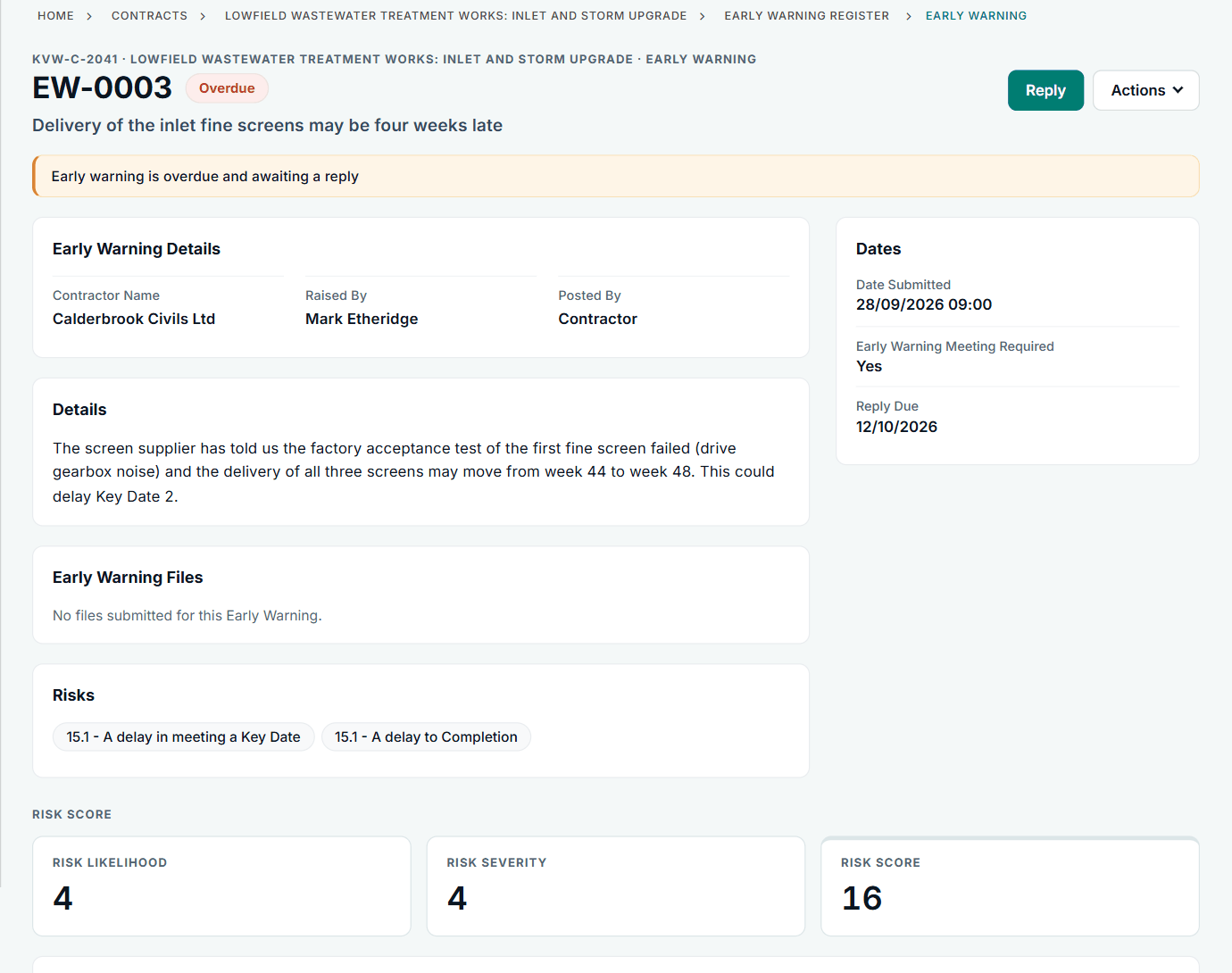
An early warning in Contract Status, with its risks, reply date and score. See the worked example.
See how this works in practice
Click through Contract Status with sample contracts: raise the notice, reply to it, and watch both sides of one record.
Take the guided tour Book a demo
Use the NEC deadline calculator, use the free NEC tools or download free NEC templates.
This guide is general information in our own words, not legal advice. Your contract and its Contract Data always govern. NEC, NEC3 and NEC4 are trade marks of Thomas Telford Ltd; Contract Status is not affiliated with or endorsed by NEC.