
Yes, in most cases: the way to omit work under NEC is a Project Manager's instruction changing the Scope, and clause 14.3 gives that power with no size limit stated. What decides the outcome is who gave the instruction, what was omitted and why, because those facts set the price change and any risk of challenge.
This covers NEC4 ECC. In NEC3 ECC the power is also at 14.3, but it changes the Works Information.
What decides the position
| Fact | Contract position |
|---|---|
| A Client or designer tells site to drop the work | Not a valid change. Only the Project Manager (or a notified delegate) instructs. Ask for the instruction first |
| Project Manager instructs a Scope change | A compensation event under 60.1(1). The Contractor obeys under 27.3 and the event is assessed |
| Work was stopped first, then removed | The stop is an instruction under 34.1 and an event under 60.1(4). A later instruction can restart it or remove it from the Scope |
| Change is to the Contractor's own design, at its request | Not a compensation event, as the 60.1(1) exception applies |
| Contractor proposed the change to reduce what the Client pays, and it was accepted | Clause 16 applies. On Options A and B the Prices fall by the value engineering percentage of the saving (63.12), and on C and D they stay put (63.13) |
| Omitted work then given to another firm | Not addressed in plain terms. See below |
If you are the Client or Project Manager
- Decide exactly what's coming out, by drawing and specification reference. Vague omissions lead to disputes about what remains.
- Consider asking for a quotation for a proposed instruction first (65.1), so the Client sees the effect on price before committing. The cost of the quotation is worth it on larger changes.
- Give the instruction and notify the compensation event at the same time (61.1), with the instruction to quote (61.2).
- Assess the reply against the rule: forecast Defined Cost saved, plus the Fee, rather than the tendered rate. Scope change events are explained in more detail in that guide.
If you are the Contractor
- Stop ordering for the omitted work straight away and tell your supply chain. Clause 63.9 assumes a prompt, competent reaction.
- Make a dated list of what's already been ordered, made or designed for it.
- Submit your quotation within three weeks of being told to (62.3; two weeks under NEC4 ECS). An omission can be priced with costs both ways, and it can also affect the programme and remaining efficiency.
- If no event is notified with the instruction, notify it. The time bar doesn't apply to an instruction, though leaving it serves nobody.
Sample wording: "We have received your instruction of [date] omitting [work]. We treat this as a compensation event under clause 60.1(1). Orders for this work have been held from today. Commitments already made are listed in the attached schedule and will be included in our quotation."
Will the Prices fall by what we priced?
No. Clause 63.3 says a saving doesn't reduce the Prices unless the contract says so, and 63.4 says so for a Scope change. The reduction is worked out on forecast Defined Cost and the resulting Fee under 63.1. That's why the answer on margin is often different from what both sides expect. Losing profit on omitted work has a worked example. Time usually doesn't change much, but the Completion Date can only move for delay under 63.5; the contract doesn't bring it forward automatically for an omission, though the Parties can agree a change.
Can the Client give the work to someone else?
The contract says the Project Manager can change the Scope and doesn't list reasons. It doesn't say in clear words that work can be removed just to give it to another contractor at a better price. In practice this is where omissions get challenged. The Contractor will argue that the power exists to change what the Client wants built, and that taking away its work to hand on is a breach. That's a question of law on the wording and facts, so both sides should take advice before that instruction is given or accepted.
A related practical trap for the Client: if another firm does the work on Site and the Scope doesn't state it, 60.1(5) can give the Contractor a further event if that affects it. See work by the Client or Others.
What the other side is likely to argue
Contractors often say the omission is so large that it's really a different job, and ask for loss of overhead recovery. Project Managers often point to the Fee and say that's the end of it. Clause 63.6 favours the Project Manager on the remedy, unless the change is outside the power. Look for Z clauses that limit or extend omissions, as these can decide it. More situations are covered in NEC questions answered.
Related guides
- NEC Questions Answered: Real Situations on Site
- The Drawings and Specification Disagree: Which One Applies?
- We Priced the Job Wrong: Can We Get It Changed?
- We Hit Unexpected Ground Conditions: Who Pays?
- Can We Submit One Global Claim for Everything?
- Can We Recover Loss of Profit on Omitted Work?
How this looks in Contract Status
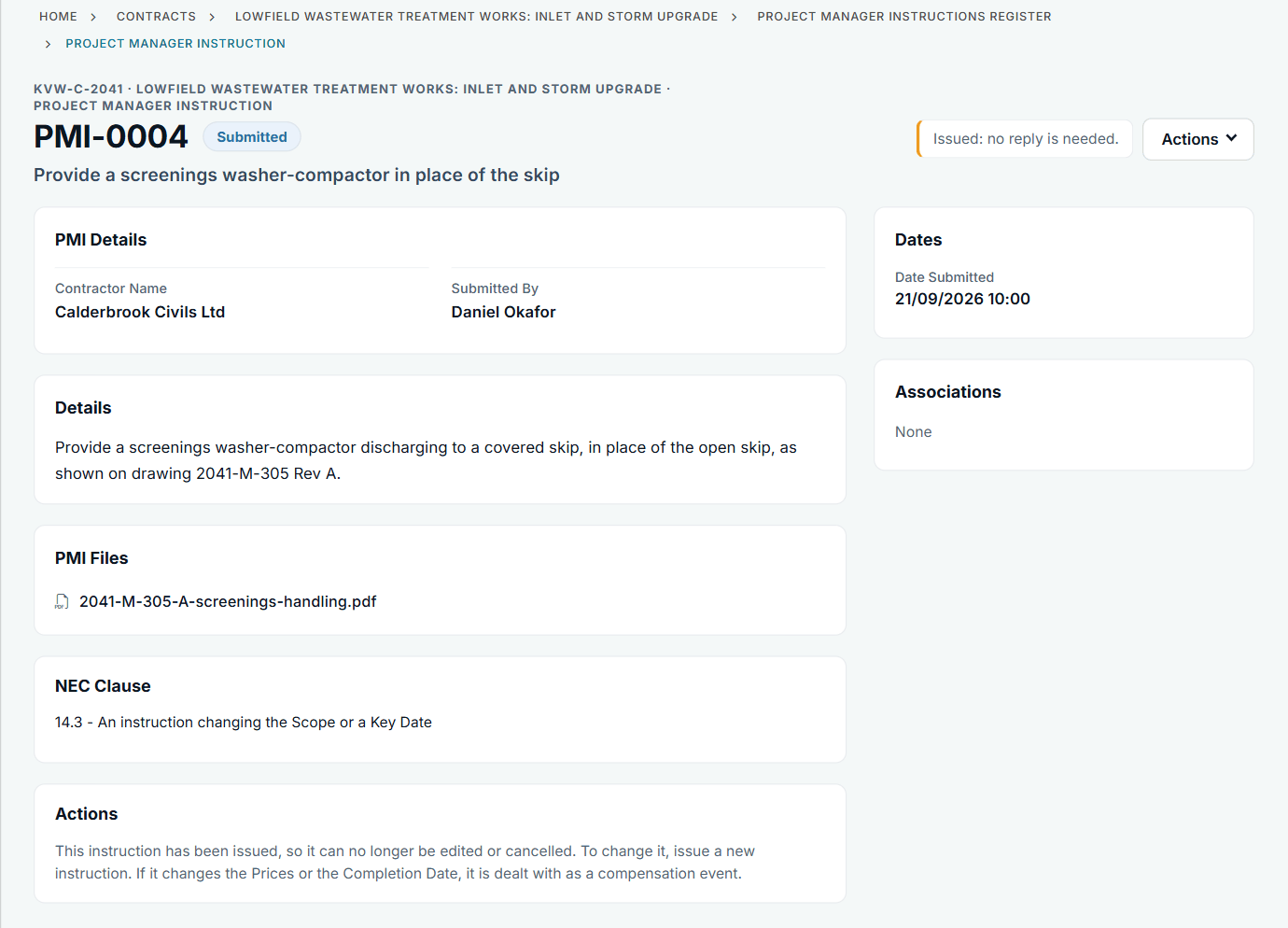
An issued instruction with its file and clause. See the worked example.
See how this works in practice
Click through Contract Status with sample contracts: raise the notice, reply to it, and watch both sides of one record.
Take the guided tour Book a demo
Use the NEC deadline calculator, use the free NEC tools or download free NEC templates.
This guide is general information in our own words, not legal advice. Your contract and its Contract Data always govern. NEC, NEC3 and NEC4 are trade marks of Thomas Telford Ltd; Contract Status is not affiliated with or endorsed by NEC.