
It depends on why you can't price it. If the effects are too uncertain to forecast reasonably, ask the Project Manager to state assumptions under clause 61.6 and price those; if the unknowns are ordinary risks with a real chance of happening, put a risk allowance in your compensation event quotation under 63.8 and submit it.
What you shouldn't do is wait. The three weeks to quote keeps running (62.3, in NEC3 and NEC4 ECC; two weeks in the NEC4 subcontract), and a missed deadline hands the assessment to the Project Manager under 64.1. A quotation is a forecast by design: NEC expects you to price the unknown. More answers are in the NEC questions section.
Sort out the unknowns first
| Your unknown | Route | Example |
|---|---|---|
| A big fact nobody can estimate yet | Assumption (61.6) | How long the flooded basement will take to dry, before the investigation has reported |
| A fact the Client will decide later | Assumption, or ask for the decision | Which replacement cladding the Client will choose |
| A risk with a significant chance of occurring that isn't an event | Risk allowance (63.8) | Lower productivity in the winter on the added work; a delivery that might slip |
| A remote risk that would itself be an event if it happens | Leave out. Notify it if it happens | Very unusual weather during the added work |
| Something you just haven't got round to pricing | Get a supplier quote, or ask for an extension | A subcontract price that's due next week |
In NEC3 the risk allowance rule is 63.6, and it's worded around matters at the Contractor's risk. The assumption rule is 61.6 in both.
What to do this week
- Write down what you don't know, and which items actually move the number.
- Ask for an assumption, in writing, now. The clause has the Project Manager stating assumptions in its instruction to quote, so if they're not there, ask for them. Propose the wording.
- Ask for an extension before the deadline if you need one. Under 62.5, an extension is possible only if you both agree before the submission is due.
- Submit on time regardless. A quotation that lists your assumed basis and allowances is much better than none.
- Keep the workings. Show how you built up each allowance: chance, consequence, and what it's for.
Sample request
How assumptions change the outcome
A correction is an event under 60.1(17), so the assessment can move with the facts, and it can go down as well as up (63.4 in NEC4). An assumption moves the risk of being wrong away from you. Without one, you bear that risk: the assessment isn't later revised because a forecast was wrong. See also corrected assumptions.
A fictional example
| Item in a quotation (illustrative) | Basis | Amount |
|---|---|---|
| Direct work on six beams | Assumption from the Project Manager | £24,000 |
| Night working: 30% chance if the plating contractor can't get day access | Risk allowance, 30% of an estimated £10,000 | £3,000 |
| Fee at an illustrative 10% | Fee percentage on the Defined Cost | £2,700 |
| Total change to the Prices | £29,700 |
If the survey shows eight beams, the Project Manager notifies a correction, and the extra two are assessed. If it shows the night working wasn't needed, the £3,000 stays. It was a forecast of a risk you carried.
Expect pushback on these
- "Just quote it, we won't give an assumption." The decision is theirs, because the clause depends on what the Project Manager decides is too uncertain. Then price the risk honestly, and show why.
- "That allowance is just padding." A vague contingency percentage invites this. An item with a reason doesn't. Risk allowances are in the contract; see what quotations contain.
- "You could wait and see, and we'll pay actuals." NEC doesn't provide for that on its own terms. If both sides really want to, record the assumption or an agreed approach in writing, and don't rely on an informal promise. Clause 63.2 lets you agree rates or lump sums.
- Own assessment. If it thinks your figure is wrong, the Project Manager can assess (64.1). That isn't a failure on your part, and you can dispute the result.
Contract and practice
The contract asks for one number, based on a reasoned forecast, by the deadline. In practice, the conversation before the quotation matters most: 15 minutes with the Project Manager to agree which unknowns get assumptions can save both sides from weeks of revisions. Keep a note of what was agreed, and put it in the quotation.
Related guides
- NEC Questions Answered: Real Situations on Site
- The Work Is Already Done: How Do We Quote?
- Actual Cost Came In Higher Than Our Accepted Quotation
- Actual Cost Was Less Than the Accepted Quotation: Do We Keep It?
- The PM Rejected Our Compensation Event Without Reasons
- The PM's Assessment of Our Compensation Event Is Too Low
How this looks in Contract Status
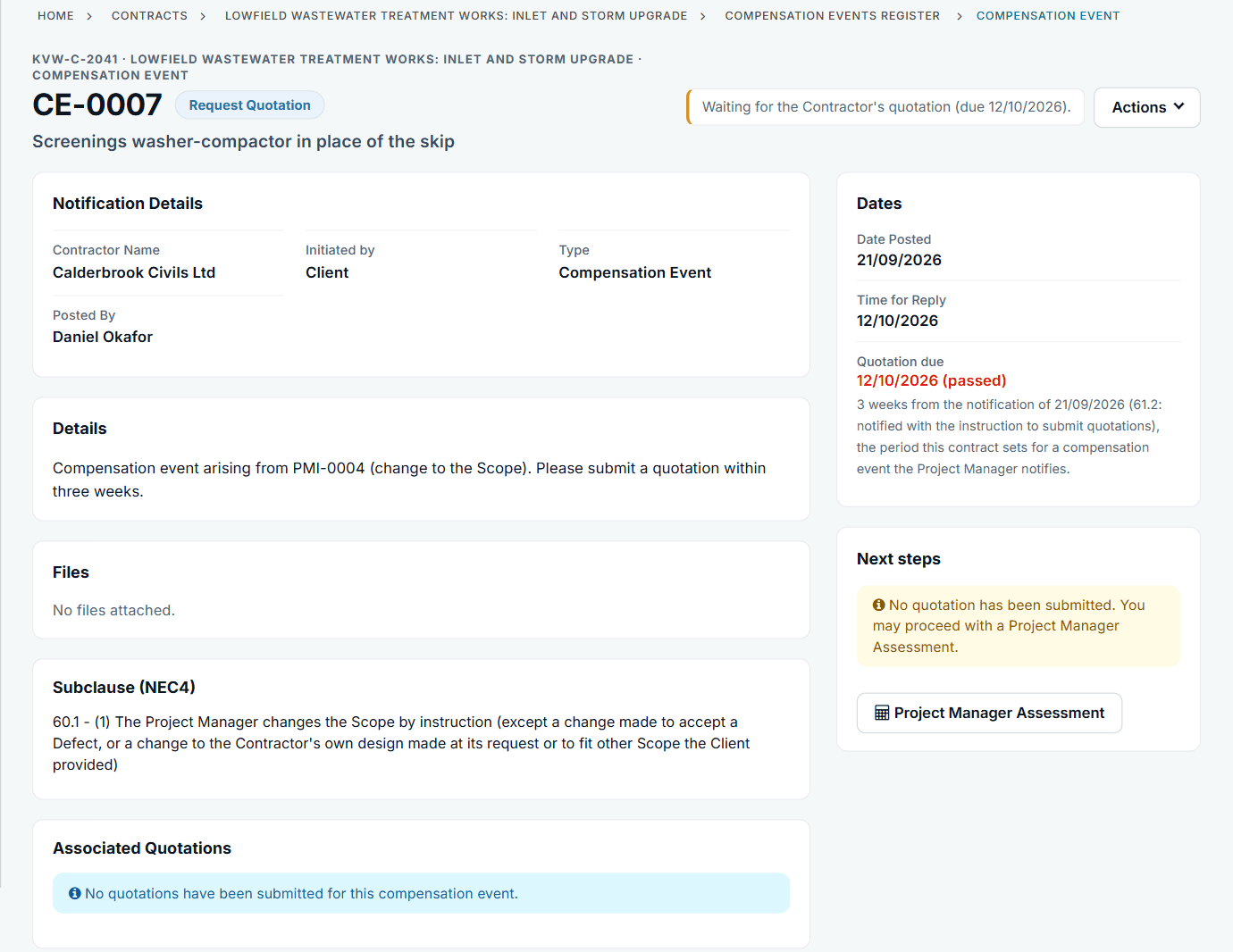
The quotation date has passed, and the record offers the Project Manager's assessment. See the worked example.
See how this works in practice
Click through Contract Status with sample contracts: raise the notice, reply to it, and watch both sides of one record.
Take the guided tour Book a demo
Use the NEC deadline calculator, use the free NEC tools or download free NEC templates.
This guide is general information in our own words, not legal advice. Your contract and its Contract Data always govern. NEC, NEC3 and NEC4 are trade marks of Thomas Telford Ltd; Contract Status is not affiliated with or endorsed by NEC.