
No, there is no automatic money penalty when a contractor is not updating the programme under NEC. The quarter held back from payment applies only to a missing first programme, so what decides your position is whether an Accepted Programme exists and how stale it has become.
The Project Manager still has real tools, and the first one takes a single instruction. This page follows the NEC4 Engineering and Construction Contract (ECC); clause 32.2 carries the same number in NEC3. It sits with the other NEC questions answered.
What to do this week
- Check the interval. The Contract Data sets how often a revised programme is due. Work out the date the last one fell due and how many have been missed. If Z clauses add a remedy, such as a holding back of payment, they will be there too.
- Instruct a revised programme under 32.2. The Contractor then has the period for reply to submit it, so a clock is running from the day you send it.
- Record the failure at the next meeting and add it to the Early Warning Register if it threatens Completion or a Key Date.
- Move to your own assessments on any compensation event quoted without a programme the contract requires (see below).
- Keep the point out of the payment certificate. Without a Z clause, a late revision is no reason to reduce the amount due.
Sample instruction, in our own words
"Under clause 32.2 I instruct you to submit a revised programme for acceptance within the period for reply. It should show actual progress to a status date no earlier than [date], the effects of compensation events and your plans for dealing with delays and notified Defects. The last programme you submitted is dated [date]. The Contract Data requires a revision every [interval]."
What the contract gives you
| Tool | Clause | What it achieves |
|---|---|---|
| Instruction to revise | 32.2 | A dated duty, on top of the regular interval |
| Your own assessment of a compensation event | 64.1 | Available where the Contractor hasn't submitted a programme or alterations the contract requires |
| Assessing on your own view of the remaining work | 64.2 | You aren't stuck with an out-of-date plan when pricing time |
| Notifying a default | 91.2 | For a substantial failure to comply with obligations, this starts the route to reason R11. It is a last resort |
That second and third row usually get attention fastest. A Contractor who wants to argue for extra time and money on its own figures needs a current programme to do it. How the programme feeds compensation events explains the link.
Why a stale programme hurts the Client as well
The Accepted Programme stays in force until a later one is accepted, however old it gets. Delay from a compensation event is measured against the one current at the dividing date (63.5 in NEC4; 63.3 in NEC3). NEC4 allows for events since that programme's date, but the older it is, the more the assessment depends on reconstructing the past. You also lose your best early view of a late finish, and of whether Key Dates are safe.
What the Contractor is likely to say
| Their answer | The contract position |
|---|---|
| "The last revision is still with you" | The interval keeps running. But check your own desk first: a reply is due within two weeks, and under NEC4 silence can lead to treated acceptance after a further notice (31.3) |
| "We can't revise until events are assessed" | Not a reason the contract gives. A revision records the effect of compensation events; in practice, unresolved ones can be shown with stated assumptions |
| "You rejected the last one, so what's the point?" | Rejection needs a reason the contract allows. If yours was thin, expect that to come up |
| "Our planner has left" | A resourcing problem for the Contractor, not a relief from the duty. In practice, agree a short date rather than arguing |
In practice
Most lapses have a cause you can find with one phone call: a planner moved to another job, an argument about float, or a real delay nobody wants to put on paper. If the last of these is the reason, the missing programme is itself a warning sign. Ask for a walk-through with the site team alongside the formal instruction. If the Contract Data interval is unworkably short, or the two of you can't keep up with it, see how the revision interval works before escalating, since changing it needs agreement. Treat termination language with care, and take legal advice before notifying any default.
Related guides
- NEC Questions Answered: Real Situations on Site
- The Contractor Has Not Submitted a First Programme
- The Client's Change Used Up Our Float: Can We Claim?
- We Missed a Key Date: What Does It Cost?
- The PM Will Not Accept Our Programme: What Now?
- There Is No Accepted Programme: How Are Events Assessed?
How this looks in Contract Status
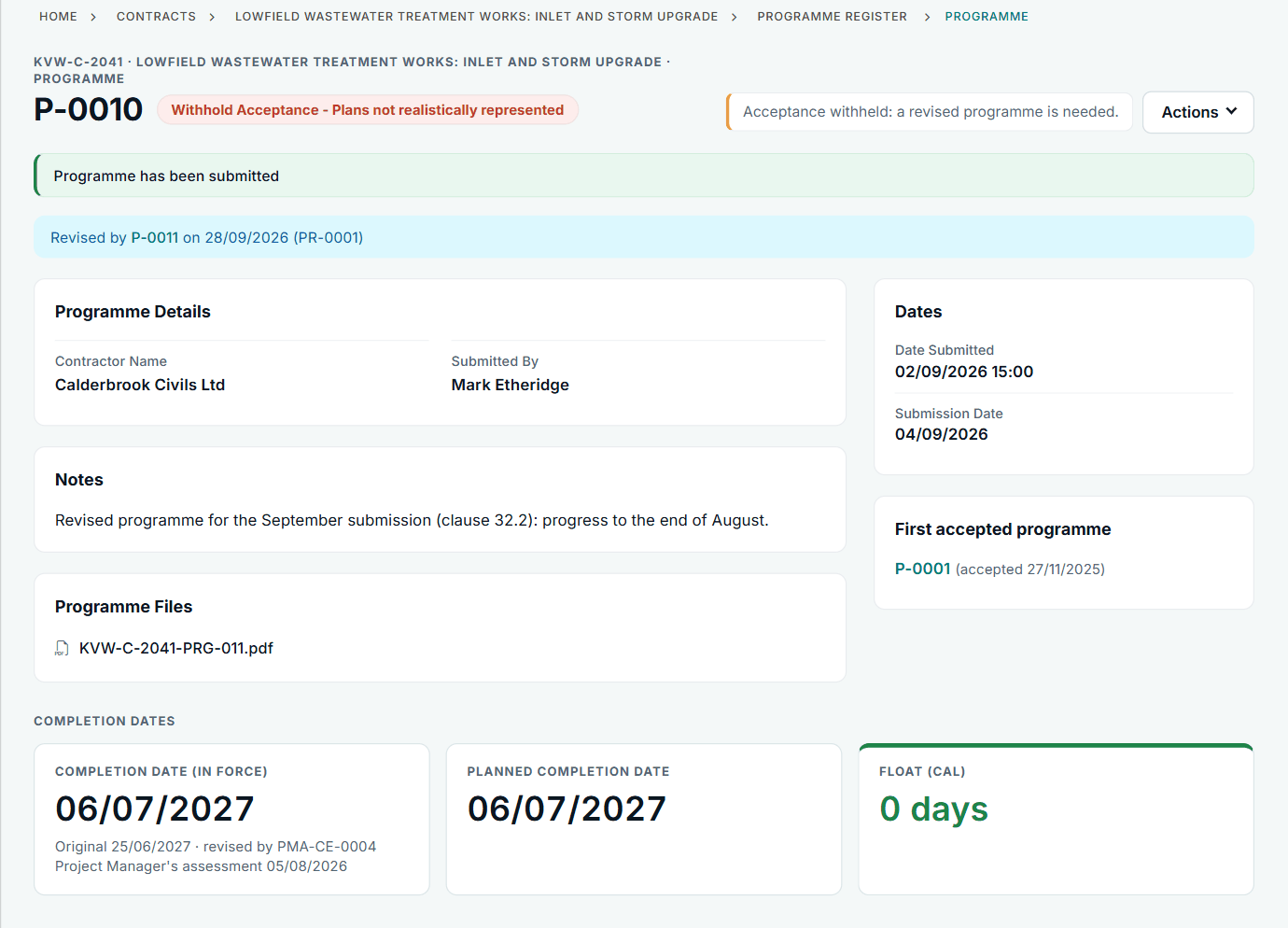
A programme not accepted, from the Contractor side, with the reason in its status. See the worked example.
See how this works in practice
Click through Contract Status with sample contracts: raise the notice, reply to it, and watch both sides of one record.
Take the guided tour Book a demo
Use the NEC deadline calculator, use the free NEC tools or download free NEC templates.
This guide is general information in our own words, not legal advice. Your contract and its Contract Data always govern. NEC, NEC3 and NEC4 are trade marks of Thomas Telford Ltd; Contract Status is not affiliated with or endorsed by NEC.