
It depends on who was to provide the drawings and what the Accepted Programme shows. Late drawings are a compensation event if the Client or its designer was to provide them and they arrive after the programme date; if your own designer was to produce them, they aren't.
NEC has no event called "late drawings". You have to fit the facts to one of the listed events, using the NEC4 ECC numbers below, which match NEC3 for these events. This answer sits within our NEC questions section.
Start the clock check first
- Find the day you knew the date had been missed. Under NEC4 clause 61.3 you have eight weeks from knowing the event has happened. The NEC4 subcontract has seven. NEC3 counts from awareness of the event, which can be earlier.
- Notify, even without a price. A notification needs the event and the sub-clause you rely on. The Project Manager then has a week to reply (two under the NEC4 subcontract). See how to notify.
- Don't confuse it with your warning. An early warning doesn't count as notification. If you haven't warned, do that as well.
Which event fits
| Facts | Event | What you need to show |
|---|---|---|
| The Scope makes the Client responsible for providing the drawings, and they came after the date on the Accepted Programme | 60.1(3) | The duty to provide, plus the programme date |
| A separate designer, who counts as Others, didn't work within the times on the Accepted Programme | 60.1(5) | The designer's status and the times shown. See the event for Others |
| The drawings arrived on time but change what's required | 60.1(1), once instructed | A Project Manager instruction. See revised drawings |
| You asked a contractual question and the reply missed its period | 60.1(6) | The required reply, the period and the effect |
| The Client breached the contract some other way that caused the lateness, and no other event fits | 60.1(18) | The breach. Treat this as a fallback and take advice |
| Your own designer was late, for its own reasons | None | Your own risk |
The programme decides more than people expect
60.1(3) tests against the date shown on the Accepted Programme, not the date you wanted, and not a date in a drawing schedule or in meeting minutes. So:
- If the programme shows the need date, the test is simple.
- If your latest programme shows a date but was never accepted, the last Accepted Programme governs.
- If the programme shows no date for those drawings, 60.1(3) is much harder to rely on. Fix it in your next revision.
- If there's no Accepted Programme at all, the Project Manager will assess the time effect on its own view of the remaining work (64.2).
Worked example
A fictional Option A school block, with illustrative figures. The Scope says the Client's engineer provides the foundation drawings, and the Accepted Programme shows them on 3 March. They arrive on 24 March. The Contractor notifies 60.1(3) on 5 March, two days after the date passed.
| Assessment item | Outcome |
|---|---|
| Planned Completion | Moves two weeks. The third week is absorbed by a re-sequence the Contractor found |
| Forecast Defined Cost | Site staff and cabins for two extra weeks, plus standing groundworks gang for one: £31,000 |
| Fee | Added at the stated fee percentage |
The dividing date is the notification date, 5 March, so almost all of it is a forecast. Because the assessment isn't later revised if the forecast is wrong, get it right in the quotation.
Expect these replies
- "You could have warned earlier." A 61.5 statement can reduce the assessment, but it doesn't remove the event.
- "Your own work was already behind." Delay is measured against the programme current at the dividing date, so progress you've lost by then counts against you. Show the drawings still drove the critical path.
- "Those drawings were your design." Go to the Scope. It's the document that allocates design; the drawing's title block doesn't.
In practice, keep a drawing register showing the date needed, date promised and date received, because it's the first thing either side will ask for. Whether a specific set of facts is a breach is a legal point: if a large sum turns on 60.1(18), take advice.
Related guides
- NEC Questions Answered: Real Situations on Site
- Our Own Designer Is Late With Drawings: Who Pays?
- Revised Drawings Arrive After IFC: Is That a Change to the Scope?
- Our RFI Has Not Been Answered: What Can We Do?
- IFC Drawings Are Late: Should We Give an Early Warning?
How this looks in Contract Status
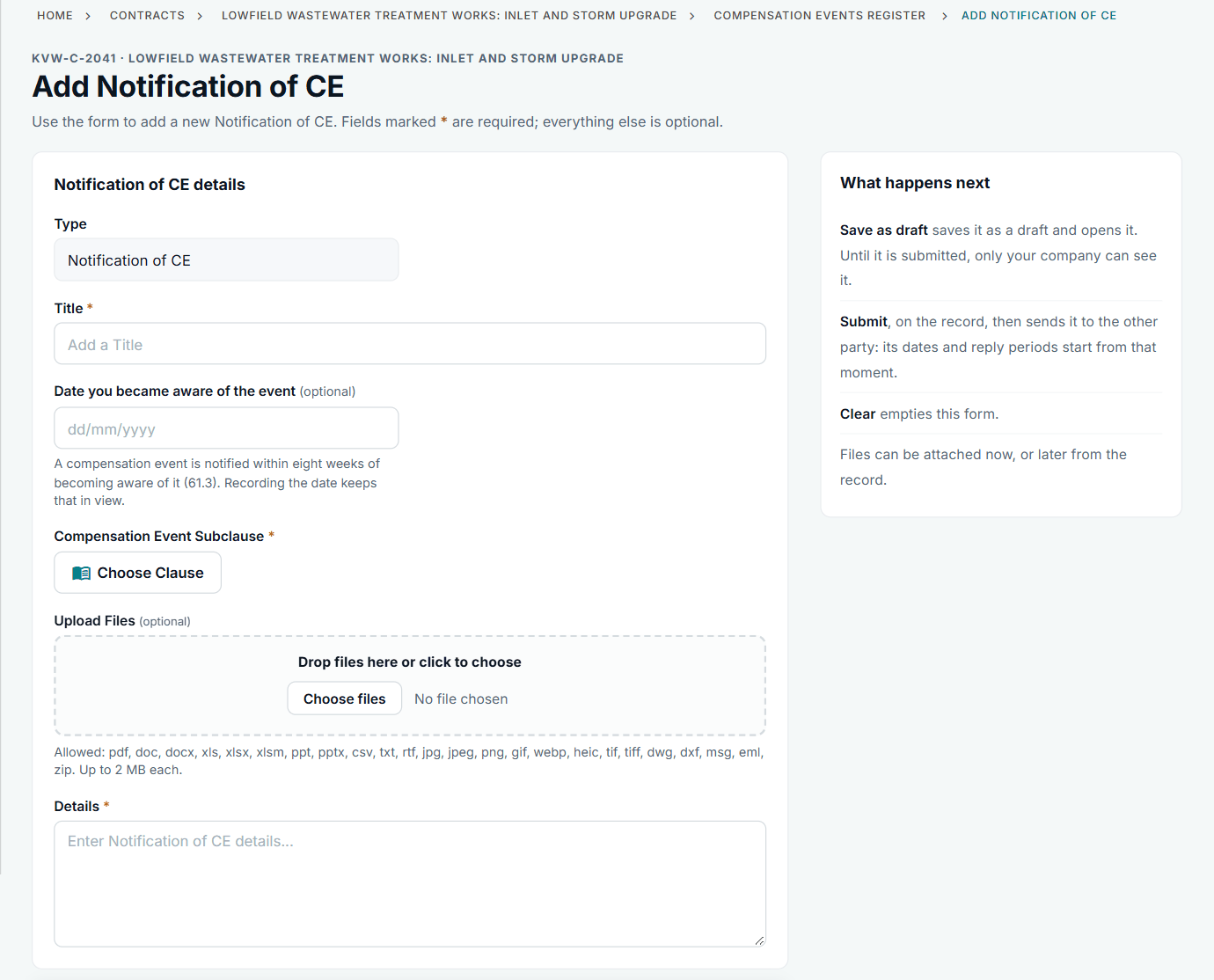
Notifying the event separately, with the date you became aware. See the worked example.
See how this works in practice
Click through Contract Status with sample contracts: raise the notice, reply to it, and watch both sides of one record.
Take the guided tour Book a demo
Use the NEC deadline calculator, use the free NEC tools or download free NEC templates.
This guide is general information in our own words, not legal advice. Your contract and its Contract Data always govern. NEC, NEC3 and NEC4 are trade marks of Thomas Telford Ltd; Contract Status is not affiliated with or endorsed by NEC.