
Yes. Give an early warning as soon as you know late IFC drawings could delay Completion or a Key Date, raise the total of the Prices, or harm how the works perform in use. That holds whoever owns the design; ownership decides who pays, not whether you warn.
"IFC" isn't an NEC term, so the contract looks only at the effect. Clause 15.1 of NEC4 ECC sets the duty (16.1 in NEC3), and the test is whether the matter could have one of those effects, not whether it certainly will. It's one of the common situations in our NEC questions section.
What to do today
- Send the warning now. The contract gives no grace period: it says as soon as you become aware. Don't wait for the date on the programme to pass.
- Compare the need date with the Accepted Programme. Find the date shown for the information, the last date that avoids delay, and the first operation affected.
- Ask for a meeting. An early warning meeting is the place to agree priority packages, re-sequencing or a partial issue of drawings. See how clause 15 works.
- Diarise the separate time bar. If this turns into a compensation event you are the one notifying, the eight weeks in clause 61.3 runs from awareness that the event has happened under NEC4, and the warning doesn't stop it.
- Protect your own programme. Record what you did to reduce the effect. Assessments assume a competent and prompt reaction.
How design ownership changes what follows
| Who owes the drawings | Warn? | What follows |
|---|---|---|
| Client or its designer, with a date on the Accepted Programme | Yes | Possibly a compensation event, once you've notified it |
| Contractor or its design subcontractor | Yes | Normally your own risk. The warning still lets others help reduce the effect |
| Shared: Contractor's designer waiting on Client information | Yes | Split the causes. The Client-side input may be an event; your designer's own lateness isn't |
| Unclear from the Scope | Yes | Raise it now, and ask the Project Manager to confirm who is providing what |
Why silence can cost you
If the Project Manager decides an experienced contractor could have warned and didn't, it says so in the instruction to quote under clause 61.5. The event is then assessed as if you had warned (63.7 in NEC4, 63.5 in NEC3). You keep the event but lose whatever an earlier warning could have saved. On late drawings that's often easy to argue, because the drawing register shows when you knew.
Under Options C, D and E, there's a second exposure: cost incurred only because a required warning wasn't given is Disallowed Cost.
Sample wording
What the Project Manager may say back
- "The drawings aren't late yet." True, and irrelevant. A warning covers what could happen.
- "Your own programme says later." Check. If the Accepted Programme shows a later need date, that later date is the one that matters for 60.1(3).
- "This is a claim." It isn't. An early warning is never accepted or rejected, and it doesn't commit either side on money.
The contract and common practice
The contract says a warning is a notification, so it should go as its own communication. In practice, teams raise design slippage at progress meetings and assume that's enough. It's weak evidence: minutes are read later, often by someone else, and clause 13.7 expects notifications to be kept separate. A short notice takes minutes. For a template, use our early warning notice.
Related guides
- NEC Questions Answered: Real Situations on Site
- Are Late IFC Drawings a Compensation Event?
- Our Own Designer Is Late With Drawings: Who Pays?
- Revised Drawings Arrive After IFC: Is That a Change to the Scope?
How this looks in Contract Status
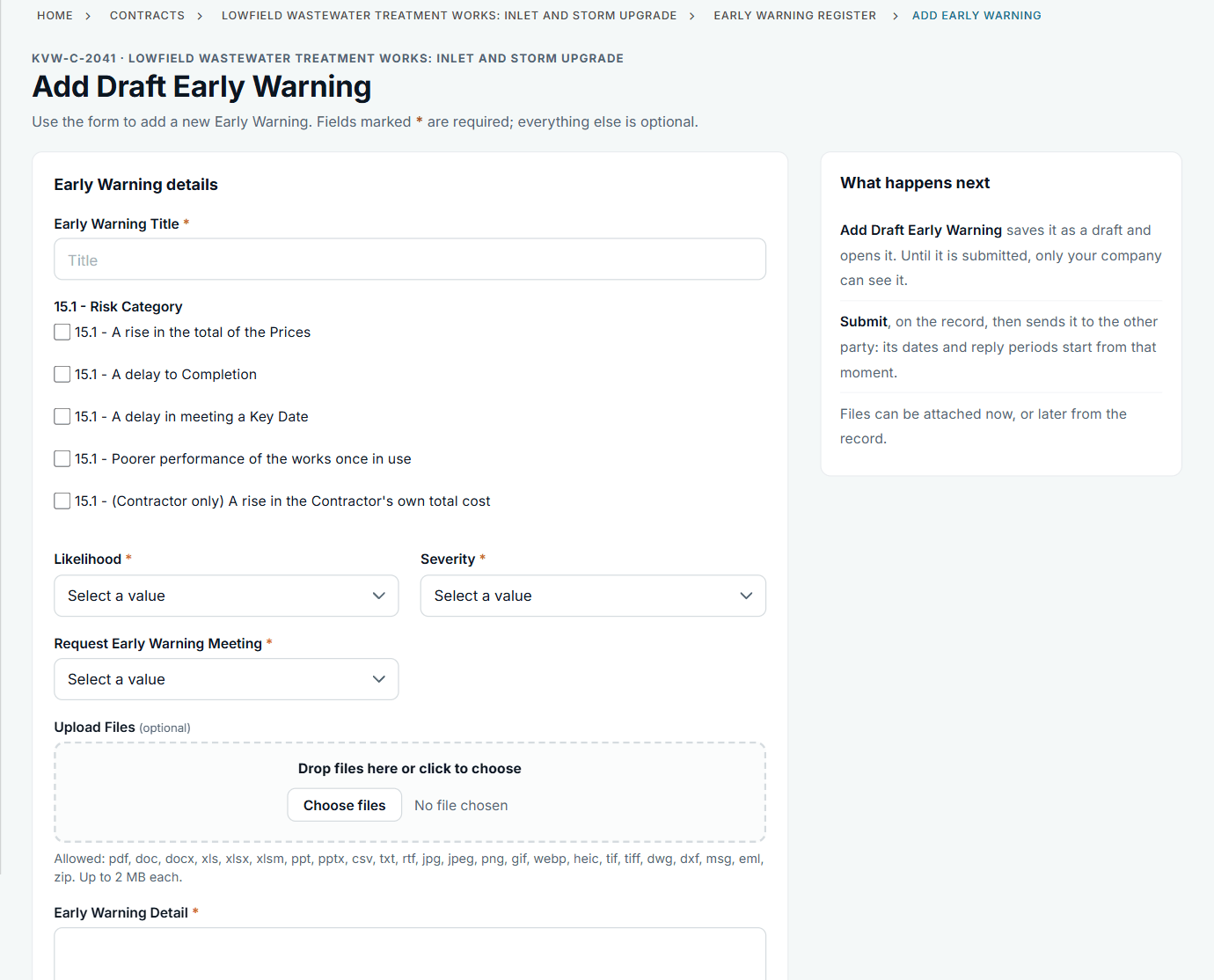
Raising the early warning: risks, scores and a meeting request. See the worked example.
See how this works in practice
Click through Contract Status with sample contracts: raise the notice, reply to it, and watch both sides of one record.
Take the guided tour Book a demo
Use the NEC deadline calculator, use the free NEC tools or download free NEC templates.
This guide is general information in our own words, not legal advice. Your contract and its Contract Data always govern. NEC, NEC3 and NEC4 are trade marks of Thomas Telford Ltd; Contract Status is not affiliated with or endorsed by NEC.