
It depends on who is responsible for that utility's work, and on what your documents show: a utility delay under NEC is the Client's risk when the company counts as Others and falls within 60.1(5), and the Contractor's when the Scope or your own appointment puts it with you. So start with three questions: who employs them, what the Scope says, and what the Accepted Programme shows.
This applies to NEC3 and NEC4 ECC alike. A utility is normally one of the Others, but the Scope can change where the time risk actually lands.
Who takes the risk: the situations
| Facts | Risk sits with | Why |
|---|---|---|
| Utility's works shown on the Accepted Programme, and they overrun | Client | 60.1(5), working outside the times shown |
| Scope states working conditions for the utility, and it breaks them | Client | 60.1(5), outside the conditions stated |
| Utility digs on Site with no mention in the Scope | Client | 60.1(5), work not stated |
| The Client undertook to provide a connection or a diversion by a programme date | Client | Possibly 60.1(3), something to be provided by the Client |
| Scope makes the Contractor responsible for arranging and programming the utility work | Depends on wording | Read carefully. You may hold co-ordination risk, but the company is still Others and 60.1(5) may still apply if it's shown on your programme |
| You appointed and pay the company as your Subcontractor | Contractor | Not Others. Under 26.1 you're responsible as if you hadn't subcontracted |
| Accepted Programme doesn't show them, and the Scope says they will work at some point | Contractor is exposed | There's no time to test against |
| Scope or Z clause takes all statutory undertaker delay risk away from the Client | Contractor | Amendments override the core entry, so read them first |
What to do this week
- Get a dated forecast from the utility, in writing where you can. Their own programme letter is very useful evidence.
- Give an early warning (15.1) and ask for a meeting that includes the Client and, if possible, the utility. The Client may have more influence with them, and it may hold the agreement.
- Notify the event if the programme date has passed, or you expect it to pass (61.3). The clock is eight weeks from becoming aware it has happened (seven under NEC4 ECS).
- Re-sequence what you can, and record what it costs.
- Don't quietly move the utility dates on your revised programme without a notified event behind them. If that programme is accepted, the baseline moves and the 60.1(5) test gets harder to meet.
Worked example
A fictional housing development on Option A, with illustrative figures. The Scope says a gas network operator will divert a main under its own agreement with the Client. The Contractor's Accepted Programme shows that diversion from 3 to 21 March, with drainage following. On 24 March the diversion is still unfinished, and the operator now says 11 April.
The Contractor warned on 14 March, when the slippage was first mentioned, and notifies on 24 March. By moving drainage crews to another phase for three weeks, it limits costs to re-sequencing and retained traffic management of £28,000 of forecast Defined Cost, plus Fee. Planned Completion moves by nine days and so does the Completion Date, since other work on the critical path could continue. If the same programme had shown the diversion as "by others, date to be agreed", there would have been no date to test, and the Contractor would have been in a far weaker position.
How the Project Manager will probably respond
- "You agreed the programme and the utility dates were yours to verify." Under 31.2, your programme shows others' work as last agreed with them. If you had no agreement behind those dates, expect the point to be raised. Keep the correspondence that supports the dates shown.
- "The utility isn't under our control." That doesn't matter: 60.1(5) doesn't require the Client to control them.
- "You didn't apply in time." If your application, payment or Site prep was late, the delay may be yours. Keep the application date and reference.
Contract position against practice
The contract says the event turns on the programme and the Scope, not on whose fault the slippage is. In practice, utility dates move a lot, so show them clearly on every submission, with their source, and revisit them at each revision. If you're a Client preparing a contract, decide openly who holds this risk and state it, because it's priced whichever way you go. For the full picture, see the guides to the compensation event for Others and what the Accepted Programme is. Where the utility's work uncovers services nobody knew about, see unmarked utilities. More reader scenarios are in NEC questions answered.
Related guides
- NEC Questions Answered: Real Situations on Site
- Our Materials Are Delayed by the Supplier: Who Takes the Risk?
- Material Prices Have Risen Sharply: Can We Recover the Increase?
- We Cannot Get Enough Labour: Is There Any Relief?
- The Client Restricted Our Access Part Way Through
- Another Contractor Is Delaying Us: Is That a Compensation Event?
How this looks in Contract Status
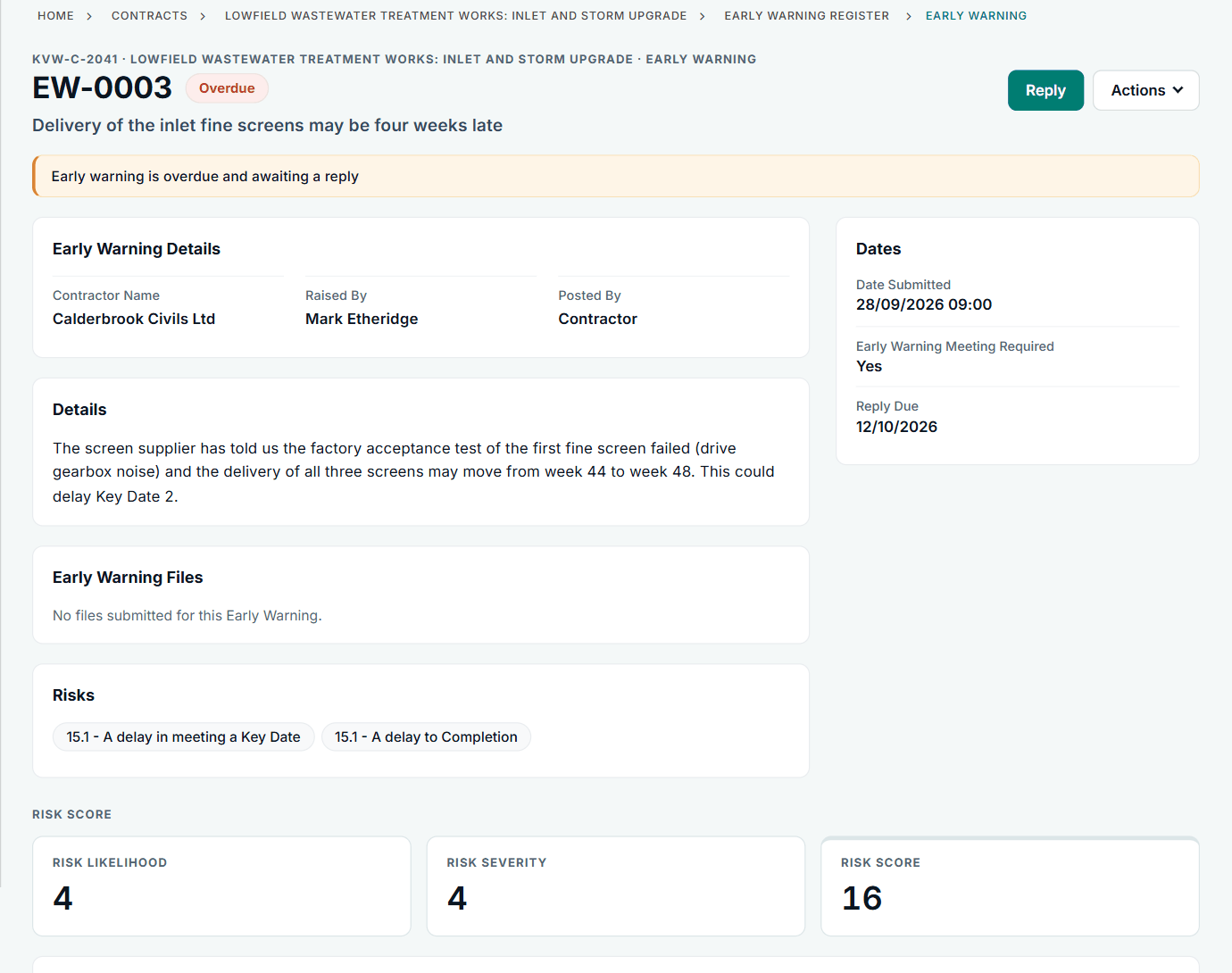
An early warning in Contract Status, with its risks, reply date and score. See the worked example.
See how this works in practice
Click through Contract Status with sample contracts: raise the notice, reply to it, and watch both sides of one record.
Take the guided tour Book a demo
Use the NEC deadline calculator, use the free NEC tools or download free NEC templates.
This guide is general information in our own words, not legal advice. Your contract and its Contract Data always govern. NEC, NEC3 and NEC4 are trade marks of Thomas Telford Ltd; Contract Status is not affiliated with or endorsed by NEC.