
A Supervisor's notification isn't the last word, but ignoring it is risky: in a Supervisor defect dispute under NEC, the question is whether the work meets the Scope, not who is more convinced. What decides it is what the Scope says, and what a test or inspection can show.
The correction clock may already be running while you argue, so answer in days. This page follows the NEC4 Engineering and Construction Contract (ECC), where notifying a Defect is clause 43.2. In NEC3, it is 42.2. Other problems like this are in NEC questions answered.
Reply this week
- Read the notification closely. Note its date, and ask which part of the Scope or accepted design it relies on. If none is named, ask.
- Work out your correction date. Before Completion, the period starts at Completion. After it, the period starts on notification (44.2). If you are near or past Completion, this date matters most.
- Answer in writing. Say you don't agree, and why, using the Scope wording and your evidence. Don't leave it in the minutes.
- Propose a way to test it. Agree a joint inspection, an independent lab test or a measure.
- Diary the dispute route. Under Option W1 a four-week limit runs from becoming aware of the action you dispute; under W2, you can adjudicate at any time. See time limits for disputes.
Sample reply, in our own words
"We have received notification [reference] of [date]. We do not agree that this is a Defect. Section [x] of the Scope requires [requirement], and the attached [results] show the work meets it. Please confirm which requirement you say isn't met. We propose a joint inspection on [date], or a test by [method], with both sides reviewing the result together. Our response doesn't accept that the item is a Defect, and we reserve our position."
Testing the disagreement
| What the argument is really about | Who probably wins |
|---|---|
| The work departs from a clear Scope requirement | Supervisor. It doesn't matter if it works well, unless the Scope is changed |
| The Supervisor prefers a higher standard than the Scope states | Contractor. If a better result is wanted, it needs a change to the Scope, through the Project Manager (60.1(1)) |
| The Scope is ambiguous or the documents conflict | Ask the Project Manager for an instruction on how to resolve it (17.1) |
| Contractor's design meets the Scope but not what was accepted | Supervisor: accepted design counts, and acceptance doesn't remove your responsibility |
| Client's own design has been followed, and the outcome is poor | Contractor. Not a Defect if it meets the Scope |
Check the Defect definition before you write, since these are exact tests.
Your four practical options
| Option | When it fits | Risk |
|---|---|---|
| Correct it, and reserve your position | Small cost; a fight would delay more | On Options A and B, it's on you unless you win a dispute later. Say clearly in writing that you reserve the point |
| Ask for a search instruction (43.1) | The issue is hidden, such as behind a finish | If it finds no Defect, it is a compensation event under 60.1(10). If it finds one, you bear it. The Supervisor decides whether to instruct |
| Propose accepting the Defect (45.1) | The item works and correction is disproportionate | Needs agreement, and a quotation showing reduced Prices or an earlier date. See accepting Defects |
| Refuse and go to dispute | Large cost, and strong evidence | If you lose after the period ends, you face 46.1: the Client's cost of having it done by others. Take advice before refusing |
The main cost risk, in figures
A fictional example, with illustrative figures. A floor finish is notified as a Defect. Correction would cost the Contractor £40,000. Having others do it would cost the Client £70,000, including management. The Contractor refuses, and an Adjudicator later agrees with the Supervisor. The Project Manager may now assess under 46.1, so the Contractor's position is £30,000 worse than if it had corrected and reserved. If the Adjudicator had agreed with the Contractor, it would have saved £40,000.
What the Supervisor may say
- "I decide what a Defect is." The Supervisor notifies. The contract doesn't make that decision final, and it can be taken to the dispute route.
- "Correct it, or I'll fail your next test." Tests have their own rules at clause 41. A test delayed unnecessarily may be a compensation event under 60.1(11), and repeat test costs fall under 41.6 only where a Defect is found. See tests and inspections.
- "You have to stop work until it's sorted." The Supervisor can't stop the work. Only the Project Manager can, under 34.1.
In practice, take the heat out early: stand in front of the work with the Scope in hand. Disagreements often turn out to be different readings of one sentence. On Options C to E, remember that correcting a Defect before Completion generally stays in Defined Cost, so the sums there are different from those on Option A.
Related guides
- NEC Questions Answered: Real Situations on Site
- A Test Failed: Who Pays for Retesting?
- The Supervisor Made Us Open Up Work and Found Nothing
- The PM Wants a Member of Our Team Removed: Can They?
- The Contractor Will Not Fix a Defect
- The Client Will Not Give Us Access to Fix a Defect
How this looks in Contract Status
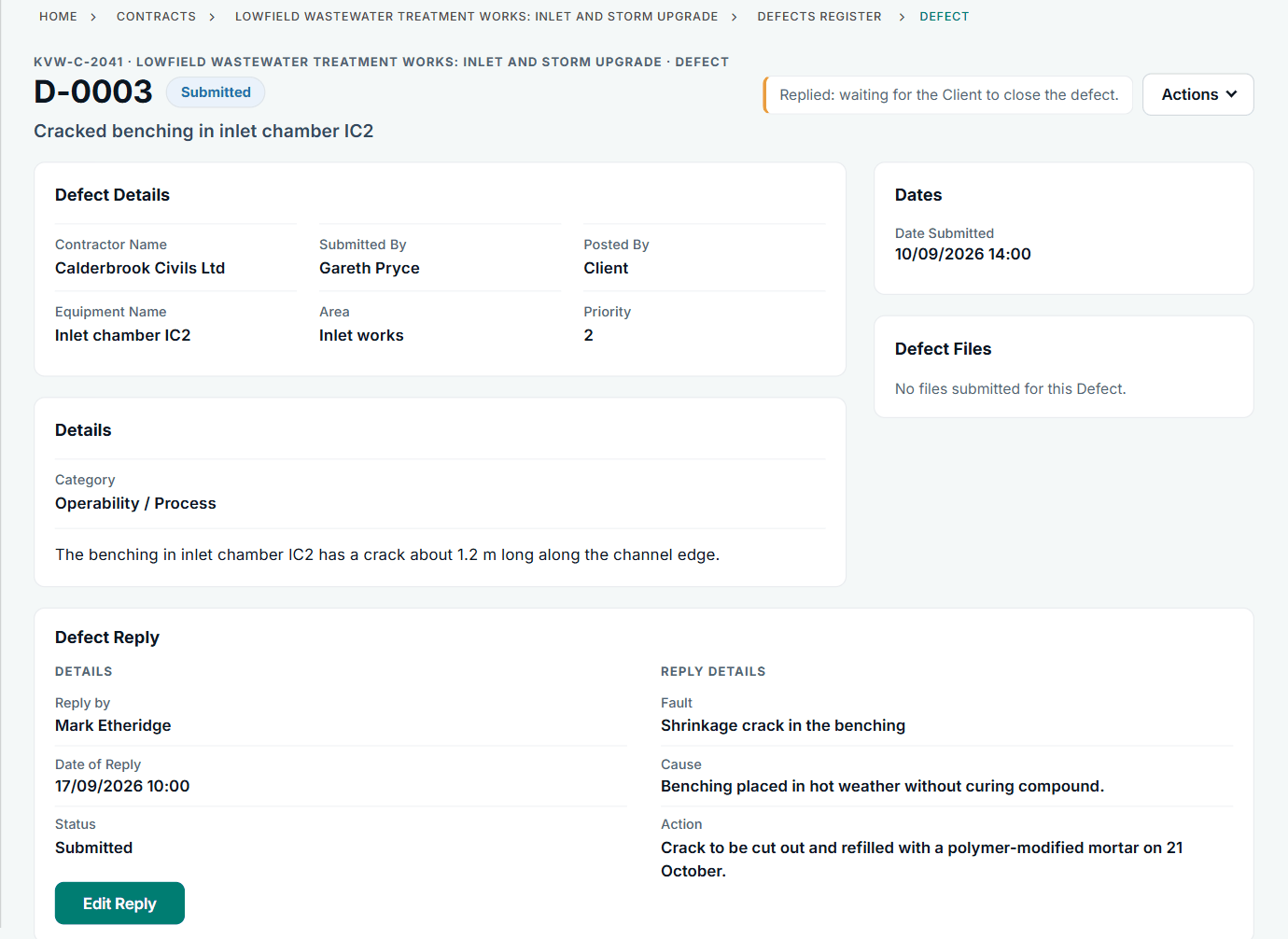
A Defect with the Contractor's reply: fault, cause and action. See the worked example.
See how this works in practice
Click through Contract Status with sample contracts: raise the notice, reply to it, and watch both sides of one record.
Take the guided tour Book a demo
Use the NEC deadline calculator, use the free NEC tools or download free NEC templates.
This guide is general information in our own words, not legal advice. Your contract and its Contract Data always govern. NEC, NEC3 and NEC4 are trade marks of Thomas Telford Ltd; Contract Status is not affiliated with or endorsed by NEC.