
A client change of mind becomes a Project Manager's instruction changing the Scope under clause 14.3, which is a compensation event under 60.1(1). The Client can find out the price first by having the Project Manager ask for a quotation for a proposed instruction under clause 65.1 of NEC4 (61.2 and 62.3 in NEC3).
What decides the details is who holds the design and whether the instruction has been given yet. The Client doesn't instruct the Contractor itself. Everything goes through the Project Manager, and if it doesn't, see the Client instructing directly.
Two routes
| Instruct now | Price it first | |
|---|---|---|
| Clause (NEC4 ECC) | 14.3, then 60.1(1), 61.1, 61.2 | 65.1, then 65.2 |
| Does work change straight away? | Yes | No. The Contractor doesn't act on it |
| Price known before commitment? | No, unless already agreed | Yes |
| Quotation time | Three weeks from the instruction to quote | Three weeks under the ECC (65.2); two under the NEC4 subcontract |
| Reply | Two weeks | By the date stated in the instruction. No reply means not accepted |
| If not taken forward | Not applicable | Under NEC4, the rejected quotation is itself a compensation event under 60.1(20). See that guide |
The second route suits a Client who hasn't decided. Under NEC4 it isn't free, because the cost of pricing it can be recovered through 60.1(20). See proposed instructions in NEC4 and pricing a change before instructing.
Who owned the design?
| Whose design changes | Result |
|---|---|
| The Client's design, in the Scope | Compensation event under 60.1(1) |
| The Contractor's design, because the Client's requirement in the Scope has changed | Compensation event. The Scope's requirement is what has moved |
| The Contractor's design, changed at its own request or to meet the Scope the Client already provided | Excluded from 60.1(1) |
| The Client prefers something different, but the Contractor's design meets the Scope | Not a Defect. Needs an instruction changing the Scope to get the change |
Comments on an accepted design often blur this. Saying "we'd rather have the brick" in a design review doesn't make it a Scope change, but the Contractor who follows it without an instruction may have no event. See the guide to the compensation event for a change to the Scope.
What to do, by role
Contractor:
- Don't act on a comment or a chat. Ask for a Project Manager's instruction under 14.3.
- Stop any work that would be wasted, once instructed, and tell your supply chain.
- Record what's been done: orders, fabrication and design hours.
- Quote within three weeks of the instruction to quote, including wasted work and the effect on planned Completion.
- If no event is notified, notify under 61.3. It arises from an instruction so the bar shouldn't apply, but send it anyway.
Client and Project Manager:
- Decide on a route before talking to site. A casual remark can produce abortive work and an argument.
- Ask for a proposed-instruction quotation if the decision depends on the price.
- Set a realistic decision date in that instruction, because the cost of waiting usually rises.
- Reply on time, and if the answer is no, notify it. Don't let it just lapse.
An illustration
A fictional school on Option C. After the Accepted Programme is issued, the Client asks for the assembly hall roof to change from profiled metal to standing seam. The Project Manager issues a proposed instruction with a decision date three weeks after the quote. The Contractor quotes £48,000 and two weeks. The Client decides against it and the Project Manager notifies. The cost of pricing the option, say £1,800, is then assessed under 60.1(20). If the Client had gone ahead, the £48,000 would have raised the total of the Prices and so increased the target. The figures are illustrative.
What each side tends to argue
- Client: "This is just developing the design." Check the Scope. If it already required the outcome, the Client may be right.
- Contractor: "The change disrupts everything." It may, but the quotation should show why, using the programme. See disruption claims.
- Project Manager: "Your quotation is high." Ask for a revision with reasons, or make your own assessment, on the grounds in the contract.
The Project Manager may still issue the instruction after a quotation has been turned down, with a new quotation (65.3 in the NEC4 subcontract text). NEC3's route is at 61.2 and 62.3, and has no event for a rejected quotation. More situations are in the NEC questions hub.
Related guides
- NEC Questions Answered: Real Situations on Site
- How Does the Client Get a Price Before Instructing a Change?
- We Can Save the Client Money: How Do We Propose It?
- The Client's Budget Is Being Exceeded: What Controls Exist?
- Does an Early Warning Count as Notifying a Compensation Event?
- We Gave an Early Warning and the PM Ignored It
How this looks in Contract Status
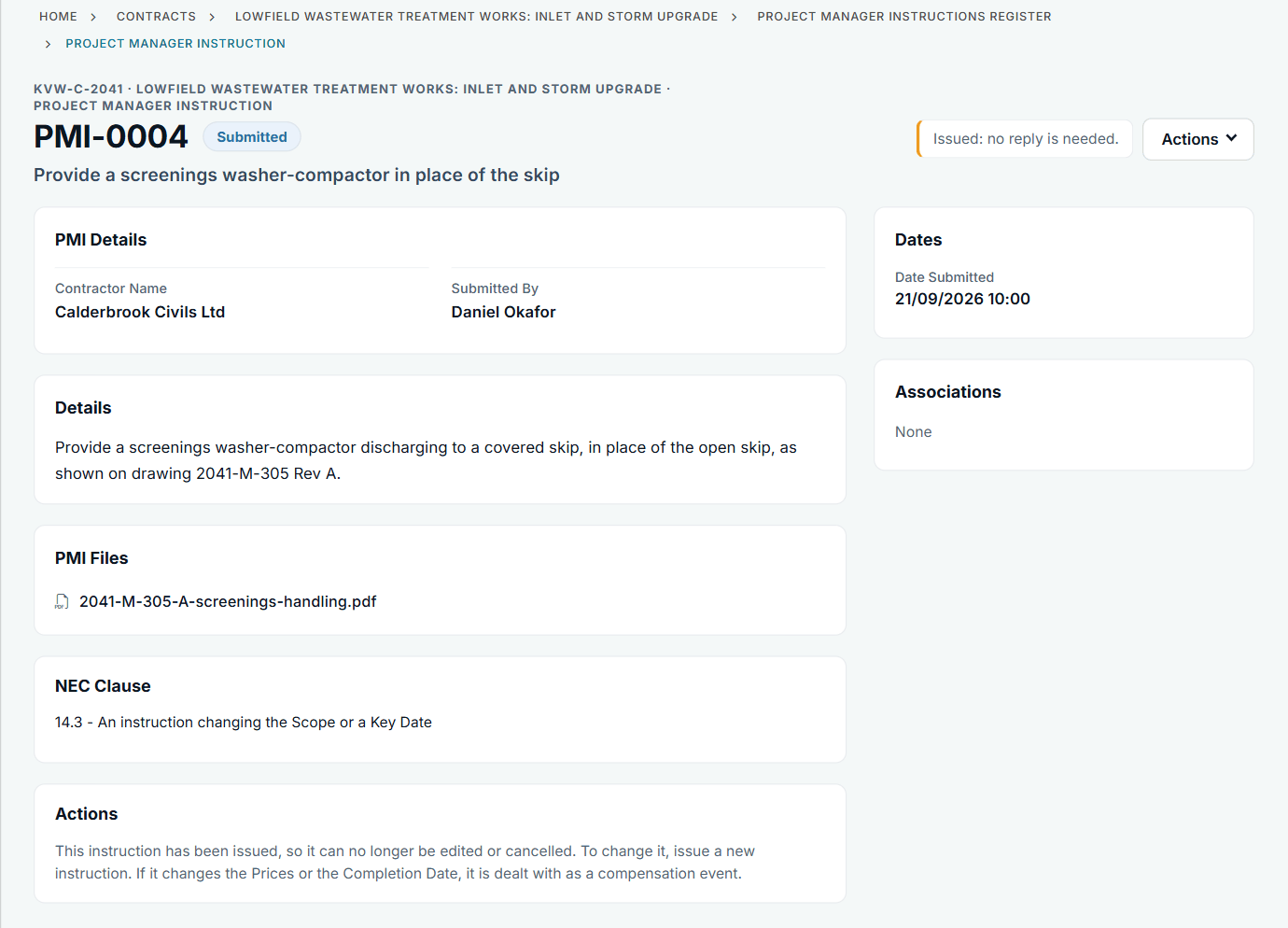
An issued instruction with its file and clause. See the worked example.
See how this works in practice
Click through Contract Status with sample contracts: raise the notice, reply to it, and watch both sides of one record.
Take the guided tour Book a demo
Use the NEC deadline calculator, use the free NEC tools or download free NEC templates.
This guide is general information in our own words, not legal advice. Your contract and its Contract Data always govern. NEC, NEC3 and NEC4 are trade marks of Thomas Telford Ltd; Contract Status is not affiliated with or endorsed by NEC.