
You prove it with the figures from the supplier named in the Contract Data, compared against the listed past weather data: that's the core weather compensation event evidence under 60.1(13). Site gauges and diaries can't establish the event, but they do show what it cost you. So the proof comes in two parts, and each needs different records.
The entry is the same in NEC3 and NEC4 ECC. The test itself is explained in the weather event guide; this page is about building the file.
Part 1: proving the event happened
| Item | Where from | Why it matters |
|---|---|---|
| The measurement list | Contract Data part one | Only listed measurements count: normally monthly rainfall, days over 5mm, days below freezing and days with snow lying, plus any additions |
| The place | Contract Data part one | The test uses that location, even if it's miles from the Site |
| The supplier | Contract Data part one | Ask them for the month's figures in writing |
| The weather data, or assumed values | Contract Data part one | This gives the comparison. Where records don't exist, assumed ten-year values may be stated |
| The one-in-ten calculation | Your workings, agreed if possible | Past records don't always state this directly, so show your method |
Keep the comparison like for like. It's that calendar month against the same calendar month in past years. Also check the date: the reading has to be taken before the Completion Date for the whole job.
Part 2: proving what it did to the job
- Daily site records. What each gang was doing, what stopped, how long for, and the reason given at the time. A diary that says only "rain" is weak; "earthworks stopped 10:30, formation saturated" is useful.
- Resource and cost records. Plant, labour, standing time, and any costs for pumping or protection. These become Defined Cost in your quotation.
- The Accepted Programme in force on the dividing date (63.5). For this event, that's the date of your notification, so the programme should be up to date before you notify if you can manage it.
- Your own gauge readings. Good for showing when it rained on Site within the month, and to back up the link to lost time. They support the assessment, not the event.
- A clear method for the excess. Only the difference between what was recorded and the one-in-ten level is assessed.
Turning excess into lost time: a fictional example
A resurfacing job on Option C, with illustrative figures. In January the listed station shows 158mm of rain against a one-in-ten level of 130mm, so 28mm is excess. The days-over-5mm measurement doesn't pass. How do you turn 28mm into lost time?
The Contractor's method: over the month, Site records show 11 stopped days for 158mm of rain, or about 14mm per stopped day. On that rate, 28mm is about two days. It compares this against the actual sequence: rain fell mainly when surfacing was critical. Planned Completion moves two days, and the running cost of those two days goes in the quotation at actual and forecast Defined Cost, with the Fee added. The method is simple, stated openly, and tied to the Site record. A Project Manager can disagree with a step, but can't say there's no reasoning.
Timing to watch
- The time bar runs from becoming aware the event has happened (61.3): eight weeks in NEC4 ECC, seven in NEC4 ECS.
- Don't wait for a certified figure if the interim results already point that way. Clause 61.3 lets you notify an event you expect, and you can refine it afterwards.
Sample request to the Project Manager
"The [supplier] figures for [month] at [place] show [X] against a one-in-ten value of [Y], calculated as attached. We notify a compensation event under clause 60.1(13). Effect on the programme and Defined Cost will follow in our quotation; please confirm you agree the one-in-ten figure, or state yours, in your reply."
Likely challenges
- The value is wrong. The Project Manager may calculate one-in-ten differently. Agreeing the method at the start avoids this, and the page on claiming for weather shows how the question comes up.
- The effect isn't real. They may say the affected work wasn't critical, or that weather-proof work could have continued.
- The whole month is claimed. This one fails quickly. Only the excess counts.
- You should have warned. If a warning could have been given, the assessment can proceed as if it was (63.7). See the guide on early warnings and compensation events.
In practice, set up a one-page table on day one, with each month's one-in-ten figure for each measurement, and add each month's result. It takes minutes per month and it means you know where you stand, without any drama. More questions are answered in NEC questions answered.
Related guides
- NEC Questions Answered: Real Situations on Site
- Snow or High Wind Stopped Work: Is That Covered?
- The Site Flooded: Who Is Responsible Under NEC?
- We Have Not Been Given Access to the Site: What Do We Do?
- We Found Archaeology on Site: Who Pays?
- It Has Rained for Weeks: Can We Claim for Weather?
How this looks in Contract Status
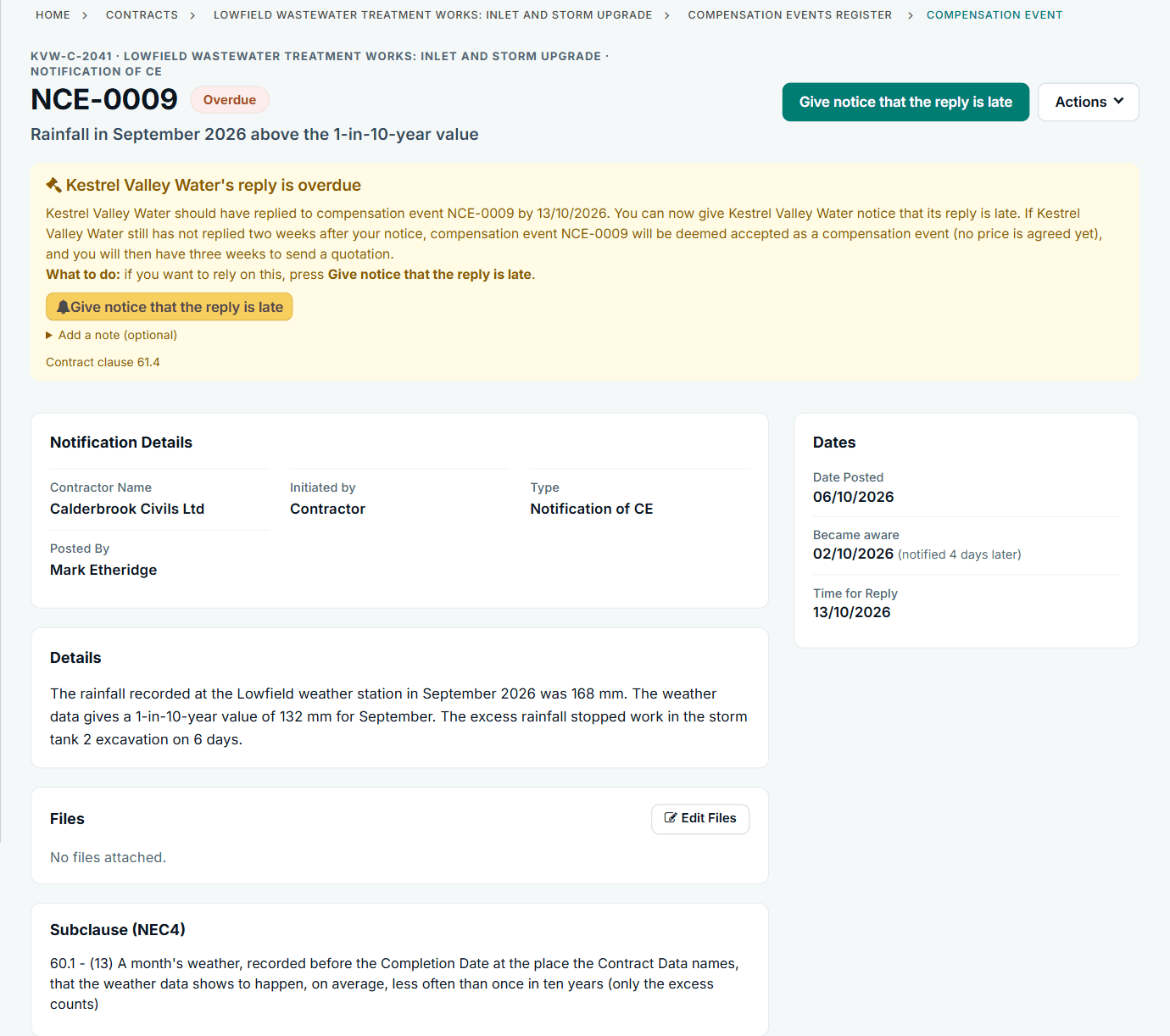
A weather event notified with the recorded figure against the one-in-ten value. See the worked example.
See how this works in practice
Click through Contract Status with sample contracts: raise the notice, reply to it, and watch both sides of one record.
Take the guided tour Book a demo
Use the NEC deadline calculator, use the free NEC tools or download free NEC templates.
This guide is general information in our own words, not legal advice. Your contract and its Contract Data always govern. NEC, NEC3 and NEC4 are trade marks of Thomas Telford Ltd; Contract Status is not affiliated with or endorsed by NEC.