
It depends on the Project Manager's decision, because neither document automatically wins: NEC's core clauses set no order of precedence for an ambiguity in the Scope. Either side notifies it, the Project Manager states how it is resolved, and if that changes the Scope the price follows the reading best for the Party that didn't write it.
So what decides the money isn't which document looks more authoritative. It's who provided the Scope, and what each reading would have cost. An amendment could change this, so look for a precedence clause in your Z clauses.
What to do now
- Notify as soon as you know. Clause 17.1 puts this duty on both the Contractor and the Project Manager, and it starts the moment either realises. No fixed period is stated, so do it straight away.
- Don't build either version on your own assumption. Identify the affected work and when you need the answer. If the decision is critical, give an early warning too (15.1).
- Ask for the Project Manager's statement of how it is resolved, and record the period for reply. A late answer is an event of its own under 60.1(6).
- When the answer comes, check whether it changes the Scope. If it does, it's a compensation event under 60.1(1), and it should be notified with the instruction.
- Quote on the favourable reading as set out below, showing both versions.
Sample notice: "Under clause 17.1 we notify an inconsistency. Drawing [ref] shows [X]; specification clause [ref] requires [Y]. This affects [work], planned to start on [date]. Please state how it is to be resolved by [date] so that we can maintain the Accepted Programme."
How the change is priced
Clause 63.10 (NEC3 ECC: 63.8) prices the event by treating the Prices and dates as based on whichever reading best suits the Party that did not write the Scope. Whoever wrote the document carries the cost of the muddle.
| Who provided the conflicting Scope | Favourable reading is | Practical effect |
|---|---|---|
| The Client | Best for the Contractor | If the Client wants the more expensive version, the Prices rise. If it wants the cheaper one, they are assessed against the cheaper as the base, so there's usually no change |
| The Contractor, in its own design | Best for the Client | The Contractor can't charge for following the better version; and changing its own design to fit other Scope isn't an event under 60.1(1) |
Worked example
A fictional Option A warehouse slab, with illustrative figures. The Client's drawing shows 150mm concrete, and its specification says 175mm. The Contractor priced 150mm. It spots the conflict and notifies. The Project Manager states that 175mm applies.
The instruction is assessed as a change from the Contractor's best reading, 150mm. Forecast Defined Cost for the extra thickness and the longer pour comes to £38,000, plus a 10% Fee of £3,800, so the Prices rise by £41,800. Had the Project Manager decided on 150mm, there would be no increase, and no saving to the Client either. And had the Contractor priced 175mm anyway, the same result applies: the assessment looks at the favourable reading, not the price it actually allowed.
Traps that change the answer
- Site Information isn't Scope. A conflict there about ground conditions falls under clause 60.3, which assumes the Contractor took account of the conditions more favourable to doing the work.
- A gap isn't always an ambiguity. If the Scope is silent, ask what else is needed to Provide the Works. An item that's incidental to what's described may already be included.
- A Bill of Quantities mistake has its own rule. Under Options B and D, see 60.6 and 60.7 in the guide to Bill of Quantities events.
- The impossible or illegal. A requirement that can't be carried out or breaks the law goes under 17.2, and the Project Manager changes the Scope.
What the Project Manager may say
The usual reply is "an experienced contractor would have queried it at tender" or "the specification always takes priority". The core clauses contain neither rule, though tender documents or amendments might, so ask where it comes from. A sharper response is to question the facts: there may be no real conflict if the documents can be read together, for instance a note that a typical detail is overridden by the specific one. The contract position is clear once an instruction resolves a true conflict. Whether there was a true conflict is often the real argument.
In practice, raise conflicts during programme planning rather than the week of the pour. It's cheaper for both sides, and it stops the conversation turning into a dispute about who should have noticed. For related questions, see NEC questions answered.
Related guides
- NEC Questions Answered: Real Situations on Site
- We Priced the Job Wrong: Can We Get It Changed?
- We Hit Unexpected Ground Conditions: Who Pays?
- We Found Unmarked Utilities: Is It a Compensation Event?
- Can We Recover Loss of Profit on Omitted Work?
- The Client Wants to Omit Work: Can They?
How this looks in Contract Status
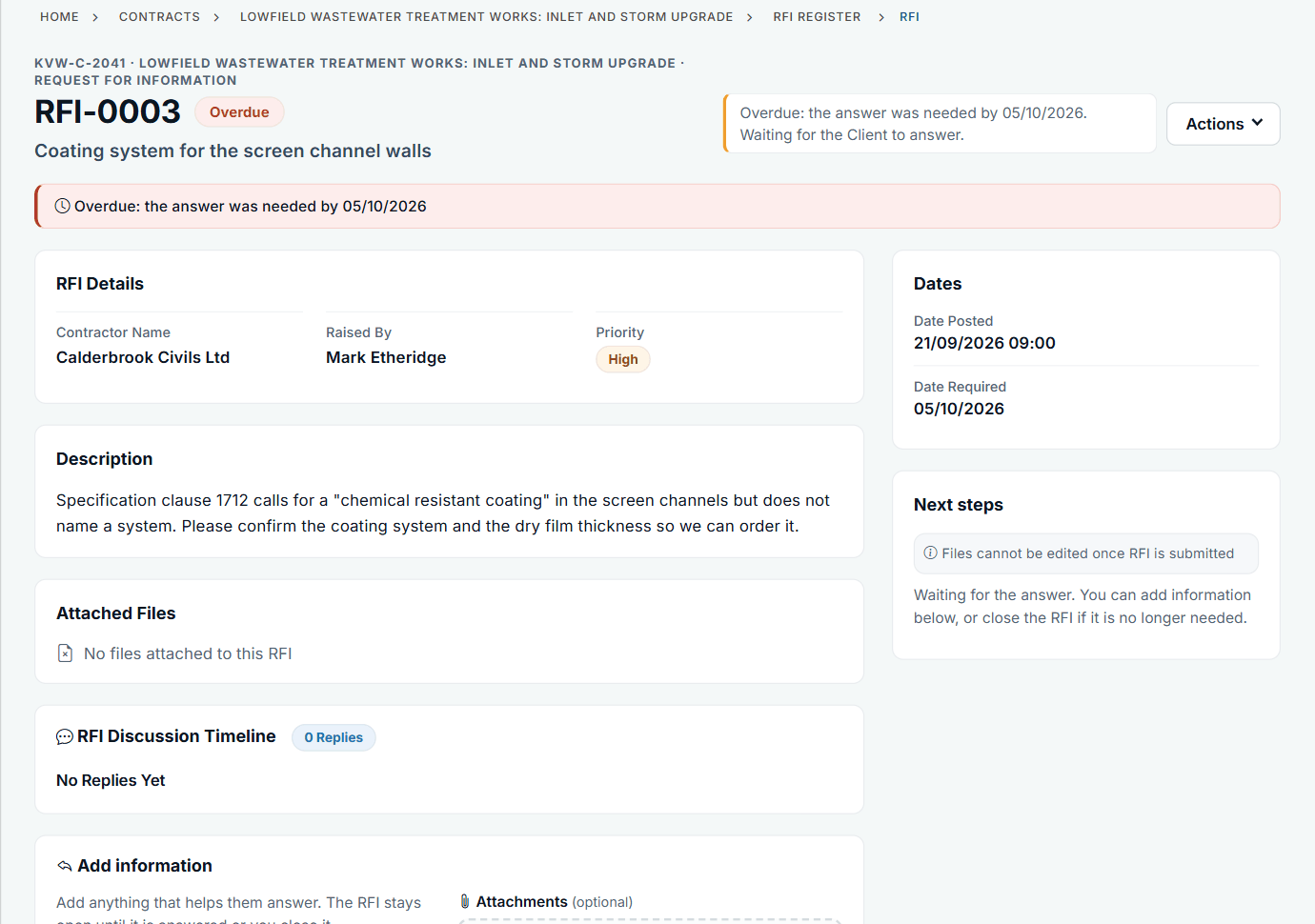
An overdue RFI from the Contractor side, waiting for the Client. See the worked example.
See how this works in practice
Click through Contract Status with sample contracts: raise the notice, reply to it, and watch both sides of one record.
Take the guided tour Book a demo
Use the NEC deadline calculator, use the free NEC tools or download free NEC templates.
This guide is general information in our own words, not legal advice. Your contract and its Contract Data always govern. NEC, NEC3 and NEC4 are trade marks of Thomas Telford Ltd; Contract Status is not affiliated with or endorsed by NEC.